This year marks the 30th anniversary of Andrew Kötting’s great British film Gallivant. Gallivant—such a word! You’d expect a romp, a lark, a knockabout. All the fun of the fair. Kötting travels around the coastline—the skin of the island, so to speak— with his 85-year-old grandmother, Gladys, and his 7-year-old daughter, Eden. It sounds like a perfect recipe for a road movie; time for banter, for tenderness, bonhomie between generations.
But there’s a catch, or more than one. Gladys is brittle, her memory going. And Eden has a rare genetic condition called Joubert Syndrome that messes up her balance, muscle movement, speech. Off they go, an unlikely trio on an unlikely, stop-start journey. One full of pratfalls, with Kötting shattering his ankle slipping off the side of a van.
Eden was not expected to reach adulthood. How wonderful, then, to see her in This Our Still Life (2011) set in the director’s ramshackle Pyrenees home, where rattlesnakes climb the walls in summer and the winters are excruciatingly cold. Home movie footage shows her inching through the years, becoming herself. She plays with a toad; blows out candles on a birthday cake while wearing a Bad Girls Club top; singing along to Jimmy Cliff’s “I Can See Clearly Now” while washing dishes; painting still lives. This is no happily-ever-after pastoral; the sound design is too crooked, the images sometimes glitchy and pixelated. What comes across most forcefully is the sheer work of keeping it—one’s sanity, body, family—together.
Over the years, both father and daughter have kept going. Eden is less and less the subject of Kötting’s work, and more its co-creator. Her vivid drawings are both the anchor and motor of Diseased and Disorderly (2021), a book as well as a film, which uses words, collages and 3D imaging to take us on what the director calls “a phantasmagorical journey into a world of Eden’s making and then beyond”. That “beyond” is crucial. Kötting is not an activist-artist focused on raising consciousness or demanding political changes for those whom society regards as disabled or divergent. His approach—evident from the title and diacritics of his book Quantum Shenanigans & Gravitational To-Dos Downyönder in a Place of Energy & Wonder—is more anarchic, rambunctious. (It includes photos of Eden in an upturned wheelchair, on a penny farthing, looking at her dad whose naked bum we can see.)
Their latest collaboration, The Memory Blocks, is their most ingenious to date. It gets its name from the gasket-like chunks of shaped metal (resembling the outer casing of smartphones) we see being produced in a light industrial unit. We’re led to infer that, like a motif from a science-fiction film, these contain precious morsels of human memory. Either that or the thrilling, scary possibility that they are state-of-the-art bits of hardware that enable memories to be extracted and transplanted.
Fate dealt Kötting’s family an unlucky hand and his response is absurdist humour, tragic laughter
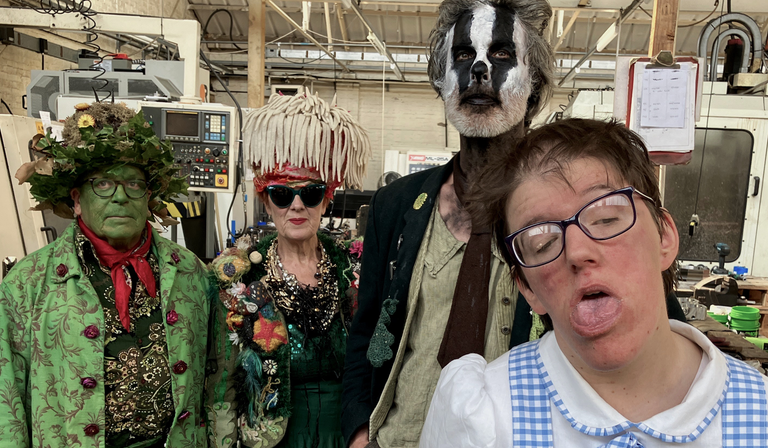
Yet this is no behind-the-scenes look into the latest developments in Big Pharma-sponsored brain science. How could it be? Here’s Eden, in a checked pinafore that might have been worn by Judy Garland in The Wizard of Oz. Here’s a dysfluent, lab-coat-sporting young woman on the verge of falling down (“This memory block, erm… it’s bloody heavy, Andrew”). Who on Earth are these strange men and women milling about, their faces painted like badgers, outfitted in Mummers’ play costumes?
Kötting could easily play the Gravedigger in Hamlet. Fate dealt his family an unlucky hand and his response, time and time again, is absurdist humour, tragic laughter, the embrace of befuddlement. Why not treat the malady known as “memory block” as a material object—something that exists rather than being an absence—and imagine it as something akin to a component in a production plant? Why not show—literally—what a faff it is to handle and transmit memory?
The Memory Blocks is a cornucopia, a spillage fete of characters, gags, ideas. Neurodiverse artists associated with the Turner Prize-nominated Project Art Works collective in Hastings are shown improvising and inventing personae to merry effect. Super 8 footage of Kötting’s partner Leila—barely six, playing with her mother in 1960s Aden—evokes textures of a Yemen that no longer exists. The motley Green Man-ish crew traipse through the countryside where they encounter a group of memory-depleted pensioners.
And there, at the heart of it all, is Eden. Alive, alive, oh! Remembering, dreaming, Zimmerframing. So present. Both knowable and unknowable. Is she his muse, I ask Kötting. “Without me she’d fall over,” he reflects. “Without her, none of this would have existed. We’re conjoined muses.” Long may they gallivant together.