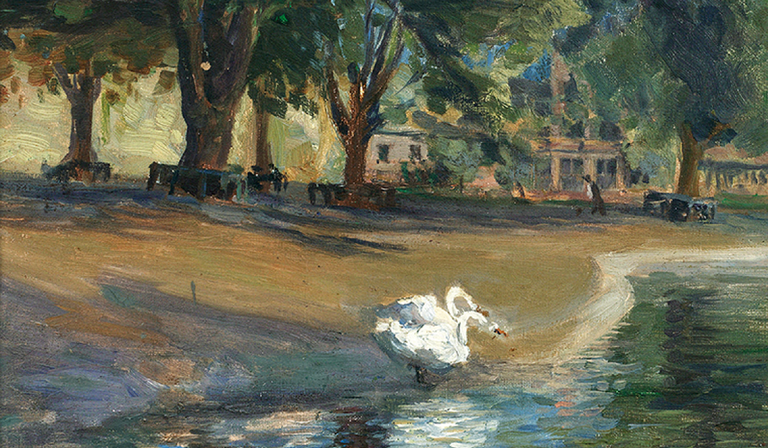
Landlocked Munich (well-supplied with lakes) was my first port of call in Germany, and an auspicious one for an Englishman: a city with a green space called, in emulation of London’s fashionable Hyde Park, Der Englische Garten; and with a royal treasury that displays the oldest medieval English crown, that of Anne of Bohemia, wife of the ill-starred Richard II.
I arrived in the summer of 1981 as a student, a couple of us staying in the suburbs with a friend from school. We bicycled (Munich is a great bicycling city, paths lined with trees to protect you from summer showers) and we drank great steins of radler (lager and lemonade) or weissbier (the superlative local wheat brew) in the Englische Garten. Our liberal-minded hosts tried to get us to visit Dachau; embarrassed schoolboys, we declined. Teenage devotees of The Waste Land, we went on in sunlight into the Hofgarten and drank coffee and talked for hours. I had little idea at the time that Munich would later go on to be such an important part of my life.
♦♦♦
Because Munich is a city of music: five orchestras and a great opera house rebuilt by public subscription after the war. A house which thus somehow belongs to the Munich public and for which Peter Jonas, the brilliant operatic impresario who ran it between 1993 and 2006, reinvented the slogan of his English National Opera—Opera for All—as Oper für Alle. Under Peter’s spell, I sang some opera here (Monteverdi’s Poppea, Britten’s Rape of Lucretia and Stravinsky’s Rake’s Progress) and countless Lieder recitals, starting with an icy Winterreise in the curlicues of the rococo Cuvilliés Theatre. This was the old court theatre, where Mozart’s Idomeneo was premiered, a grand and noisy opera for a place that only holds about 500 people. It was bombed out during the war, but the precious carved and gilded boxes had been hidden away, and the theatre was meticulously recreated in the 1950s.
This week, I am back in the theatre where almost all of my Munich performances, concert and opera, have taken place, the Prinzregententheater, just across the river from the city centre. Built around the turn of the 20th century as a festival theatre for the operas of Richard Wagner, it is modelled on Wagner’s own famous theatre at Bayreuth, with a similar amphitheatre-style auditorium and concealed orchestra pit. With the pit covered, and a capacity of about 1,000, it is the perfect place for song.
♦♦♦
It’s 50 years since the death of Benjamin Britten, and I’ve been back at the Prinz, as it is known, to mark the event with his two orchestral song cycles, the Serenade for Tenor, Horn and Strings and the Nocturne. I’ve never sung them both in one concert and it was rather a daunting prospect. But age seems magically to strengthen the vocal cords (as it weakens everything else), and I managed. And I had the same experience I always have when I sing these pieces in continental Europe: people who have never heard them before (Britten, unfairly, remains something of a specialism) come up and say the equivalent of, “Wow, what incredible music—how come I didn’t know it?” One day the logjam will break, and people will accept Britten into the pantheon. In the meantime, I’m comforted by Shostakovich’s words to Britten after hearing the premiere of the cello symphony in Moscow: “You, great composer—me, little composer.”
My other Britten celebration in Bavaria was at Schloss Elmau, a wonderful hotel and spa at the foot of the Bavarian alps, 20 minutes from Garmisch-Partenkirchen. With a complex 20th-century history—built during the First World War by a theologian who supported Hitler but publicly criticised antisemitism as a “disgrace for Germany”—Elmau became, after the end of the war, a centre for music and reconciliation. In 1957, the Amadeus Quartet founded the German-British Chamber Music Week at Elmau and, since then, a host of eminent classical, and more recently jazz, musicians have come to stay and perform.
Britten himself visited Elmau many times, hence our mini-festival of music by him and associated with him: Schubert, Mozart, Shostakovich, Dowland and his own devastating song cycle The Holy Sonnets of John Donne, written at fever pitch after his return from playing at the liberated Belsen camp in August 1945. We started by performing all five of his Canticles, cantatas for various forces (voice, piano, horn, harp) to various texts (the metaphysical poet Francis Quarles, Edith Sitwell, TS Eliot). These are pieces which he wrote over the whole course of his career from 1947 to 1974, with no idea of their forming a unity, but which nevertheless hang together with a strange dramaturgy of their own—as we move from the “Song of Songs” to “Abraham and Isaac” to Sitwell’s “Still Falls the Rain” to “The Journey of the Magi” to “The Death of St Narcissus”—and as a picture of the artist’s life and mind.
That last canticle, for tenor and harp, was given its first performance at Elmau; and this strange early poem of Eliot’s, with its pre-echoes of The Waste Land, seemed to belong to these mountains: “Come under the shadow of this gray rock…”