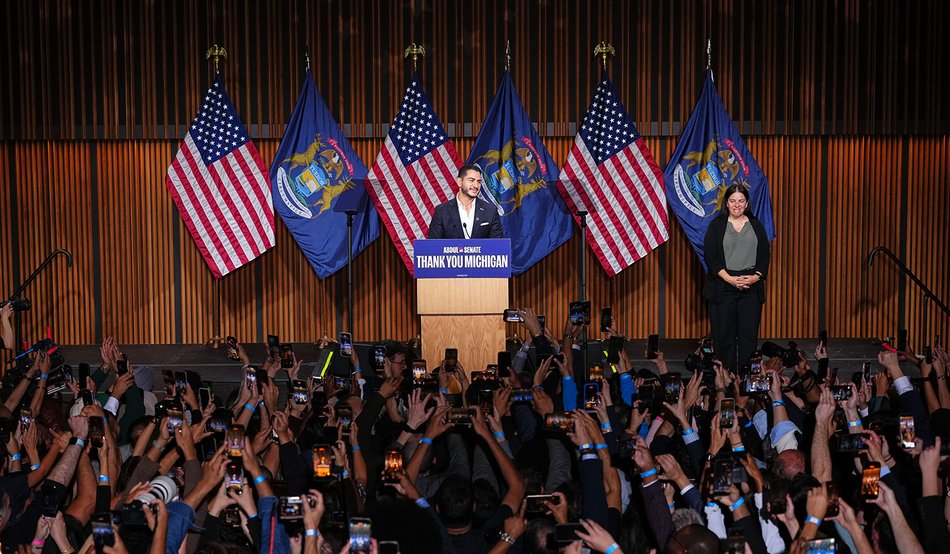
The simplest—and most appropriate—analysis for the massive Democratic victories in the midterm elections is that hubris, corruption and gerrymandering don’t create a path to victory. Nor do racism and hatred. The fed-upness of the American electorate was on full display. Big money turned out to be a big failure as old-fashioned organising corralled massive voter anger.
The biggest spender, Elon Musk, put in more than $450m, with around half of it going into the Texas senate race won by Democrat candidate James Talarico. Of the top 15 donors, only the Soros family and former New York mayor Michael Bloomberg were exclusively supporting the Democrats.
By Wednesday morning, the Democrats were projected to control the House of Representatives with at least 228 seats by the New York Times (they needed 218 for a majority), with many of the undecided seats likely to go Democratic. By midnight, the Democrats had taken the Senate, with 54 seats as of Wednesday morning, and Alaska and Mississippi still counting.
Hakeem Jeffries, a Democratic congressman from Brooklyn, will likely become the first black speaker of the House. Some on the left of the party (from the Democratic Socialists of America, for instance, which will be a small grouping within the new Democratic intake), will protest his corporate backing. But Jeffries has the votes and the respect earned by crafting this victory, which will give Democrats extraordinarily important oversight of White House shenanigans on policy and personal graft.
Voters told pollsters they made their choice mostly on the basis of two issues: corruption and the cost of living, both tied directly to President Trump. There was a robust turnout in a country where participation numbers are among the lowest across peer democracies. In Michigan, polling stations had to stay open later partly because so many people were waiting in line (in the US, you must be allowed to vote if you are in the queue when the polls close).
There were Democratic victories in parts of the country that haven’t been in play since almost forever. The last time a Democrat was elected to the Senate in Kansas was in 1932. A too-close-to-call race for the Mississippi Senate appears to have gone Democratic (Votes were still being counted at the time of writing.) The last time the Democrats won there, in 1982, the party’s senator was a white racist in a party still full of Southern white racists. In 2026, Scott Colom, the Democratic nominee for Mississippi, is a black district attorney who is part of a broad-based liberal party.
In South Carolina the incumbent senator Darline Graham was defeated. Graham had only been in office for a few months, having replaced her brother and key Trump ally Lindsey Graham in the Senate after he died mid-term. The winner is a paediatrician named Annie Andrews, who has never held elected office.
Democrats flipped several congressional seats in Iowa (three at the time of writing), as well as the Senate with a compelling candidate, the former wheelchair basketball Paralympian and state representative Josh Turek. The economy mattered here as elsewhere: diesel prices in Iowa are up by 60 per cent year-on-year, and Trump’s tariffs scheme greatly impacts farmers there.
The Democrats took back religion from the right wing too. The new senator from Kansas, Adam Hamilton, is a pastor with the largest United Methodist congregation in the country. James Talarico, the new senator from Texas, began his victory speech with a story about David and Goliath and ended with a parable about Jesus.
The Democrats also did well in the Midwest, winning in Ohio and Michigan, where they had lost in recent years in line with a fall in trade union memberships. In Ohio, governor-elect Amy Acton achieved an important and symbolic win over Vivek Ramaswamy, in a huge embarrassment both to Trump and JD Vance, who represented this state as senator before becoming vice president.
Many of these wins were unprecedented. In Georgia, Keisha Lance Bottoms, the former Atlanta mayor, became the nation’s first black female governor, beating by nine percentage points an opponent who put more than $200m of his own funds into the campaign. Wisconsin elected its first black governor, David Crowley.
Gina Hinojosa became the first Mexican-American governor of Texas, defeating a hard-right, long-time incumbent who made immigration detention and expulsion a cornerstone of his governing. Deb Haaland will become the first Native American woman to serve as a state governor following her victory in New Mexico, while New Hampshire’s Chris Pappas is the first openly gay male US senator and Michigan’s Abdul el-Sayed is the first Muslim US senator.
All the while, Trump spent election day on his Truth Social media platform posting attacks on news personalities and Democratic congresspeople. He also defended his obsession with the Lincoln Memorial Reflecting Pool, where he had inexplicably decided to give his closing argument for his party. Now, however, the president might as well flap around in the half-baked construction projects he has pursued as he wrecks the monuments of Washington. Because this week, he lost his ability to govern.