It is tempting to tell the story of the past decade through the man himself. Donald Trump has been an inescapable presence in American life since he descended the escalator at Trump Tower in Manhattan to announce his candidacy for president in 2015. Since then, Americans have lived through a prolonged period of political whiplash, with political conventions, international norms and basic rules of etiquette repeatedly overturned.
Yes, Trump has been an accelerant, sometimes a one-man demolition crew, for the anti-establishment forces that have swept across the United States since 2016. He did not create the deeper crisis of the country’s political life—or the dysfunction in the international order: the grievances and structural problems that have propelled anti-establishment and populist movements across many democracies were already taking shape before he arrived. The world was already unsettled. The unipolar moment was receding. Great power rivalry had reared its ugly head. Trump merely turned anger into action—with no real plan to replace what he was eager to break.
Still, historians may one day look back on the past decade since he was first elected as “the Trump years”. And at its core, this period has changed something fundamental about America’s relationship with power. Institutions once assumed to be durable pillars of US democracy suddenly looked surprisingly vulnerable. The US Agency for International Development was shut down; Harvard and other colleges were put on notice; the Department of Education has been stripped of functions; environmental regulations were reversed; the Kennedy Center, Washington’s premium arts and culture space, was effectively closed down.
Twenty months into his second term, Trump’s instinct for demolition has met its limits at home. Sure, he has had a few quick wins: on immigration, deportations, bureaucratic appointments, and on stripping the DEI (diversity, equity and inclusion) and “woke agenda” from official policy, the Trump administration has used executive power effectively. But the story has been one of overreach and resistance. Courts have constrained his actions, universities and law firms have slowly regained their footing, bureaucrats have started discovering workarounds and culture wars remain unsettled. As Trump’s popularity dwindled to 32 per cent, his own pick for the Federal Reserve, Kevin Warsh, just raised interest rates despite Trump’s incessant demands for cuts. Another decade of Trumpism might look different. But so far, the American dictatorship has not happened.
The Trump years have, though, changed America’s relationship with the rest of the world—specifically, with the projection of its own power. Americans have come to question whether the United States actually needs to shape the world in its own image, with its familiar mix of soft and hard power tools, as proponents of US primacy have argued for decades. And, for that matter, whether sustaining the so-called US-led international order, with all its alliances and instruments, is even worth it.
For most of the post-Cold War era, Washington’s policy community—an incestuous mix of policymakers, bureaucrats and academics that together make up what writer and political commentator Ben Rhodes famously called “the Blob”—operated on a set of assumptions that it saw almost as self-evident. Globalisation was, on balance, good for the United States; alliances brought prestige and amplified American power; free trade produced prosperity; international institutions generally served American interests and brought order to a world that would otherwise descend into chaos. And, most importantly, the United States ultimately benefited from underwriting an international order it had helped create. Taken together, these assumptions formed the operating system of Washington.
That operating system has crashed under Trump, leaving a fierce debate about almost every one of those assumptions and about the idea of US supremacy. The debate stretches well beyond Trump and Maga; it runs through buildings that house Congress, political parties, universities, thinktanks and increasingly touches the electorate itself.
Some of the rebellion comes from the nationalist right—the likes of Steve Bannon, Stephen Miller and others in Trump’s America First movement—who see alliances as costly, free trade as a bad bargain and much of the international system as a pyramid scheme through which other countries take advantage of US power. On the progressive left, there is a similar scepticism about the idea of American exceptionalism—though with different conclusions on what to do. And in between sits a battered but still formidable Washington foreign-policy establishment that continues to believe in the fundamental logic of American primacy—that the US must continue to “provide leadership” here, there and everywhere.
The old idea that globalisation and economic integration were inherently in America’s interest had disappeared
This is why 2024 may ultimately prove almost as important as 2016. Trump returned to office no better prepared to translate his domestic agenda into a coherent policy, but his second victory, alongside the growing strength of an insurgent progressive left, made it impossible for Washington to continue pretending that these critiques were marginal.
Although Biden was in every respect the anti-Trump president—promising at the Munich Security Conference in 2021 that “America is back” and speaking reassuringly in the old language of alliances and US leadership—he was unable to shake off the critiques of US exceptionalism that had taken root. His presidency was unable to restore the world of 2015.
On the political economy there was far more continuity with Trumpism than Washington was willing to acknowledge. The Biden administration retained Trump’s tariffs on China, expanded restrictions on advanced technology and embraced an ambitious industrial policy. Protectionism or not, bringing manufacturing jobs back to the US was the Biden administration’s top priority. The language and the arguments presented were different, but the old idea that globalisation and economic integration were inherently in America’s interest had disappeared.
This may be one of the most significant legacies of the past decade. Trump helped usher in an era when the questions and demands from Americans were starkly different than a decade ago. Who benefits from globalisation—and who is left behind? What exactly does Washington receive in return for maintaining an enormous global empire of bases and installations? And should Americans spend blood and treasure to chase monsters around the world even when those efforts look futile? Today, the war on terror—and above all the wars in Iraq and Afghanistan—are widely remembered as costly failures that weakened confidence in US power. “Forever wars”, once the slogan of anti-war critics, has moved to the political mainstream.
The fact that these doubts about the United States’ role in the world are now aired so freely is itself part of the transformation. While much of the American public might have lost its attachment to US primacy, there is no consensus for what’s next. In its National Security Strategy, the Trump administration has adopted concepts like hemispheric defence and “flexible realism”. In action, it has been untroubled by what looks like naked imperialism—US oil companies moving into Venezuela and Syria, Armenia handing Washington a controlling stake in the corridor now named after the president and a war-weary Ukraine being pushed to sign a critical minerals deal in return for continued US supplies. “To the victor belong the spoils,” Trump told the UN in September.
This soul-searching about the US’s role in the world helped produce one of the more curious phenomena of American politics today: a foreign policy horseshoe. The nationalist right and progressive left have almost nothing in common in their diagnoses of domestic issues. But they sometimes arrive at similar conclusions about the country’s role abroad. That, too, might inadvertently be Trump’s legacy.
During the US campaign against the Houthis in 2025, the far-right politician Marjorie Taylor Greene wrote on X, “I don’t care about Ukraine or Iran or Houthis or whatever foreign country I’m told I’m supposed to care about,” saying these conflicts should not matter more to Americans than problems at home. She, along with Tucker Carlson and the left wing of the Democratic party, stood up against the US-led war in Iran and continue to question US commitment to Israel.
The progressive critique comes from opposition to militarism, the US role and responsibility in the tragedy of Gaza and the enormous resources invested in sustaining US military “hegemony”.
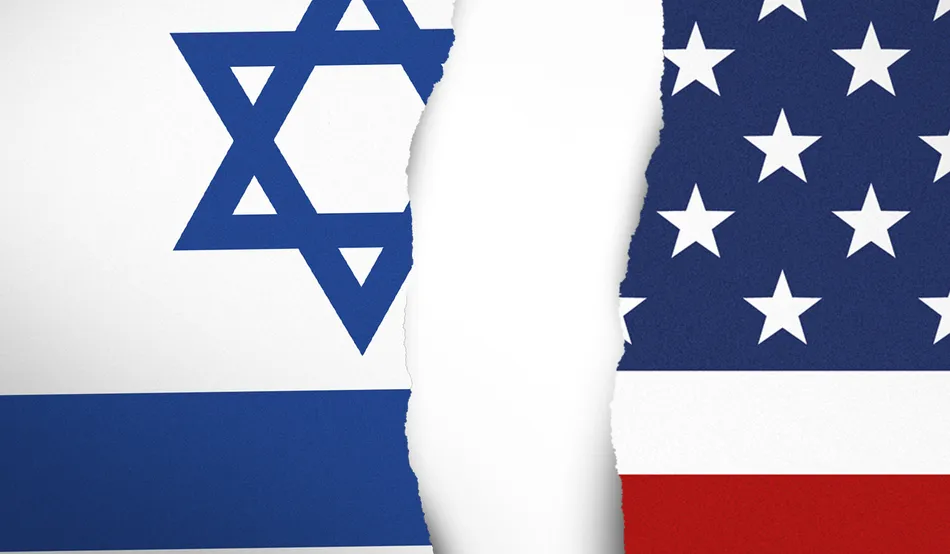
In this debate, fuelled by opposition to the wars in Iran and Gaza, Israel has become perhaps the clearest test of the new politics, for Democrats and Republicans. For decades, support for Israel sat close to the centre of the bipartisan foreign policy consensus. It no longer does. In July 2026, 103 House Democrats voted for an amendment to cut $3.3bn in military aid to Israel (98 opposed it). In Democratic primaries, left-wing insurgency is keeping Israel and Gaza in the debate that makes even the Democratic establishment uncomfortable.
There is no doubt that Americans are souring on Israel—and that, too, will likely be a trend that outlives the Trump years. Sixty per cent of Americans now have an unfavourable view of Israel. The numbers go up farther among Democrats and younger voters. Among Americans under 30, Pew found 58 per cent held favourable views of Palestinians and 32 per cent of Israelis. Among young Democrats, the gap was 72 to 26.
“The west” itself no longer commands the common political meaning it once did
It is no coincidence that Trump did not meet with Benjamin Netanyahu at the UN General Assembly in New York this autumn—and instead visited New York’s socialist mayor Zohran Mamdani, who had been publicly calling for Netanyahu’s arrest. The Israeli prime minister spent months publicly and privately lobbying the US president to attack Iran. But with the Strait of Hormuz still closed and energy prices rising, Americans have the sense that Israel actually dragged the US into another war. Trump has never been shy about scapegoating others for his own decisions.
This has sharpened a much larger argument over the true “special relationship” and whether the US’s commitment to Israel serves American interests; this too will likely outlive the Trump years. Already Democratic hopefuls and JD Vance, a potential Republican contender in the 2028 race, are amping up their criticism of Israel.
More broadly, the shifts in public attitudes to US foreign policy suggest that “the west” itself no longer commands the common political meaning it once did. Questions that not long ago produced broad agreement with European governments—on alliances, war, free trade, international law and America’s role as security guarantor—now run through fault lines in western societies themselves.
This is no longer only an American argument. Alternative for Germany, Marine Le Pen’s National Rally and Reform UK are now permanent features of the European landscape and have a patron in Washington. The self-declared Christian nationalists inside the Trump administration make no secret of their preference for a right-wing surge in Europe and will keep backing it for the remainder of the term. They regard the European Union itself as an inherently anti-American project.
The rest of the world is moving on. As Americans argue about whether US supremacy is still desirable, other countries are adapting to a world in which the US is already less visible or less dependable—and when it is there, more exploitative than it has ever been towards allies, something Canadians, Danes, Taiwanese and Saudis simultaneously seem to be discovering.
This is the world of the middle powers. India, Turkey, Saudi Arabia and Brazil increasingly resist the idea that they must either stick to an alliance with the US or choose a different geopolitical camp. The whiff of a post-western order is already in the air. The middle powers see the world in nonbinary terms and are happy to rely on the United States for security, China for trade and Europe for legitimacy and technology. Rather than permanent alignment, they seek room for manoeuvre.
Everyone’s posterchild for middle power solidarity is the Canadian prime minister, Mark Carney—though countries have a different understanding of what a post-American order would look like. At Davos in January, Carney declared that the world was experiencing a “rupture, not a transition” and urged middle powers to organise themselves rather than wait for the old order to return. “If we’re not at the table, we’re on the menu,” he said.
As Europeans patiently hope to develop geopolitical muscle for the big bad world out there, others are moving fast. The Mecca Joint Defence Agreement signed by Turkey, Saudi Arabia and Pakistan this summer is a clear expression of this impulse. It is not a Muslim Nato, nor does it yet replace US security guarantees. But the signatories’ aspiration is clear—to develop a collective-defence mechanism of their own in a world where the American security umbrella can no longer simply be taken for granted.
Mark Leonard, director of the European Council on Foreign Relations, describes the state of today’s world as “un-order”—in which rules are frequently broken with no clear agreement about what they were in the first place. In his 2026 book Surviving Chaos, he makes a distinction between the architects of world order, the Jean Monnets of the world who tried to build a coherent multilateral system, and artisans, such as the ever-hedging Recep Tayyip Erdoğan, who improvise their way through fragmentation. Increasingly, middle powers are behaving like artisans.
This is not yet a post-American age. The United States remains the world’s most significant military and financial power. But it is no longer certain that primacy is worth its price—and the rest of the world is no longer certain that American primacy can be relied upon. Donald Trump’s larger historical legacy may be that he accelerated the passage from one order to another without defining what comes next.
The midterms this November will likely cost Trump his hold over Congress and make it harder to keep pushing his domestic agenda, while still leaving considerable latitude in foreign policy. But whatever happens then, and the 2028 elections, it is hard to imagine a future president standing before Europe to shout that “America is back!”
The more interesting question is what Democrats learn from the Trump years—and from Americans’ loss of enthusiasm for US primacy in the world. Quiet conversations are already under way about foreign aid, how to manage alliances, Russia and the scale of America’s global commitments. But the real dilemma for Democrats is what kind of presidential candidate will emerge from these debates. Will it be a younger version of Biden, defending the old language of US leadership everywhere and all the time, or a Democratic populist more focused on economic issues at home and willing to reduce America’s military footprint abroad? The choice may be the real legacy of the Trump years.