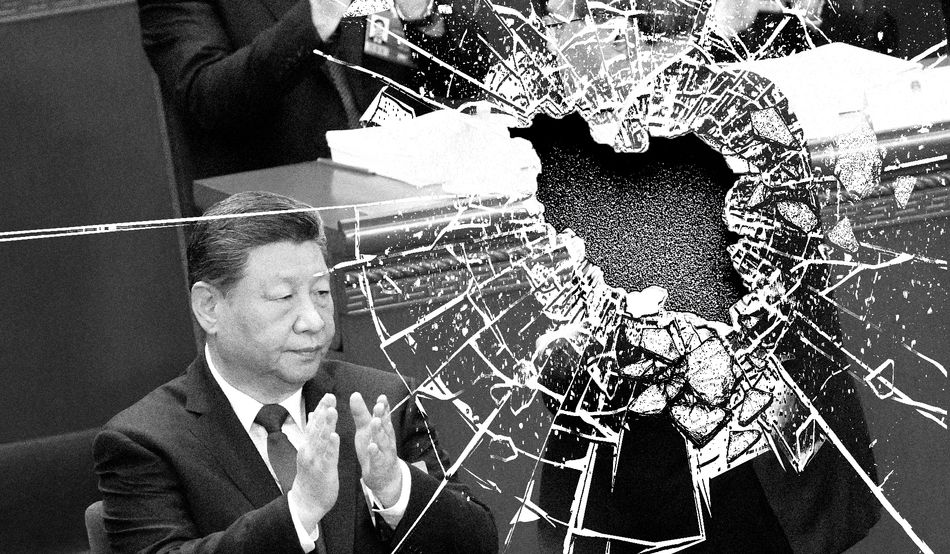
Of the many excuses advanced for Donald Trump’s attack on Iran, the assertion that it is part of a longterm plan to damage China is one of the silliest. Decapitating both Venezuela and Iran, that argument goes, not only deprives China of vital oil supplies, but erodes its global influence by exposing its alliances as empty: China may say it is your friend, but it won’t help you out in a crisis.
Leaving aside the Trump administration’s treatment of its allies, if that was the view of China’s position among White House staffers, then they were seriously mistaken. Venezuela and Iran did supply China with oil, but the arrangement was less significant for Beijing than for the suppliers who together made up only 17 per cent of the country’s imported oil. It has spent years trying to lessen dependence on seaborne imports of fossil fuels and the risks associated with maritime chokepoints, using a strategy of building pipelines and a combination of renewable and nuclear energy. It has also built strategic reserves of oil equivalent to more than 100 days of its total needs.
In total, around half of China’s crude oil and a third of its liquified natural gas (LNG) comes from the Gulf and the costs and inconvenience of disruption will certainly be unwelcome. But China’s reserves and alternative sources give it a greater capacity to cope with the impacts of Trump’s war than India or the nations of southeast Asia, as well as America’s closer allies such as Japan and South Korea. Besides, since China is a friend of Iran, a few Chinese ships and others bound for China have transited through the Strait of Hormuz unmolested.
Like China, India also appears to have negotiated a pass through the Strait. Some 40 per cent of India’s oil supplies pass through the waterway and it imports 88 per cent of its oil, making it vulnerable both to price shock and interruption in supply. A scarcity of bottled gas is already being felt, and a prolonged conflict could also slow India’s economic growth by raising energy and transportation costs. Even more politically sensitive are the deaths of five Indian sailors and the security of the nine million Indian citizens living and working in the Gulf, who remain at risk during the hostilities.
In an ideal world, China would prefer peace in the Gulf, not least because Beijing wants a healthy global economy full of eager customers for Chinese goods. Nevertheless, there may be several advantages for China. It has long been a Chinese ambition, for instance, to drive a wedge between the United States and the European Union, but Beijing could hardly have dreamed of how effectively Trump is doing that job for them. The US president’s attacks on Nato are also good news for China, and the lifting of oil sanctions on its close ally Russia will be read in Beijing as an encouraging sign of western weakness.
The US may have the world’s most powerful armed forces, but it has a particularly poor record in the kind of asymmetric warfare that Iran is pursuing. The longer Trump is bogged down in an unpopular conflict, wasting expensive ordnance to no benefit, the more difficult he could find it to persuade his shrinking base to support the defence of Taiwan. US allies in the region, including Japan and South Korea, are already concerned by the diversion of military hardware and attention away from the Pacific to support the adventure in Iran, and the encouragement this might offer to Beijing.
China is unlikely to attack Taiwan for the time being, not least because of the shock that would deliver to the global economy and because of the continuing turmoil at the top of its military machine. But Beijing is taking the opportunity to study the rapid evolution of contemporary warfare, including the use of AI and of drone swarms, and to observe the rapid depletion of US stocks.
According to the Payne Institute for Public Policy, the US blew through more than 300 Patriot missiles in the first 96 hours of the war and its Gulf allies used a further 618, which amounts to more than the current annual production of around 600 missiles a year. Not only is that depletion rate unsustainable, but replacing those missiles will require several critical and strategic minerals, including gallium, neodymium and samarium. China currently has a monopoly on the processing of all of these, including 98 per cent of the world’s supply of refined gallium.
In August 2023, China’s Ministry of Commerce imposed restrictions on exports of gallium and other strategic minerals and, in December 2024, banned refined gallium exports to the US entirely. Although China suspended the ban for a year after Trump and Xi Jinping met in Busan last October, restrictions on sales to the US military were not lifted. Despite recent US attempts to form new partnerships for the processing of rare earths and strategic minerals, for now it remains dependent on China’s permission to replace its Patriot missiles.