Imagine building a firewall. The wall remains intact, but the fire behind it keeps growing. At what point do you stop admiring the strength of the wall and start asking why nobody has put out the fire?
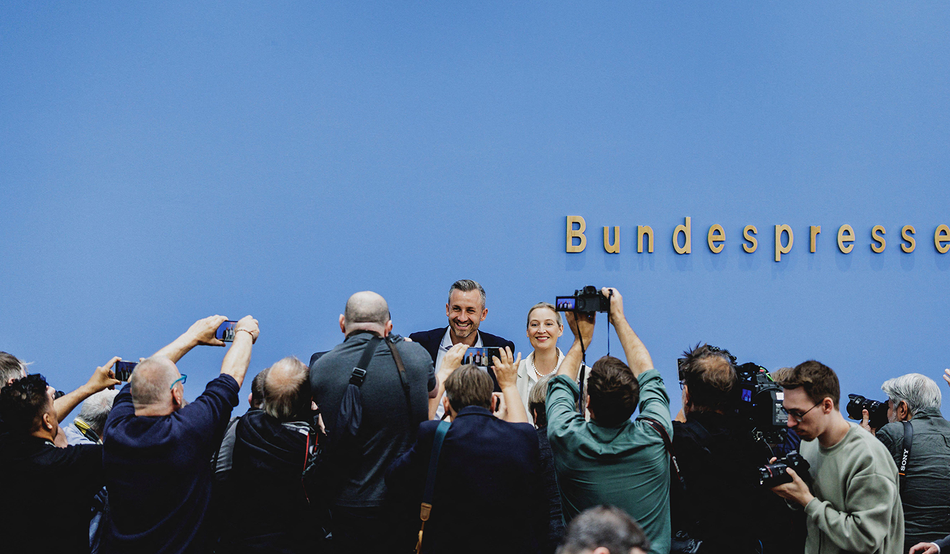
German politics has just such a firewall or Brandmauer, designed to keep the far-right Alternative für Deutschland (AfD) away from real power since the party emerged in 2013. No matter how many votes the AfD wins, the theory goes, Germany’s democratic parties will refuse to govern with it. After the state election in Saxony-Anhalt, when the AfD, led by Ulrich Siegmund, narrowly missed winning an outright majority, the Brandmauer is still standing, yet the flames beyond it are getting bigger.
The AfD won 43.8 per cent of the popular vote in Saxony-Anhalt, more than doubling its share from the last state election in 2021. Friedrich Merz’s Christian Democratic Union (CDU), which had governed the state since 2002, was a distant second with 17.2 per cent. But with the other major parties refusing to enter a coalition, the AfD could yet remain outside government.
As someone who was born in Hamburg and lived there for 12 years, I grew up thinking that modern Germany’s greatest political strength was its alertness to extremism. The postwar republic did not assume that democracy would defend itself. It built institutions, habits and taboos intended to stop it from being dismantled through democratic means. The Brandmauer belongs to that tradition, and its purpose should not be lightly discarded.
But to keep the AfD out, its opponents will have to assemble another awkward coalition of parties that have little in common. They will be united by what they oppose rather than what they want to achieve. The AfD, meanwhile, would enjoy the best of both worlds: the authority of having won an election and freedom from the responsibility of governing.
Under this scenario, it does not have to explain how its promises of mass deportations, cheaper energy, cultural renewal and a return to an older, more recognisably “German” Germany fit together, survive legal scrutiny or answer the practical needs of an ageing nation dependent on foreign workers. If a coalition government struggles, as it probably will, the AfD can simply point and say: we told you so.
The AfD alone can remain politically pure, never dirtied by compromise, budgets or having to deliver what it promised.
Thorsten Benner, co-founder and director of the Global Public Policy Institute in Berlin, writes that this protection from the consequences of power may help explain why the AfD has become more radical as it has grown more popular. Far-right parties elsewhere have moderated as electoral success brought government within reach. The AfD has moved in the opposite direction.
The Saxony-Anhalt branch has been classified as right-wing extremist by the state’s domestic intelligence agency. Siegmund campaigned on starting a deportation offensive, banning rainbow flags in schools and replacing Saxony-Anhalt’s slogan, “Think Modern”, with “Think German”. Germany’s democratic parties can’t be expected to escort such a movement into office.
But refusing to govern with the AfD is a boundary, not a political strategy. It can’t determine what voters believe or make their anger disappear.
For years, it was possible to describe the party as a protest movement. Despite it entering the Bundestag in 2017 with 12.6 per cent of the vote and coming first in Thuringia’s state election in 2024, it could still be viewed as outside the German political mainstream. That is much harder when a party attracts nearly half the vote. Supporting the AfD is no longer merely a protest against the whole German political system. For a large number of Germans, it is becoming a serious option within it. Nor is its success confined to one eastern state. The AfD is leading nationwide polls at 28 per cent, seven percentage points ahead of the CDU/CSU.
Imitating the AfD is no answer. Merz has already tested that theory, borrowing parts of the party’s rhetoric while seemingly accepting its premise that reducing migration should be the overriding measure of whether government is working. He has introduced stricter border controls, accelerated deportations and limited family reunification for some categories of refugee. Merz even described migration as a “problem in the cityscape” before telling critics to “ask your daughters” what he meant. Irregular migration has fallen, but the electoral reward has gone to the AfD. Far from weakening the far right, Merz has helped legitimise its framing and left voters with a choice between the real thing and a more cautious imitation.
There is a lesson for Britain’s two parties, at a time when black-clad, balaclava-wearing anti-immigrant protesters are descending on Dover and Portsmouth. Both Labour and the Conservatives have used tougher rhetoric on immigration in response to Nigel Farage and Reform UK. But, Germany shows, voters rarely reward the imitation.
Migration alone does not explain the struggles of east Germany since reunification. Saxony-Anhalt has experienced industrial decline, an ageing population and the departure of many younger residents. Beneath its politics sits a feeling that decisions are made elsewhere, usually by people who arrive to explain what eastern Germans ought to think about them.
The AfD has become skilled at gathering these different grievances into a story: one of economic stagnation, migration, green policies, the war in Ukraine and distrust of Berlin, which are all presented as evidence that ordinary Germans have lost control of their country. Some of these grievances are real. Dismissing every AfD voter as extremist evades the question of why so many people no longer believe the other parties are listening to them.
At the same time, Germany’s institutional alertness to the threat of the far right has descended into ritual. Each AfD advance produces shock, condemnation and another firm promise that nobody will work with it. The language reassures Germans, like me, who remain inside the democratic consensus, but does little to reach those who have left it. Worse, it allows the established parties to frame protecting democracy as indistinguishable from the protection of themselves.
Germany’s democratic parties must now do something harder than blocking the AfD out of government. They need to show that pluralism can still produce decisive leadership, that economic change does not require abandoning whole regions and that German identity can mean something beyond ancestry or the colour of one’s skin. They must actively compete with the AfD and defeat its ideas—not merely try to quarantine it.