Before Serbia’s Student List has even taken office, its campaign against impunity and corruption seems to be coming to fruition. On 1st November, prosecutors arrested a police chief, Marko Kričak, and the head of the Crime Suppression Service, Boško Šekulović, for alleged abuse of power. Days later, nine police officers were detained for the torture and intimidation of protesters.
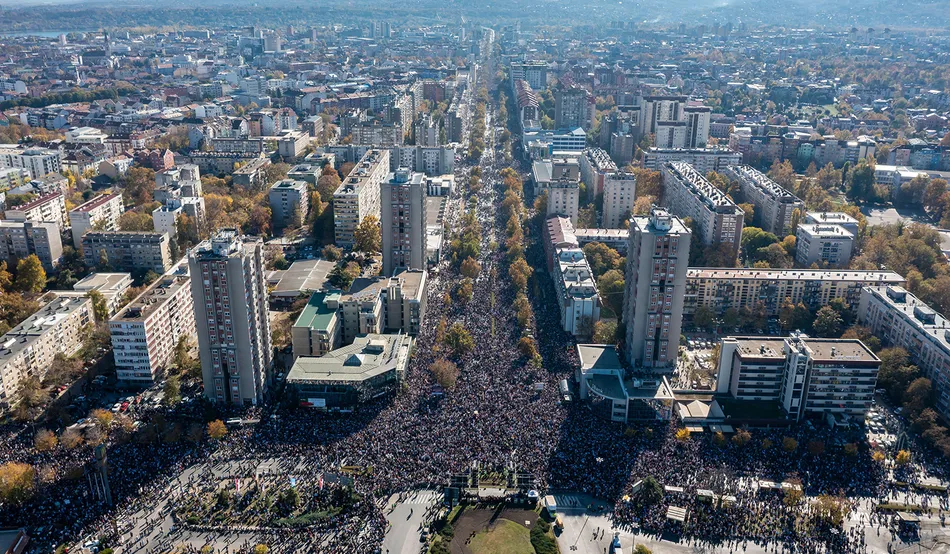
All this has happened quickly. When I left Belgrade in late August, removing Aleksandar Vučić was a cherished but still distant aspiration. His grip on power seemed tight, with pro-regime thugs camped outside the Presidential Palace and his propaganda filling the airwaves. The student protest movement that had been agitating since November 2024 had no visible route to power. In the last two months, that student movement has rallied into the Student List, not a formal political party, but a diverse group of candidates from across civil society. This unprecedented electoral organisation won 52 per cent of the vote and 140 out of 250 seats in parliament. Now it is beginning to unpick the repressive state that sustained Vučić’s rule.
Their victory was extraordinary. Students faced a captured state, electoral intimidation, a hostile media and a western establishment that accommodated Vučić’s democratic backsliding. Now the Student List faces a different challenge: to turn a movement built on resistance and decentralised participation into a government capable of reforming the institutions it has inherited.
The first obstacle to the List’s electoral success was the Serbian state itself, the coercive power of which was turned against protesters. Ilija Srdanović, the cardiology professor who became the nominal leader of the List, accused police of using illegal chemical agents against protesters in September 2025. Behind this repression sat the skimming of public money to reward government loyalists. Such embezzlement was "prolific", writes student researcher Rade Meech-Tatić, whose analysis of 160 recent procurement contracts found an estimated €3.6bn out of €34.6bn in public investment unaccounted for.
Overturning state oppression is the Student List’s clearest mandate. The List promised a system of law that does not “depend on who stands before it”, alongside greater transparency in public finance. How it brings Vučić’s cronies to justice will be the first test of these commitments.
For those with long memories in Belgrade, this is reminiscent of the equally euphoric removal of Slobodan Milošević in 2000, which never yielded a sustainable liberal democratic alternative. Serbs are fond of saying that the sun set on Milošević, but the new dawn never truly broke. The students have been emphatic that rebuilding impartial institutions must be the “first step” if they are to avoid the same disappointment.
This election reengaged swathes of Serbian society that had become disillusioned with the democratic process. But the Student Plan, the List’s “programme of 11 points”, recognises that “a single election” does not solve the nation’s problems, nor does it restore democratic confidence. The List must first manage the threat Vučić continues to pose to the democratic process. The former president is already casting doubt on the prospect of a smooth transition, questioning whether the December presidential election will be “normal” or even “possible”. Having pledged in a social media video with Viktor Orbán to “come back”, Vučić is unlikely to relinquish his influence over Serbian politics without a struggle. Long-term, the List must restore faith in institutions that elections in the region have too often undermined. The democratic culture that the Student List prizes will be slow to truly take root.
The third obstacle to the Student List was propaganda, the use of which Vučić refined as Milošević’s information minister. National media outlets referred to supporters of the democratic opposition as “enemies of the state” and made unfounded accusations that Srdanović had a track record of violence against women. Young Serbs found their news online, but their older relatives remained enraptured by tales on state TV of student brutality.
In its plan, the Student List promises to “free the media”, establishing the conditions for genuine discursive pluralism. Pursuant to this objective, the public broadcasters RTS and RTV have apologised for one-sided coverage, and key figures have resigned or been dismissed. On election night, protesters broke into the office of the Informer, a pro-Vučić television station, chanting for its editor’s arrest. This episode highlights a tension in the students' own programme over how to hold propagandists to account without reaching for the regime's own tool of state pressure on the press. Dismantling a captured media environment is one task, but building an independent one is another.
The most underappreciated obstacle overcome by the Student List was particular to Serbia, however: western accommodation of Vučic. For many Serbs, Vučic was removed despite western indifference. One of the highest-profile interactions between British media and Vučic was an April interview on The Rest is Politics. In the grandeur of the Presidential Palace, Alastair Campbell and Rory Stewart, fierce advocates for liberal democracy in other contexts, discussed Serbia’s relationship with Hungary and re-litigated Nato’s 1999 bombing campaign—all ground on which Vučic’s nationalistic narratives thrive. Though they did acknowledge that Vučic had been criticised for democratic backsliding, the pair made little effort to hold him to account for this or for suppression of protests.
This reflects a broader “Stabilocracy”, the term used by Balkan scholars to refer to the sacrificing of democratic accountability for predictable government. Europe tended to prioritise strategic accommodation with Vučic. One example is Jadar in western Serbia, home to one of the largest lithium deposits on Earth. Extraction was suspended after mass protests in 2021 but reauthorised in 2024, inspiring a fresh wave of opposition.
Despite this controversy, Vučic left a dinner with Ursula von der Leyen, president of the European Commission, and António Costa, European Council president, in March 2025 saying the project had strategic EU backing. Lithium is crucial to Europe’s energy transition, but Serbs opposed the extraction for environmental reasons. As such, Jadar represents a direct trade-off between European interests and Serbian democratic representation. The project is currently suspended, and leading figures in the List strongly oppose any further extraction.
On election night Vučić blamed independent media, unnamed European countries and an “American deep state” for his defeat. In reality, the counterweight to his propaganda was domestic. Now, Von der Leyen and Costa congratulate the List, and the EU enlargement commissioner, Marta Kos, says the door is open for Serbia to join. To many in Serbia, such friendship after victory seems cheap.
How they relate to Europe is just one example of perhaps the greatest struggle the Student List government will face. It must take firm positions on questions best avoided in opposition. For instance, the List campaign was strategically vague on foreign affairs. When pressed on EU orientation or Russia sanctions, Srdanović often redirected attention to the struggle to remove Vučić. He presented this as an existential fight for Serbia’s future that trumped all other considerations. While foreign policy could have split the movement, a common enemy restored unity. With the enemy vanquished, unity in government will be harder to sustain.
This reflects an organisational tension that protesters from Albania to India will be watching closely. In opposition the movement resisted hierarchy through a network of democratic plenums, inoculating itself against intimidation or the discrediting of a single leader, and holding together a diverse coalition. Now it has a majority but not yet a prime minister (one is in the process of being selected); a mandate but no complete manifesto. The true test of government will be whether the List can organise around clear lines of responsibility and a coherent policy platform—and whether it can do this without compromising the truly democratic movement that finally unseated an autocrat.