In Langtang, Nepal, a group of locals and glaciologists gathered to mark the demise of the Yala glacier, which had shrunk by 66 per cent since the 1970s; its death—which for a glacier is marked when it no longer flows—was said to be imminent due to global warming. More than 50 people took the high-altitude trek to the site for a Buddhist ceremony and the placing of memorial plaques. This took place on 12th May 2025. Much worse was to come.
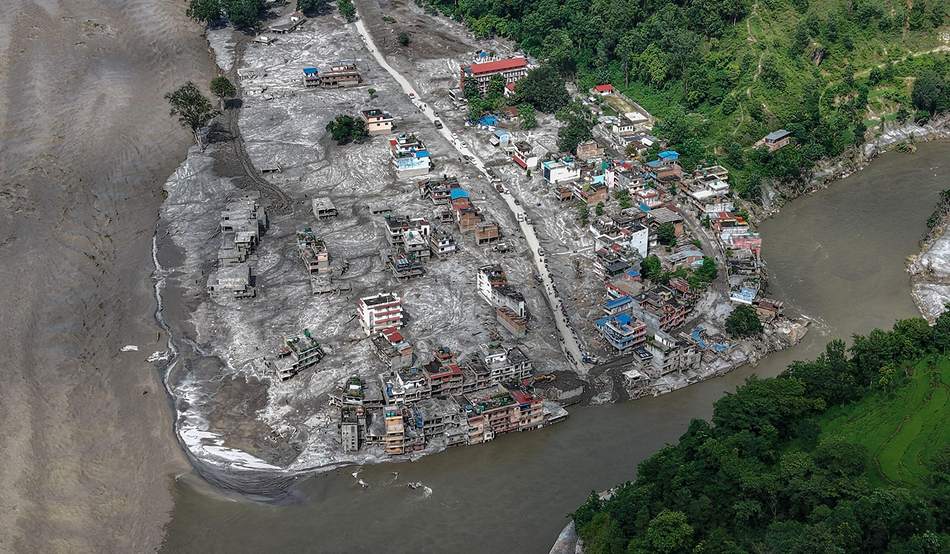
When a section of glacier cliff over half a kilometre wide sheared off the north face of the mountain of Langtang Lirung on 26th August this year, it fell 1,200 metres in a matter of seconds. As it hit the ground below, it registered as a magnitude 5.2 earthquake, and began a debris flow that travelled 100km down the Trishuli and Bhote Koshi river valleys at an average speed of 193km per hour, destroying towns, bridges and hydroelectricity dams in both Nepal and Tibet, China. Nepal’s early warning system relied on a network of river level-gauges that can register flash floods, but not 80m high mudflows and boulders the size of houses; many people had no time to get to safety. At the time of writing, 1,287 people are confirmed dead and more than 5,000 are still missing.
This was no freak event: like the smaller floods that hit communities in 2016, 2021 and 2024, it was caused in part by rapid warming. The Himalayan region as a whole is warming 50 per cent faster than the global average, and ice loss rates across the Hindu Kush have roughly doubled since 2000. A recent study of the Langtang region found it had warmed by 0.31°C every decade between 1960 and 2023. July was its second warmest July; August, up to the collapse, was the warmest ever.
Langtang Lirung’s high mountain slopes are held together by permafrost—and “As that frozen ground warms and ice inside thaws”, explains Umesh Haritashya, professor of earth, environment and sustainability at the University of Dayton, writing in the Conversation, the cement-like ground “weakens, and slopes that stood for thousands of years can lose their grip.” Meltwater from snow and ice seeps into cracks in the rock. Where it refreezes, cracks are prised ever wider. Satellite images of the site from before and after analysed by Dan Shugar at the University of Calgary show considerable snowmelt in the days preceding the disaster.
An editorial in the Nepali Times noted that that policymakers in the country had been warned “to prepare for floods unleashed by extreme weather, glacial lake outburst floods, and transboundary climate calamities”.
“This was not a ‘natural’ disaster,” it said. “Nothing about it was natural—not the glacier melting due to greenhouse gas buildup due to fossil fuel burning, not the location of expensive hydropower plants on trans-Himalayan rivers, not designing highways to follow rivers, not the settlements that have grown around them, not the corruption and greed, not the poor governance.” It was, in short, a predictable tragedy.
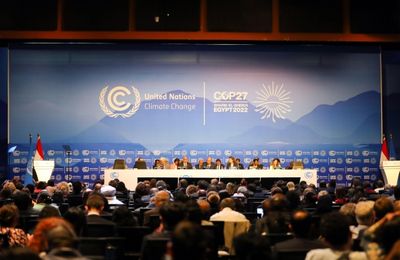
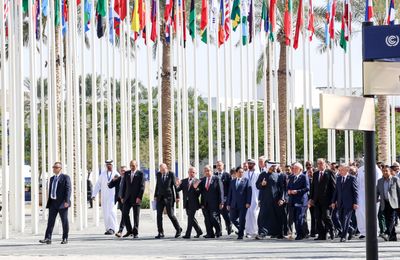
Perhaps predictably, too, the Nepal disaster has brought debates about “loss and damage” funding back to the fore. The concept of big emitters paying reparations to the countries that are most vulnerable to climate change had been front and centre at the Cop27 climate conference in Egypt in 2022—where a specific fund was established to help those hit by disasters—but it has since fallen out of favour. Compared to a stated need of $100bn-$580bn a year, the entire fund sits at $631m—towards which the UK (the fifth largest historical carbon emitter) has contributed $50m—with only around $350m available for reparations, and the rest going towards the costs of running the fund.
In 2025, while also cutting funds for overseas aid—including the disaster response team that might once have supported relief efforts in Nepal—the United States withdrew from the loss and damage fund agreement entirely. Other wealthy nations, including the UK, have also cut their international development aid obligations.
In the aftermath of the flood, Nepal foreign minister Shisir Khanal told Kantipur TV that, given Nepal’s own greenhouse-gas emissions were “practically negligible”, the country would be focusing less on talking about aid in future, and more on “justice and compensation”. The minister said: “This is not a matter of charity; it is a matter of legal and moral liability. The major industrial emitters—such as China, which is the world’s top emitter, the United States at number two, and India at number three—have a historical responsibility to compensate vulnerable nations like Nepal.”
Nepal had invested more than £6.7bn in building hydropower dams across the rivers, but August’s disaster flattened 12 hydroelectric plants, eradicating 10 per cent of the country’s total energy generation capacity. More than 20,000 houses will have to be rebuilt. The recovery costs are estimated by the government in Kathmandu to be more than $5bn, roughly 10 per cent of GDP. To cover these costs, Nepal still needs traditional aid—Khanal has put that figure at a relatively modest $20m.
Sunil Acharya wrote in the Guardian that “Loss and damage finance must… be additional to existing official development assistance”. I would add that it must also reach far higher figures than aid. Requests into the UN loss and damage fund already amount to $2.8bn, nearly eight times what is available, and that was before the Nepal disaster. According to the Lowy Institute, a thinktank, eight members of the UN’s Fund for responding to Loss and Damage that represent Africa, Asia and the least developed countries have called for an extraordinary meeting to discuss Nepal’s appeal, seeing it as “a test of whether the fund can act fast when it matters”.
In a 2025 book I co-authored with the UN’s Climate Vulnerability Forum and the V20 group of climate-vulnerable nations, we argued that loss and damage should be the third pillar of UN global climate diplomacy, alongside mitigation and adaptation. Seasoned Cop negotiators and UN observers acknowledged the scale of compensation is still hotly debated, and the “R” word, reparation, fiercely resisted. Meanwhile, an economist at the Maldives Finance Ministry told me that accessing any climate financing—including the UN loss and damage fund—was almost impossible.
That remains the case. The climate, however, continues to change: temperatures are rising and climate hazards are worsening. Nepal’s flood underscores this, for while the region is well known for flash floods and landfalls, no one had ever seen anything like this before. A senior UN source, who has witnessed many disasters, tells me he is “still having nightmares” from the videos. He also now expects loss and damage to shoot up the agenda at Cop31 in Turkey in November.
At the May 2025 ceremony for Nepal’s dying Yala glacier, which was conducted close to the site of this year’s disaster, a commemorative stone was erected. On it is an inscription by Icelandic author Andri Snaer Magnason. It reads: “A message to the future: Yala glacier is one of 54,000 glaciers in the Hindu Kush Himalayas, most of which are expected to vanish this century due to global warming. This monument is to acknowledge that we know what is happening and what needs to be done. Only you know if we did it.”