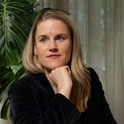
When Anna Nemzer left Moscow on the evening of 24th February 2022, she thought she would be back in a week. Her family trip had been planned long in advance, but Vladimir Putin’s full-scale invasion of Ukraine—launched on the same day—put Nemzer, a leading journalist for the independent news network TV Rain, in a fraught position: should she stay and report from Moscow, or leave while there was still time?
We see Nemzer contemplate this decision in Julia Loktev’s My Undesirable Friends, an uncomfortably intimate, five-hour documentary that follows female journalists in the Russian capital from October 2021 to the opening days of the full-scale war in 2022.
Filmed on an iPhone, Nemzer is captured in her car on the morning of the invasion, her face white with shock. Her initial reaction was not as a reporter but as a confused citizen: “I don’t have a country anymore,” Nemzer says, to herself as much as to Loktev. “I used to have one. It did horrific things, committed awful crimes. But somehow, I had one. Now I don’t.”
Moscow was Nemzer’s home for most of her life. Loktev films Nemzer cooking in her flat, the same building where she was born, as she hosts a dinner party for close friends and family. “It was not a quick decision to leave,” Nemzer tells me over Zoom. “By the afternoon, I had decided not to go. But then I had a conversation with my editor and he said, ‘you will be back in a week.’” That was four years ago. She has not returned to Russia since.
Now living in New York, she is a scholar at Bard College and is a co-founder of the Russian Independent Media Archive (RIMA). She still works for TV Rain, which has operated from the Netherlands since 2022. In My Undesirable Friends, Nemzer and her colleagues try to report freely in Putin’s Russia. Not an easy task, particularly when each TV Rain broadcast has to start with the declaration that the network is a government-designated “foreign agent”.
Prior to the invasion, Nemzer hosted a show on TV Rain, Who’s Got the Power?, in which she interviewed activists and independent journalists—the “people trying to create a civil society in Russia,” as she puts it—about the rights of migrants, the homeless, and the LGBTQ+ community. But despite logistical challenges, such as relentless financial monitoring, and raids from government agents, Nemzer and her colleagues endeavoured to show viewers that there was more to Russian society than the Kremlin’s official line. “It was so painful to see it all demolished in one day,” she says, looking back. Russian authorities ordered the shutdown of TV Rain on 1st March 2022.
But her story and those of her colleagues continue to resonate beyond Russia. Nemzer is careful not to draw too close a parallel between the United States and Russia, but she admits to experiencing “a constant feeling of déjà vu.”
“It’s devastating to observe what’s going on in America,” she says, referring to the speed and force of its authoritarian turn. Nemzer recognises the Trump administration’s attacks on universities and museums, the attempt to impose its own version of national memory: “They are playing by the book,” she says. “Taking control of the narrative, rewriting history, manipulating facts… The situation is not unique to Russia. Dictators seek to destroy any undesirable information.”
When I ask Nemzer whether she can envision ever returning to Russia, she answers pragmatically. Even if Putin dies tomorrow, she says, the country will be ravaged for a long time. She does not want to raise her child there.
She is happy to be with her family, but she misses her friends and colleagues, who are now scattered all over the world. For Nemzer, fostering a sense of community is more than just personal. “I have one philosophy,” she tells me. “You should live with your loved ones. You should live amongst these people because it’s your strength. It’s your power.”
My Undesirable Friends: Part I — Last Air in Moscow streams on Mubi from 3rd April