The Golden Age of Hollywood is becoming like the Second World War: we are losing our last living links. Over the past year or so, the obituary pages have read like closing credits. Ann Robinson, who was menaced by Martians in The War of the Worlds (1953), died at 96 in September 2025. June Lockhart, a child in the 1938 adaptation ofA Christmas Carol, followed that October at 100. Ann Blyth, Oscar-nominated as Joan Crawford’s monstrous daughter in Mildred Pierce (1945), this June at 98. And the stars who came just after them—Robert Redford, Claudia Cardinale, Brigitte Bardot, Robert Duvall—have been leaving too.
Now Eva Marie Saint has gone, on 6th October, aged 102. Since the death of Olivia de Havilland in 2020, she had been the oldest living Oscar winner. Yet she was an unlikely late representative of the studio era. She arrived, after all, just as it was crumbling, and was the product of two forces heralding that demise: television and the Method.
Born to Quaker parents in Newark, New Jersey, on 4th July 1924, the future actress grew up near Albany, New York. She went to Bowling Green State University, in Ohio, to become a third-grade teacher, like her mother. Then someone dared her to audition for a college comedy, and, to her surprise, she was cast as a Hollywood siren in a slinky gown. Until then, she had always been one of a group: chorus, orchestra, cheerleading squad. “I never wanted to be out there alone,” she told her grandson, journalist Tyler Hayden, in an interview for the Santa Barbara Independent in 2009. “Ever.” A professor wrote her a two-page letter of encouragement, noting that he thought she could take rejection.
Rejection duly followed in New York. In 1949, Life magazine wanted to profile a struggling young actress trying to break into television, so it chose Saint. “The name of Eva Marie Saint may someday be a household word like Bankhead, Bergman or Berle,” the article started. “Or on the other hand it may never become known at all outside a few casting offices.”
Happily, Life’s first prediction came true. Within a few years, Saint was being called “the Helen Hayes of television”, a celebrated part of the live dramas broadcast by NBC and CBS from New York. After she played a young woman in love with a much older man (EG Marshall) in Paddy Chayefsky’s Middle of the Night, strangers stopped her in the street to ask whether their own May-to-December romances might work out. Live television was, she said, “a bloodbath”—but “I’ve never been nervous since.”
All the while, Saint was honing her craft at the Actors Studio, the Manhattan temple to Method acting. There, Lee Strasberg set the shy young woman a scene in which she had to cry in front of her peers. Her own family, though “loving”, wasn’t given to tears, so she fretted over it for days. But when the moment finally came, she found her classmates were crying too. “I broke through a barrier,” she said.
It was in the 1953 Broadway play The Trip to Bountiful that the film director (and one of the founders of the Actors Studio) Elia Kazan spotted Saint. Her audition for On the Waterfront (1954) was an improvisation with Marlon Brando, in which she was told he was a young man at her door, coming to visit her sister who was not home, and her job was to keep him out of their flat. He got in, of course, put on some music and they ended up dancing. Kazan, she recalled, then kept her “off balance for the whole shoot”, which may have helped her performance as Edie Doyle, the convent-educated sister of a murdered longshoreman, who falls for Brando’s Terry Malloy, an ex-boxer mixed up in her brother’s death.
The 1950s Method was usually associated with men brooding and mumbling: Brando, Montgomery Clift, James Dean. What did it look like in the hands of an actress? Saint showed us: inward, still, entirely unshowy, yet never once overwhelmed by Brando. Watch the scene in the park where she drops a glove, and he picks it up and works his fingers into it. It has become acting-school legend.
Method acting was usually associated with men brooding and mumbling. What did it look like in the hands of an actress? Saint showed us
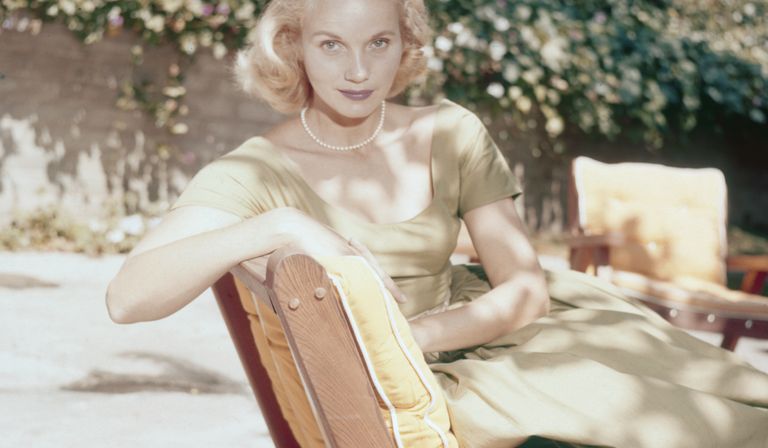
The other thing everyone noticed was how she looked. The pale, fine-boned face. The fair hair. The poise. A beauty so delicate that it was practically diaphanous. But it was the original New York Times review of On the Waterfront that made the more important point: Kazan had found “a pretty and blond artisan who does not have to depend on these attributes”.
Saint won the best supporting actress Oscar for that, her first film. She was heavily pregnant at the ceremony in March 1955. When her name was called, she paused before rising—a plan agreed with her husband, the television director Jeffrey Hayden, so that she didn’t rush and risk harming herself or the baby. To make sure, Hayden “had his thumb on my thigh; I couldn’t get up”. When she finally did make it to the stage, her speech began, “I may have the baby right here!” Their son Darrell was born two days later.
In 1959 came the other great role. MGM wanted Cyd Charisse to play Eve Kendall, the double agent who seduces Cary Grant in North by Northwest. Alfred Hitchcock wanted Saint—and won. He remade her, taking her shopping at New York’s Bergdorf Goodman department store and choosing the clothes himself. “He didn’t talk about acting,” she said. “He worked with me from the outside in.” His only direction, as she remembered it, was to lower her voice, keep her hands still and look into Grant’s eyes at all times.
Everything else came from Ernest Lehman’s supercool script—or almost everything. When Grant asks whether her tipping the steward to sit them together is a “proposition”, she replies: “I never discuss love on an empty stomach.” The censors had objected to the line as filmed—“I never make love on an empty stomach”—so she was called back to redub it. Watch her lips, and you can still see the original.
It is one of the sexiest performances in all of Hitchcock. Which makes its circumstances even more remarkable. Saint had given birth to her second child, Laurette, only weeks before shooting. “I was on the set giving my baby a bottle,” she told the Daily Herald. “It doesn’t sound sexy, but that’s how I did it.” Hitchcock, for his part, told her not to make any more “sink-to-sink” films—drab dramas about housewives. “I can’t promise that,” she replied.
Saint carried on favouring grit over glamour. Through the 1960s, she made films with Otto Preminger (Exodus), John Frankenheimer (All Fall Down) and Vincente Minnelli (The Sandpiper)—though never as many as she could have. “My agent told me, ‘If you want to be a superstar, do more films,’” she said. “I guess I didn’t want to be a superstar. My family always came first.”
Television, which had made her, became her second home. From the 1970s, she worked in miniseries and TV films, and reached a new generation as Cybill Shepherd’s mother in Moonlighting. In 1990, she won an Emmy for theminiseries People Like Us. That same year, she was candid about why she had moved over: “As I got older, there weren’t that many roles. I segued into TV and am perfectly happy.”
Happy, perhaps, but not uncritical. She was Martha Kent, Superman’s adoptive mother, in Superman Returns (2006), and then made no more films until Winter’s Tale (2014), when she was 89. At its premiere, asked why she worked so rarely, she said: “It’s not England, where a Maggie Smith or Judi Dench go for parts. We have a different attitude about older actresses… I don’t want to play a person who is in bed, dying.”
Hayden died in 2016, after 65 years of marriage. Saint went on—to her centenary and beyond. In 2011, Vanity Fair asked whether she ever watched her old films. “Sometimes I do,” she responded. “And I think, ‘Well, gee. You did that? Good job!’” Good job, indeed.