Britain’s power vacuum
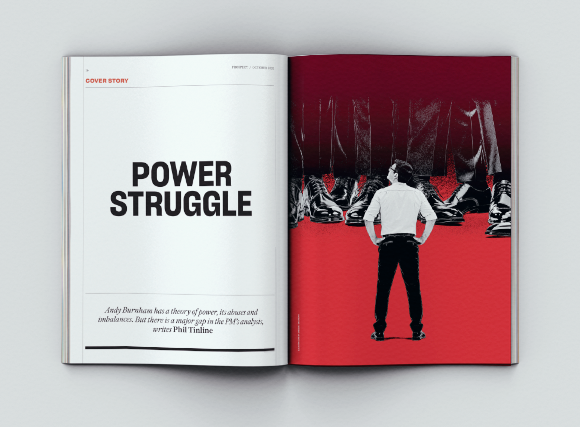
Phil Tinline’s essay (“Andy Burnham’s great power struggle”, October) is vital reading. Britain’s governance structures are floundering, and without a theory of power there is no route to reform. Over several decades Britain’s political class have abdicated their responsibilities to unaccountable public bodies and Whitehall bureaucrats. Our work at Re:State has exposed the deep flaws in this model, perhaps best captured in the fact that we don’t even know how many public bodies Britain has, never mind how well they perform. This mix of quangocracy and technocracy has been expanding, but cannot replace democratic decision-making, and so find fundamental answers to the UK’s biggest challenges.
But while the managerial state has expanded, state capacity has contracted. The civil service and many core state institutions have been unable to self-reform, leaving them unfit for purpose—monolithic, slow, analogue. The answer to Britain’s problems was not more process, regulation and bureaucrats, it was the reassertion of political control—on this Burnham is right. This cannot just mean expanding state control, but rather fixing the foundations of our social and economic model.
This is the answer to Tinline’s concern about the power concentrated in a small number of global companies. Taking on vested interests—the big money, big tech, big business which now dominate—is a fundamental responsibility for politicians. Monopolies and oligopolies are market failures, the answer is to ensure the conditions for greater competition. The same can be said of the public sector, where vested interests have been allowed to shape our public services in ways that benefit the provider over the user. Burnham’s goal should be to topple vested interests, whether state or private, not to create new ones.
Charlotte Pickles, chief executive, Re:State
A licence to print money
Prospect’s editorial (“The high cost of living—like this”, October) asks where the money for removing VAT from electricity bills, a£2 bus fare cap and defence will come from. This is a question countries like the UK and the US, with their own currency and central bank, can answer, but in surprising ways.
It’s “not taxpayer money. We simply use the computer to mark up the size of the account,” responded then Fed chair Ben Bernanke, when asked in 2009 how the Federal Reserve lent to major banks. “There’s nothing to prevent the federal government from creating as much money as it wants and paying it to someone,” Alan Greenspan, Bernanke’s predecessor, had earlier testified to the Senate in 2005.
Similarly, former Bank of England governor Mark Carney is on record saying that, with government agreement, quantitative easing (QE) could be used to purchase assets other than government debt; George Osborne’s 2013 budget papers revealed that “the creation of money… could allow governments to increase spending or reduce taxation without raising corresponding financing from the private sector”.
As, by 2017, inflation had only exceeded 2 per cent nearly 10 years after QE started, concerns that raiding the magic money tree is inflationary should recede. More recently, a paper from University College London confirmed Carney’s and the budget paper’s view: “the UK government is not exposed to the alleged risks of ‘running out of money’, defaulting on debt obligations, [or] the sentiments of bond markets”.
The money is available, but whether or not to spend it is a political decision.
David Murray, Wallington, Surrey
Happy days
Miles Saltiel (Letters, October) says that “my generation came of age in the 1970s in conditions of social and economic chaos too well known to need amplification”. I am of the same generation and I think that they need a bit more than amplification.
I started the 1970s receiving free university education and by the end of the decade my wife and I both had secure and interesting jobs with final salary pension schemes. We were buying our first flat (cost £7,400) with a 100 per cent mortgage from the Greater London Council and despite paying income tax at 30 per cent on around average earnings we were able to cover the payments without difficulty. Most of the people we knew were in similar situations.
By way of background the unemployment rate was about the same as it is now and the rate of economic growth more than twice as high. My suspicion is that if people now in their 20s could go back to the 1970s they would think that they had died and gone to heaven.
Mr Saltiel’s standards may, of course, be unusually demanding. I see that he regards the fact that he started his working life doing the jobs he could get rather than the ones he wanted as a sign of hardship. Even so, seeing the 1970s as equivalent to the wartime conditions in which the preceding generation grew up does seem more than a little hysterical.
Rory O’Kelly, Beckenham, Kent
The cosmic junkyard
I don’t quite know where to start with Isabel Hilton’s article (“Have scientists found the secret to eternal power?”, October), but it does come across as somewhat breathlessly impressed by this sense of scientific progress. As a small corrective might I suggest that you look to astronomer Professor Sam Lawler at Regina University, Saskatchewan, who writes extensively about the increasing risks to astronomy, to our atmosphere and to our environment posed by space debris.
In some respects Cassiopeia sounds a bit more sensible than Reflect Orbital, a project which already has Federal Communications Commission clearance for a test satellite to trial parking giant orbital mirrors to reflect sunshine down to Earth in the hours of darkness. This would be guaranteed at various stages to disrupt local ecologies and bird migrations; will quite probably disrupt navigation, possibly causing air accidents; and of course blind people who happen to look up at it.
In the case of Cassiopeia there is a prospect of straying aircraft getting fried in a microwave beam, as well as anybody on the ground if beam guidance happens to fail—and nothing is absolutely fail-safe.
There is an ever-increasing amount of space junk. Tech bros and others are proposing to throw increasingly large amounts of rare minerals up into space, where they are lost to earthbound use for good, and much of what fails or is considered already obsolete after a very few years either falls randomly to earth or burns up in the atmosphere, leaving metallic compounds that will destroy the ozone layer to a greater extent than the CFCs that eventually got banned.
There is little to no consideration other than financial to the vast amounts of energy and materials being expended boosting all of this stuff into orbit to be lost forever. None of them have I’m sure will even have heard of the 1970s report, The Limits to Growth, but we live on a finite planet, however much they like to ignore that fact.
And of course, there’s Kessler Syndrome—the moment where space debris proliferates through endless domino collisions. When that happens, and it is increasingly likely given the amount of junk being catapulted up there, it will also finish off the useful satellites, probably for generations to come.
Antony Gordon, Heathfield, East Sussex
Speaking in tongues
Kate Maltby (“Inside Bluebeard’s Castle”, August/September 2026) expresses surprise that, of the three books reviewed, Gisèle Pelicot’s memoir should be the most precise in its use of language because it has been filtered not only through her French ghostwriter but also the two translators into English.
Leaving aside the fact that the review is of the English translation and no comparison with the French original is made (so we can only speculate as to the ghostwriter’s precision or lack thereof), I would argue that filtering through multiple brains is just as likely to result in tighter, more precise language use than the output of a single author.
In particular, the core of the translation process (by a human, at least, not machine translation) involves analysis of the ideas and intended meaning before reformulating them in the target language. Indeed, it is not unheard of for translations to be clearer and better expressed than the original precisely because of this analysis step in which multiple options may be explored before the translator settles for that which most accurately conveys the writer’s intent. Machine translation by LLMs, by contrast, is based ultimately on the probability of one word following another; it does not engage with meaning.
At a time when some assume AI will necessarily replace human translators in many contexts, I feel a better understanding of this aspect of translation would be helpful in informing the discussion of just what is replacing whom.
Peter Withey, Paris
There is a polite fiction that art and literature offer a civilised sanctuary from the grime of daily politics. Yet your culture pages inadvertently reveal the exact opposite: culture is not a refuge from politics, but the very battlefield where political power is contested, legitimised and enforced.
Nowhere is this clearer than in the three memoirs reviewed by Kate Maltby. On the surface, Virginia Roberts Giuffre’s Nobody’s Girl, Sarah Wynn-Williams’s Careless People, and Gisèle Pelicot’s A Hymn to Life span wildly different domains: sexual trafficking among elite networks, corporate hegemony inside Silicon Valley, and domestic horror in a quiet French village. Yet their core conflict is identical and inherently political.
Each account exposes how powerful men construct systems of immunity—whether through physical surveillance, corporate non-disparagement clauses, or societal complicity—to ensure their actions are untouchable. When non-disclosure agreements, litigation and intimidation are used to suppress a text, publishing ceases to be a purely aesthetic act. It becomes an act of political resistance. It is telling that Giuffre and Wynn-Williams shared the Freedom to Publish award; their memoirs do not merely recount private trauma, but critique the structural legal systems that protect institutional power from public scrutiny.
Pakhi Dixit, via email
Beginners’ pluck
I really like the beginner’s mindset favoured by Sarah Collins (Mindful Life, October), who is always so honest and courageous when she writes about her struggles with mental health.
I think it’s a great approach to have to learning, especially for anyone who finds it difficult to concentrate and has a low boredom threshold, allowing one to reach every new level of knowledge and experience without the distracting pressures of competitiveness and unrealistic expectations of instant success, both of which can prove too much for some.
Stefan Badham, Portsmouth
I took up squash at the very unlikely age of 69. This being a game where you’re expected to absurdly nimble, verging on the hyperactive, it was an odd choice, but I love it, and I love the little community who’ve welcomed me. Bashing a little black ball against the wall repeatedly and occasionally getting it past your opponent is a brilliant mental health tonic!
Yolanda1952, via the website
Soporific honorifics
I agree with Alice Goodman (Clerical Life, October) that there is a trend to address clergy by “title plus first name”, eg “Archbishop Sarah”, but I would not label it a rule, nor would I agree that such usage is “for the sake of the dignity of the office”, or that “everyone expects those lower in the ranks to address them by their title”. To the contrary, I am on first-name terms with both my bishop and my archdeacon.
What I do think the Church should abandon is the ridiculous distinction between “Most Reverend”, “Right Reverend”, “Very Reverend”, and “Venerable”. Given the vision of the Church of England to be “simpler, humbler and bolder” perhaps the new General Synod, (an election for which is currently taking place) will vote to consign these prenominals (along with the “Right Worshipful” for diocesan chancellors).
David Lamming, member of the General Synod, 2015 to 2021
Cup of sorrow
Following my letter that was published in the last edition (Letters, October) I owe the England men’s football World Cup squad an apology.
I did not take account of their third-place play-off victory versus France, which meant they won six and not five games (in addition to a draw and a defeat) during the recent tournament.
David Rimmer, Hertford Heath, Hertfordshire