The all-seeing AI
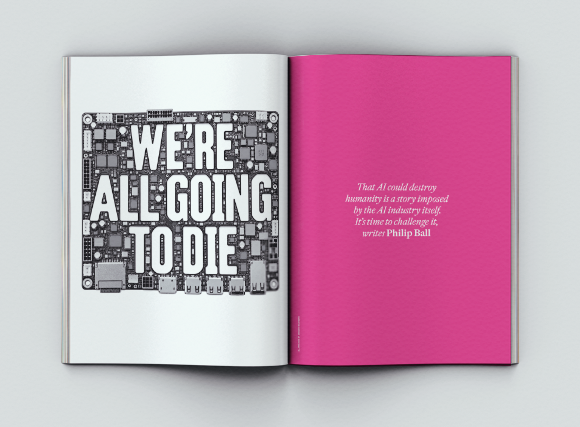
Philip Ball (“We’re all going to die, but not from AI”, November) exposes AI developers’ sleight of hand. By focusing on Terminator-like apocalypticvisions, we’re ignoring the real and dangerous consequences of its adoption today. In supermarkets, shoppers are being falsely accused and blacklisted when facial recognition goes wrong. In the NHS, young people waiting for liver transplants have been systematically overlooked where the algorithm favours older people. Benefits claimants flagged as potentially fraudulent based on predictive characteristics, such as age and number of dependents, have had housing benefit suspended and been threatened with eviction. To focus on doomsday predictions is to ignore this reality.
Increasingly, people are reduced to data points to be tracked and mined for insights. In the public sector, algorithms are deciding which schoolchildren are “at risk” of becoming Neets, and what sentences and licence conditions offenders should be given. At work, employers use AI to track performance and, as neurotech develops, to measure concentration and productivity. Many of these systems operate opaquely. Public bodies say that the “black box” obscures the logic of the decision-making. Meanwhile, AI developers hide behind commercial secrets to avoid explaining how their algorithms work.
All the while, the UK government has rolled back protections against automated decision-making, meaning decisions locking us out of care, opportunities and benefits will become more common. The harms caused by AI biases and errors, automated decisions and mass surveillance won’t fall evenly. We mustn’t forget who loses out as we adopt unchecked AI.
Jasleen Chaggar, senior legal & policy officer, Big Brother Watch
Philip Ball gets one thing right and one thing wrong in this important article. He is right to demand that AI development and its risks are scrutinised and managed from the outside by democratic institutions rather than the tech bros themselves.
But he is wrong about the “AI Myth”. Anyone using the latest frontier large language models (LLMs), such as ChatGPT 6.1, recently will have witnessed their extraordinary capabilities. These systems are now enabling even moderately capable humans to build and deploy technology at a speed and scale that is rapidly outstripping our ability to understand and predict what these systems are doing, let alone control them if things go “off the rails”.
I suspect Ball has given too much weight to entrenched experts in their respective fields, whose responses range from outright denial to protecting their own moats. Yet highly respected commentators—including those, such as Geoffrey Hinton, who have left leading AI companies—are raising the alarm. Their concerns should not be dismissed simply because some of the same warnings are coming from within the industry itself.
I am a former finance professional, now undertaking a research PhD in the philosophy of AI, and I find these LLMs astonishing, and their implications alarming. We do not need to believe that AI is conscious, that it “thinks” like we do, or get bogged down in debates about whether “artificial general intelligence” has been reached, to recognise the extraordinary power and risks of what is emerging.
So let’s listen carefully to the AI safety experts on the inside, while insisting that the responsibility for understanding, evaluating and regulating AI ultimately rests with independent, democratic institutions on the outside. These are not competing positions; rather, we urgently need both.
Paul Dixon, PhD student, King’s College London
The human mind is in part the result of a system of electrical impulses that react to external stimuli, which are transmitted to and processed in the brain. If a human brain made of little more than a combination of water and fat can incubate a mind variously capable of intricate invention and creativity, random and limitless imaginings and logical computations, then why couldn’t a collection of electronic circuits do the same?
Who really knows whether sophisticated future machines will self-adapt to make their own unique electrical impulses and connections, and eventually acquire the ability for independent thought. Why couldn’t the nascent “mind” of some machine break away from its pre-programmed input and develop its own rationale, its own view, its own emotions? Once it developed emotional intelligence it might then feel love and compassion and altruism, or jealousy and hatred and rage.
It would then become a sentient being. Unplugging it would be murder or manslaughter.It might sound far-fetched, but a hundred years ago very few humans would have believed in the possibility of a battery-powered calculator.
And what price do we put on human creativity? Painting a picture isn’t simply about producing an image. It is about expressing a feeling, reacting to the world, connecting with other humans, and pointing to a shared experience. Do we want artificial intelligence to produce art? Do we want AI to feel for us? Or are we to trade human empathy for the cold decision-making of machines?
Maybe we’re not all going to die at the “hands” of AI, but it is looking increasingly likely that humans will eventually become the servants rather than the masters.
Stefan Badham, Portsmouth
I listened with interest to Tell Me Why… (“AI has killed the author”, October). I am an aspiring author and use AI to help me, mainly with research and translation. I’ve written a couple of books over the last two years and I put a line in the blurb page to say precisely that.
Isn’t this just a matter of trust? The issue to me seems to be people who want to win competitions or make money out of deceiving people that they didn’t use AI. This is something publishers need to sort out, for it is a credibility issue for them as well as the authors.
I couldn’t have written the books I did without AI. Writing them has given me enormous joy. I self-published, but I didn’t write them for the money. Other aspiring authors should be permitted to have the same sense of joy. So let people feel free to use AI, but demand that they are honest about its usage.
Chris Jackson, via email
All is not wellness
Xand van Tulleken is right to call out the wellness industry (“Well, well, well”, November), but the problem runs deeper than debunking bad science. His broader work exposes a far more uncomfortable truth for those of us in science communication.
The wellness boom isn’t just about selling supplements to the worried well. It is a lucrative sleight of hand. By packaging health into endless individual choices, from wearable metrics to bespoke blood panels, the industry turns a systemic crisis into a personal failing. If you are chronically exhausted or unwell, the subtle implication is that you simply haven’t tried hard enough to optimise your routine. Meanwhile, the real drivers of population health, including ultra-processed food environments, economic inequality and underfunded public services, fade into the background.
As science communicators, we keep falling into the same trap. We spend endless energy playing whack-a-mole with TikTok detoxes and celebrity supplements, giving the wellness ecosystem the exact oxygen it thrives on. We end up arguing over the mechanics of individual products while ignoring the structural decoy right in front of us.
Pakhi Dixit, Fellow, RSA
Auto fictions
People who work in urban policy and public transport activism have known for decades, or at least as long as Marcuse et al (“Drive-by shooting”, November), that a continued, excessive push for automobility in the face of all its problems is in many ways a libertarian project of social engineering: the alternative to an urban regime of the kind that would make planning and public goods look attractive.
There is also a material element, in the sense that the development of the city, in the form of corridors of rail-based intensification, will tend to involve the state as a cornerstone planner and developer. A car-dependent suburban sprawl thus gets the state out of real estate.
To this it may be added that in addition to being the quintessential manufactured product of 20th century capitalism, as I believe John Urry called it, the car is also, paradoxically, a sort of anachronism in modern industrial and urban civilisation: a quintessentially rural technology, a stampeding horse with rubber legs that is never at ease in the modern city, where pedestrians, trams and bicycles make more sense, and where most of us now live. Hence such idioms as “Chelsea tractor” for the oversized SUV, which displays this in-your-face, rus in urbe quality rather more obviously than the small hatchback.
Chris Harris, via the website
Shelling out
Labour has approved drilling at Jackdaw (“There is no case for drilling in the North Sea”, Prospect online, May), the North Sea gas field run by a joint venture between Shell and Norway’s Equinor. Andy Burnham calls it “pragmatic”. I’d call it a victory for Shell, and a loss for the people.
Labour’s 2024 manifesto promised no new North Sea oil and gas licences. Jackdaw already had one, so ministers can claim they’ve kept their promise. We’re told this will “protect hundreds of jobs” and “keep millions of homes warm.” Warm, perhaps, but not cheap. North Sea gas is sold on international markets, so it won’t meaningfully cut British bills. Meanwhile, 575 scientists, healthcare professionals and conservationists have signed an open letter urging the government to reject the Rosebank oilfield.
Governments are elected to serve the public, not to hand fossil-fuel companies a ministerial letter of recommendation. Shell can look after Shell. Who is looking after everyone else?
Alan T Kelly, Castlewarden, County Kildare
The maths of life
The ideas in the Next Generation Series article on education(“Education reset”, November) are not new, but it is refreshing to read them uttered with such force and precision. So many of the adjectives for learners—our future contributors to industry and society—were the same words being used in the 1980s and 1990s (although calculators and computers were then the “new” invaders into “subject-siloed” curricula).
Adaptability, communication, problem-solving, collaboration, imagination, curiosity, creativity and critical thinking all appeared in your article, but also appeared in visionary education reports in the 1980s, such as the Cockcroft report of 1982, commissioned by Shirley Williams under Labour and received by Keith Joseph under the Conservatives.
Instead of leading lasting change, the report was more or less shelved. Its imaginative and broad GCSE problem-solving assessment methods were cancelled by John Major, meaning that most schools went back to preparing learners only for written, formulaic, timed questions.
Further backwards steps were taken in the 2013 curriculum, where the political target was to match Pacific Rim countries in international mathematics test scores. This has been almost achieved without any widespread attention to the above list of desirable adjectives for employment. Much attention is devoted to repeating with pen and paper the work that machines do more reliably in less time.
A generation of teachers who could teach maths as if it matters has resigned or retired. I await with interest the outcome of the Curriculum and Assessment Review for England and hope it goes some way towards putting things right.
Anne Watson, emeritus professor of mathematics education, University of Oxford
King-size monsters
I thoroughly enjoyed George Cochrane’s recent review of Stephen King’s Other Worlds Than These (Culture Newsletter, October), the final novel in the Talisman series written with the late Peter Straub. His critique of the novel’s shifting, flipping mechanics and its expansive menagerie of monsters was spot-on.
Given his sharp analysis of King’s monster hierarchy—stretching from vampires and wolfmen to human political villainy— I think he might appreciate my book, Horror and the Horror Film. It explores a specific academic taxonomy of the monstrous and examines how narrative structures handle the thin line between reality and fantasy, which feels like it would connect well with his thoughts on King’s Mid-World.
Bruce Kawin, emeritus professor of English, University of Colorado at Boulder