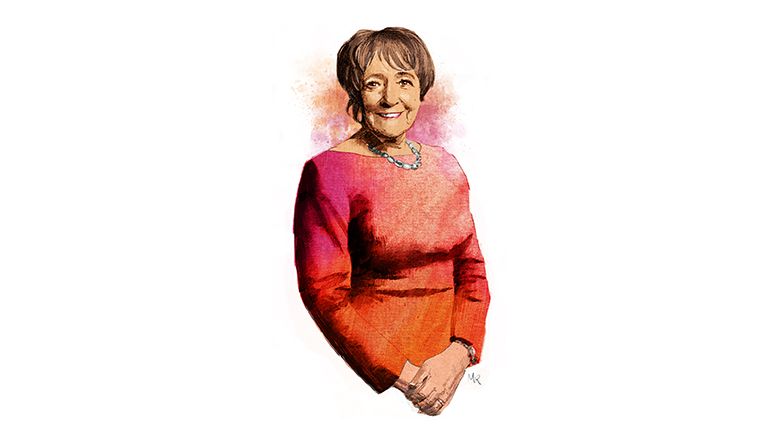
What’s your favourite book of the 21st century?
The first of a number of impossible questions you’ve asked! I’ve broken the rules and chosen three—all historical novels/nonfiction. Wolf Hall by Hilary Mantel, The Hare with Amber Eyes by Edmund de Waal and East West Street by Philippe Sands.
What’s a book that every child should read?
The Diary of Anne Frank. It is the most powerful book about what it is to be a young woman living in extreme circumstances.
Who was your idol growing up?
Nelson Mandela is the obvious answer. But I also loved Doris Lessing and Simone de Beauvoir, whose books influenced my feminism.
Do you follow any sports?
We are an Arsenal family. My husband, Henry, instilled the passion in all of us. My daughter played for Arsenal Girls, while my grandson now plays for the Arsenal Academy U12s.
The Elgin Marbles. Keep in the UK or return to Greece?
Another impossible question. On the one hand, they are clearly a beautiful part of Greece’s rich heritage and belong to them and should be returned. But the British Museum and other museums are filled with objects that one could argue should be returned to the country of origin, like Nigeria’s Benin Bronzes or the Maqdala material from Ethiopia. Denuding our museums of these objects would mean that people—not just Brits but also international visitors—would lose the opportunity to see some of the world’s greatest objects. And seeing them together in one place also helps our understanding of the history of the world. So I feel conflicted on this issue and would want to find a “third way” of enabling countries to share the objects.
Which podcasts can’t you live without?
I’m not a podcast addict, but I do listen to key political podcasts. However, my favourite is The Rest is History; I always learn something from the relaxed but informative conversation between Dominic Sandbrook and Tom Holland.
We have a new Labour prime minister. What—in brief!—would be your main piece of advice to him?
Andy Burnham has had a brilliant start; responding promptly with empathy to an eclectic range of issues that matter to people. He is using social media effectively to extend his reach. His success is reflected in the polls. So keep going on the communication strategy. The challenge will be to deliver the real change people expect in a timely way, despite the financially constrained environment. So I would urge him to focus rigorously on a few key priorities: getting more young people into education, training or employment; actually building council houses (which requires capital, not revenue); continuing the work to demonstrate that the government is in control of migration, but using his voice as PM to challenge and change the prevailing anti-immigration discourse; and bring back Sure Start, starting in those communities that we all know have been left behind.
The title and contents of your new memoir, Battleaxe, speak to your resoluteness in the face of various horrors, from the BNP to antisemitism. Do you see any examples of similar resoluteness in this parliament?
MPs are as passionate about defeating Reform as I was in the battle to defeat the BNP. Today’s MPs also feel able to use their difficult personal experiences to campaign for change. Whether it’s talking about their own mental health challenges or women opening up about everything from sexual violence to abortion, MPs pursue their campaigns using their experiences in a resolute way that would have been unconscionable when I first became an MP.
In Battleaxe, you also write movingly of your grief for your husband Henry, who died in 2009, as well as how you have learned to “cope” without him. Has culture formed any part of that process?
It has been hugely important. Playing the piano has given me much comfort and solace—hearing the wonderful tones of my reconditioned Steinway as I grapple with a Chopin nocturne is always comforting and life-enhancing.
Should opera be funded by the state?
Of course. We need to break down the uniquely British prejudice that opera is an elitist artform. In countries such as Italy and Germany culture is much more generously funded and so much more available and accessible for everybody in local communities. The city of Berlin’s annual investment in arts and culture is greater than the combined annual budgets of both the Arts Council National Portfolio programme and the Mayor of London’s entire culture programme. Opera needs more state funding, not less.
Margaret Hodge’s “Battleaxe: A Memoir” (William Collins) is out now