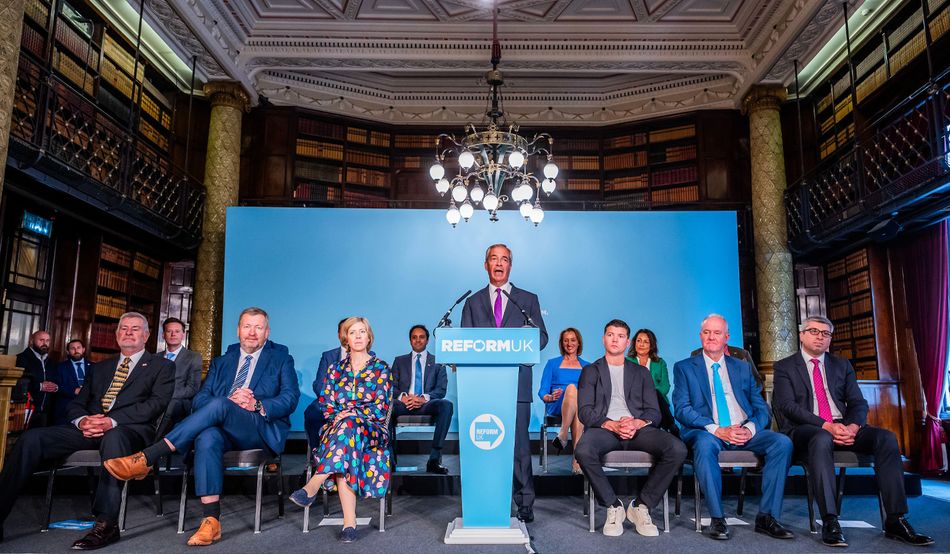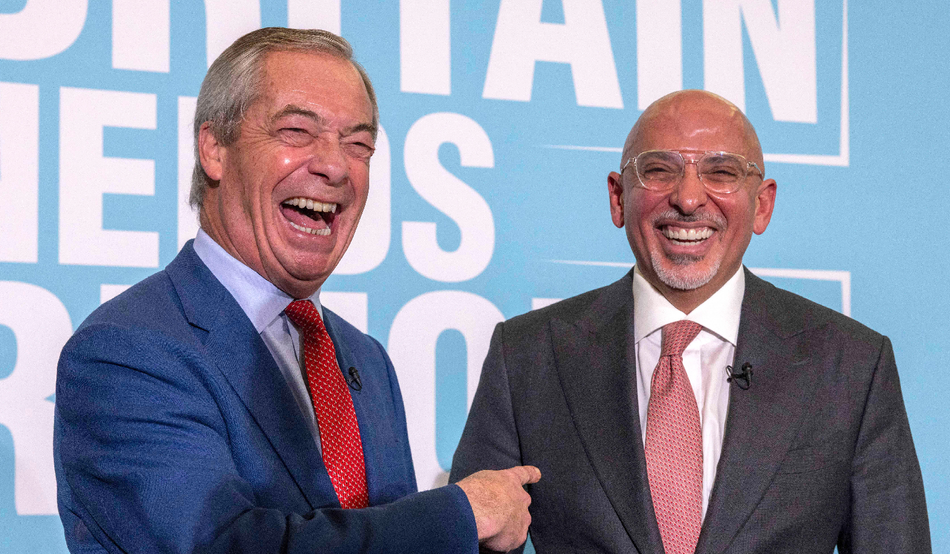
Nigel Farage is trying to inflict rapid death by defection on the Tories. Arron Banks, his longtime consigliere, boasts as much. When a critic on X said that the defection of Nadhim Zahawi this week made Reform UK look like “a dumping ground for old Tories”, Banks riposted: “So far behind the curve as usual. In order to win, Reform have to destroy the Tories or weaken them so badly they can’t compete & then take on Labour in a two horse race. Check in after the May elections!”
The suggestion implicit behind Zahawi’s defection is that association with the last Tory government is no barrier to entry. The signal, clearly directed at all sitting Tory MPs and perhaps even Kemi Badenoch’s shadow cabinet, is that all are welcome—provided they kowtow to Farage and repeat his mantra about the Tories having “broken” Britain.
So, the more Tory MP and ex-MP defectors the better. And the more senior and notorious the better, because this does the most to hasten Tory disintegration. And the sooner the better, to destroy the Tories as a serious competitor well before the next general election. At the local level, Conservative councillors and activists are all welcome too, and they have been over the past year.
This is psychology and politics in equal measure.
Psychologically, Farage is from the same stable as Trump. He, the leader, is all that really matters to the party, and all that really matters to himself. There is no meaningful internal democracy in Reform, and no question that Farage could serve in any capacity other than leader. The party is an extension of Farage’s own ego (he is now on his third party) and the more adulation the better, particularly from former opponents, provided it is unthreatening and unconditional.
Unquestioning loyalty is quite a big proviso, as a string of Farage associates who became rivals—most recently Rupert Lowe, the businessman and Reform MP who now sits as an independent—have found to their cost. But provided they know their place, defectors are not only accepted; they are the way that Farage has built up all three of his political outfits (UKip, the Brexit party and now Reform) in short order. And in all three cases, the bulk of defectors came from the Tories.
As for the politics, Farage is by upbringing and instinct a Thatcherite nationalist and an open admirer of Enoch Powell. He has been in communion with the right of the Tory party since his earliest days campaigning against immigration and the EU at the tail-end of Thatcher’s government.
Farage’s problem until recently was that the first-past-the-post electoral (FPTP) system made his desired reverse takeover of the Tory party impossible to accomplish, because he couldn’t achieve enough critical mass to elect even himself into the House of Commons against the far larger Tory party. So even Conservative MPs who admired him—particularly after his spectacular political success in the 2016 Brexit referendum—stayed put. The Tory right, and the right-wing media, also saw Boris Johnson as a more serviceable and popular Conservative version of Farage.
Now all that has changed. Boris is ancient history. Farage is an MP and Reform is polling higher than the Conservatives. Farage has also developed a near-cult following in the right-wing media, including on GB News, where he has his own show. Tory defections, which started as a trickle when Reform first took a poll lead a year ago, are now escalating into a solid flow as FPTP threatens to crown Reform and eviscerate the Tories in the next general election.
Will the flow of defections become a torrent? Arron Banks—and Farage himself—see this May’s local elections in England, and elections to the Scottish and Welsh parliaments, as a potential watershed moment when FPTP makes its effect starkly apparent in marginalising the Tories.
However, only two serving Tory MPs have as yet made the move. The Tory dam wall has been breached, but it has not yet collapsed. The next four months, before and after the May elections, could be one of most consequential periods in modern British political history.