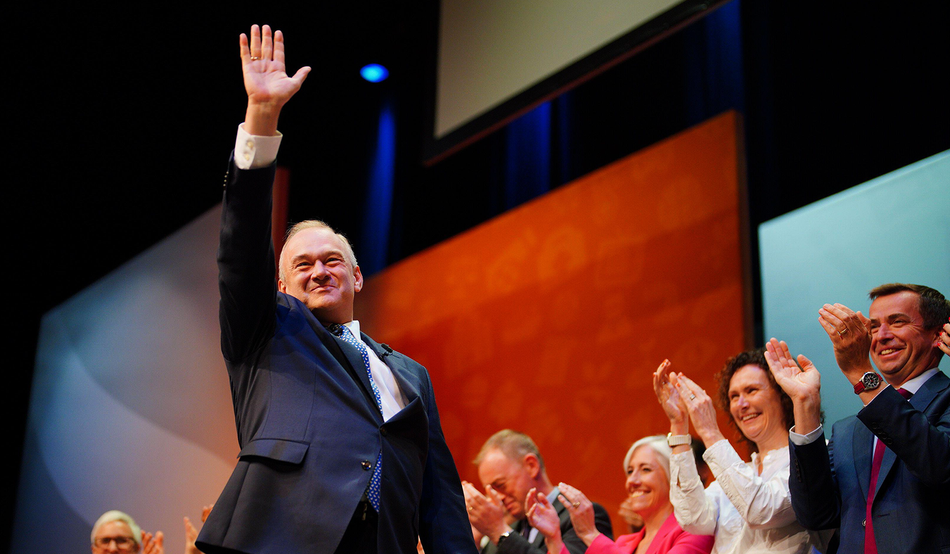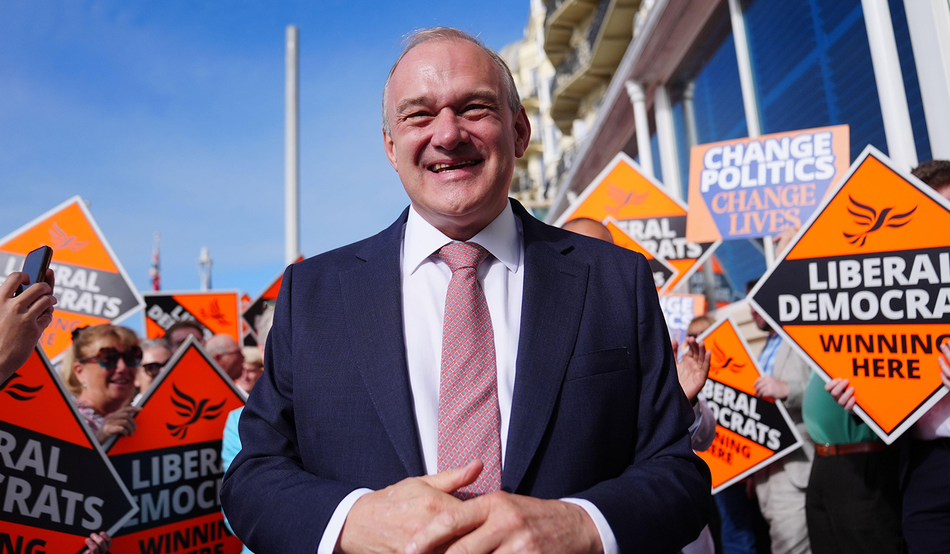
“We care. And we fight.” The message of Ed Davey’s opening speech at the Lib Dem conference in Brighton this weekend was clear enough. The party leader traced his politics back to student campaigning against apartheid and cast today’s battle against the populist right as a defence of human dignity. The Liberal Democrats knew what they were fighting against, and they wanted voters to understand what they were fighting for.
But little of that seems to be getting through to the public. More than 60 per cent of Britons do not know what the Lib Dems stand for, according to a recent report by the research agency More in Common. Through my conversations at the conference I spotted a similar tension between what the party thought it was saying, what voters were taking away, and how that all plays out with Andy Burnham now in Downing Street.
“The public don’t ordinarily understand what we represent or stand for in modern day Britain,” Duncan Dunlop, the Scottish Liberal Democrat MSP for South Scotland, told me on the sidelines of a fringe event. At the discussion organised by the Social Liberal Forum—a group campaigning to shift power from corporations and state institutions to individuals and communities— attendees wrestled with the same question. They wanted to know what exactly held Lib Dem policies together and, crucially, how to explain that to voters.
Bobby Dean, the Liberal Democrat MP for Carshalton and Wallington, offered a possible answer. Liberalism should challenge concentrated power, he said, with the state acting as “an active referee” to ensure people can exercise their freedom. He contrasted that with Labour’s emphasis on public control and public ownership.
That contrast with the Labour party also fed into the other pressing question that kept cropping up at conference: What did the party offer that was different from Burnham’s promise? It’s hard to ignore the fact that a Labour prime minister talking about devolution and political renewal competes for some of the same political ground. The More in Common report found that both the Lib Dems’ 2024 voters and the party’s current supporters held positive views of Burnham. It is an awkward position for an opposition party: your own supporters quite like the man you are trying to distinguish yourself from.
“I think we’re going to keep rowing our own boats,” Anna Sabine, the Liberal Democrat MP for Frome and East Somerset, told me. “Burnham could think about how he defines himself against liberalism instead.”
Luke Taylor, the party’s MP for Sutton and Cheam, put the distinction more bluntly: “I think Burnham talks; the Liberal Democrats would do.” He wants power dispersed further than the mayor’s office, which, to him means, councils and local communities. Sabine also said that she worried about rural communities missing out when funding follows mayoral authorities. But simply promising to be better at something Labour already favours, at least theoretically, leaves the prime minister setting the agenda.
Paul Kohler, the Liberal Democrat MP for Wimbledon, offered a different objection. He accused Burnham of hostility towards London and the southeast, and attacked a mansion tax that would penalise people who were asset-rich but cash-poor. It was easy to see how that argument might appeal in Wimbledon. Whether it would travel as easily to areas of the country other party members want to reach is less clear.
Davey’s broader public appeal was another recurring theme in my conversations with MPs. He has frequently turned to high-octane stunts to engage voters—memorably slipping down a water slide during the election campaign in 2024, the year the Lib Dems secured a record 72 MPs. Later that year he arrived at the party’s conference on a jet ski. Has he damaged his seriousness in any way, I asked Sabine, who had joined Davey on the waterslide in Somerset. The stunt had worked, she argued, but the strategy was changing. We were now seeing a “more serious, authentic Ed,” she said. Kohler was more economical: “Everything has a shelf life.”
The future of the Lib Dems takes on greater national urgency in the event the next election produces a hung parliament. According to More in Common, half of the party’s 2024 voters would be happy with a Labour–Lib Dem coalition but only 18 per cent of that election’s Conservative voters would. This is an uncomfortable finding for a party hoping to take more seats from the Conservatives while holding on to those it has already won. A push to keep Reform UK leader Nigel Farage out could pull the Liberal Democrats towards Labour. Attracting Conservative voters—and securing their lasting support—could pull them away.
The Conservatives and Reform UK may argue that a vote for the Liberal Democrats would simply become a vote for Labour in a hung parliament. Meanwhile, the Lib Dem answer has to be more convincing than asking voters to trust their local MP. What would the Liberal Democrats secure that Labour would not deliver on its own?
In Brighton, I found plenty of party members who understood the problem. They had policies, principles and a record of winning seats. What they struggled to offer was a simple account of how those things added up to a different country. Until they can, “We care. And we fight” leaves the most important question unanswered: what would change if the Lib Dems were in government once again?