SIPPs have come a long way since the first account was opened in March 1990. Initially, savers could only open these pension accounts with the help of an independent financial advisor (IFA). Over the past few decades, the market has opened up, and over the past five years, options for savers and investors have multiplied.
Much of this change is thanks to a host of disruptive fintech companies that have leveraged technology and a favourable regulatory backdrop to push costs down to the absolute minimum while maximising the range of investment options available for investors.
At the same time, the digitisation of pensions has reduced the admin required to transfer pensions and SIPPs between providers. A process that used to take a few months can now take as little as 10 days.
Taking control
Unless you have a complex pension arrangement involving assets such as commercial property, cost, flexibility, and quality of service are the three most important factors to consider when choosing a SIPP provider.
SIPPs can be far more flexible than other pension products, which particularly matters for savers close to or in retirement. Generally, most workplace pension schemes bucket investors into funds based on their target retirement age. These funds are structured to reduce the allocation to higher-volatility, riskier assets such as equity as savers approach retirement age. The main drawback of this strategy is that it doesn’t take into account each individual investor’s risk profile or other assets they may own.
Some investors may not be comfortable holding any equities later in life, while others may be content with a higher equity allocation if they have additional income streams. SIPPs offer the flexibility to do just that, with a range of options from funds, ETFs, corporate bonds and government debt.
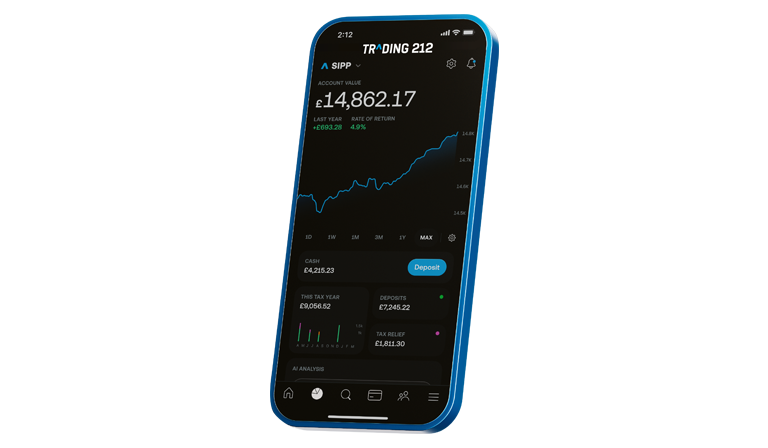
Cash interest rates are also important. Most platforms don’t offer much interest on cash held in SIPP accounts. Interactive Investor, for example—as of 23rd September—one of the UK’s largest platforms, offers only 2.3 per cent interest if you have over £100,000 in cash in your account. Trading 212, by contrast, offers 3.8 per cent (for new investors), paid daily on all cash balances within a SIPP wrapper.
Costs
The impact costs can have on long-term returns is often overlooked, but it shouldn’t be. Indeed, costs can be one of the most detrimental factors to wealth creation over the long-term, although they are one of the easiest to manage. According to Interactive Investor, a staggering 83 per cent of UK adults have no idea what they’re paying in pension fees.
There are two different fee structures: fixed (including free) and percentage-based. Percentage-based platform fees suit smaller combined balances, whereas flat annual platform fees become significantly more cost-effective as the total consolidated pot grows.
Some investors may not be comfortable holding any equities later in life, while others may be content with a higher equity allocation if they have additional income streams
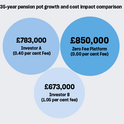
The best way to illustrate the long-term impact of costs is with an example. Two investors, A and B, start saving into a pension, investing £500 a month with a 35-year horizon. Investor A chooses a platform with total annual fees of 0.4 per cent. Investor B pays 1.05 per cent per annum,
After 35 years, investor A would end up with a pension worth £783,000, compared to investor B’s £673,000. That extra 0.65 per cent has cost investor B £110,000 extra over the 35-year period. If investor A moved to a platform with no fees, they could accumulate a pension pot of £850,000, a full £178,000 more than investor B.
Consolidation
While a lot of work has gone into streamlining the process of pension consolidation over the last decade, around 30 per cent of people who consider combining legacy pensions actually proceed according to Aviva.
There are four reasons generally cited as being behind savers’ reluctance to transfer old pots. Fear of making a mistake is at the top of the list, followed by a lack of confidence in managing the transfer process and uncertainty about how to get started. Savers also worry about losing hidden benefits.
This reluctance to switch is costing savers billions of pounds annually. Standard Life estimates there are roughly 3.3 million lost pension pots with £31.1 billion in assets. What’s more, charging structures on smaller and legacy schemes are eating away at savers’ hard-earned money. In 2022, the government moved to ban flat-fee structures on default funds of schemes used for automatic enrolment with a value of £100 or less after finding some providers were imposing fixed fees that had consumed entire pensions. Frequent job switching can result in lots of smaller pots of just a few hundred pounds. Fixed fees of £2 a month on a pot of just £300, for example, are equivalent to 8 per cent per annum, more than enough to wipe out any investment returns.
Pension platform PensionBee is one provider in the consolidation market. This platform leverages the UK Government’s Pension Tracing Service database, available to any consumer, to track down savers’ lost pots. Savers can track old pots using their full name, date of birth, and National Insurance details as well as policy numbers where available. Before starting a transfer, savers should always check for non-fee perks such as Guaranteed Annuity Rates (GARs) or protected tax-free cash allowances higher than the standard 25 per cent.
Any SIPP transfer must occur directly between providers and most providers do offer this service. The process starts with opening a new SIPP. When the transfer is initiated, the platform will manage the transfer from end-to-end, ensuring funds are tracked, securely routed, and moved without manual paperwork bottlenecks. The type of transfer will depend on the investments held within the wrapper. Cash transfers are usually completed in a few weeks, but do require the liquidation of all investments before the process begins. In-specie transfers can take a few months in the worst case scenario, but allow savers to continue to hold their investments. The one thing to watch out for here is that in-specie transfers require both the old and new platforms to offer identical investment options.
The value of investments is variable and, unless guaranteed, can go down as well as up
This article was produced in association with Trading 212