There are certain classics that only the National Theatre—or, in happier times, the RSC—could afford to produce. Several critics made this point about Summerfolk, Gorky’s 1904 ensemble response to Chekhov’s The Cherry Orchard, staged this spring in an irreverent adaptation by siblings Nina and Moses Raine.
The Cherry Orchard ends with the sound of trees being chopped down to clear land for a new generation of dachas for Russia’s emerging bourgeoisie; Gorky, within a year, wrote Summerfolk to stage the summer ennui of that newly affluent class. There are 18 named roles, plus numerous servants and groundkeepers. Given the place of plays like Summerfolk in the canon—texts that unlock a moment of theatre history, by authors overshadowed by greater contemporaries—it takes a cycle of roughly 25 years for someone at the National to decide they owe the nation a chance to see them expensively staged again. Set your watches now for revivals of Thomas Heywood and Harley Granville-Barker in the mid-2030s.
For those of us with long theatre memories, powerful nostalgia hits when these landmark productions roll round again. Some things remain constant; some do not. In 1999, when Trevor Nunn’s production of Summerfolk premiered at the National, reviews celebrated the acting relationships built over varied productions and months of work by Nunn’s repertory company, an approach that has now largely gone the way of the dodo. “This production triumphantly demonstrates the benefits of ensemble acting that the National would be foolish to squander,” wrote Michael Billington in the Guardian. It’s not just the National but most of British theatre that has since ditched rep, in favour of short productions built around the all-important availability of bankable screen stars.
I was 13 and theatre-crazy in 1999. What sticks in my memory is the lightness of Nunn’s production, a world of dappled lighting on Christopher Oram’s beech tree set, where questions of purpose and politics emerged only slowly across an indulgent summer holiday. The Nato bombing of Yugoslavia had concluded; 9/11 was yet to come; our world felt secure, proxy wars hovering only on the periphery.
Robert Hastie’s new production ramps up the tension and brings the darkness close. Unlike Gorky’s original, this version begins and ends with gunshots, the final sequence a fusillade of military fire prefiguring the 1905 and 1917 revolutions. Resentful peasants loom in the foreground, openly refusing orders. Perhaps this is a production for audiences who might not otherwise know to expect class-warfare in post-Chekhovian Russia. Perhaps this is just true to the world of 2026, where we expect to see conflict in its most overt form.
Unlike Gorky’s original, this version of ‘Summerfolk’ begins and ends with gunshots
My early adolescence coincided with a golden era for the National under Nunn: 1998 saw the premiere of Copenhagen, Michael Frayn’s brilliant play about the wartime meeting of two nuclear scientists, Niels Bohr and Werner Heisenberg. When the same director, Michael Blakemore, revived the play in 2018, I questioned why I had previously loved it. Frayn pioneered the science play, mapping out the path of atoms on his stages and painstakingly explaining their analogues to human relationships with a clarity lacked, at times, by show-offs like Stoppard. But, by 2018, he seemed to have suffered the fate of all pioneers, outstripped by successors such as Nick Payne or Lucy Kirkwood. Frayn’s perspective on Bohr’s wife Margrethe—she represents emotion; the men intellect—had aged badly.
Fortunately, the latest major British production of Copenhagen is now on at Hampstead Theatre and proves we were right to fall for this show in 1998. All we needed was a director from a younger generation (Michael Longhurst) and a knowing actress (Alex Kingston) to heighten the ironies of the Bohrs’ domestic world. Margrethe’s lines about typing and retyping Bohr’s papers get entirely new laughs in 2026.
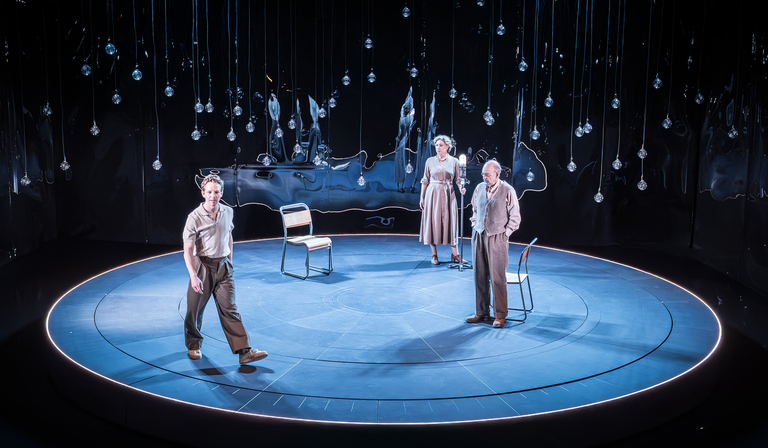
Damien Molony also refreshes the role of Heisenberg, breaking from the mould of Matthew Marsh’s terse performance in 1998 and giving us a mischievous, elfin boy-genius. Designers Neil Austin and Joanna Scotcher have done wonders with a set of pendant lightbulbs, which turn on in new combinations to indicate a molecular structure, a plot-crucial lamppost or the flotilla of small boats that led Bohr and Denmark’s Jewish population to safety across the Swedish sound. If only Richard Schiff, as Bohr, didn’t swallow Frayn’s most famous lines and leave a hole at the heart of this trio.
Like Summerfolk, Copenhagen last hit London in that era of late-1990s stability. If British theatregoers could afford calmly to debate the morality of atomic weaponry, it was because the question had never seemed more abstract, their renewed use almost unimaginable. Both plays now seem more fraught, less idly theoretical. In 25 years time, let us hope things have changed again.