Across the globe, operagoers know the ways of water. In Venice, for instance, a canal snakes behind Teatro La Fenice, lapping gently as gondole pass its canopied, gated doors. On the shores of Lake Constance, home to the Bregenz Festival, a floating stage plays host each summer to sets of epic proportion: a subsiding village (Carl Maria von Weber’s Der Freischütz), a 75-foot skeleton (Giuseppe Verdi’s Un ballo in maschera), a flurry of playing cards released into the air by a manicured pair of hands (Georges Bizet’s Carmen). Though open-air theatre is always a risky business, the threat of inclement weather can be thrilling: as in Bregenz, so in Cornwall’s cliff edge Minack Theatre, audiences look on and breathe in expectantly, attuned to what the night may bring.
Still, the relationship between this artform and the elements goes deeper. If some operas reward waterfront staging, others need no such assistance; these are operas in which we find the briny sting and crash of waves already present, from shrieking woodwind right down to the grumbling tremolo of low strings and tuned percussion. Few, perhaps, have taken to water as keenly as Richard Wagner to orchestrating its effects or to plumbing its mythic depths; with the nixies of Der Ring des Nibelungen, you might say, he struck gold. So much has been made of his ambitions to revolutionise musical drama in practical terms that it would be easy to forget he believed no less strongly in the words he used to sound it out. Writing in 1849 of “The Art-Work of the Future”, Wagner was insistent: “We cannot yet give up our simile of the Ocean, for picturing Tone’s nature. […] Man dives into this sea; only to give himself once more, refreshed and radiant, to the light of day.”
The dawn of Wagner’s mature work was beckoned not by Rhinemaidens, but by Der fliegende Holländer. Inspired by his readings in folkloric literature, and stricken, too, by a rocky voyage along the Norwegian coast, he set to with The Flying Dutchman in 1840. From its very beginning, you might apprehend a conflicting vision, acutely so in Welsh National Opera’s new production. Launching into the territory of a tone poem, the overture places us at once in stormy waters, as though abandoned to the elements. Yet the promise of navigation is immediately felt: here, with conductor Tomáš Hanus at the tiller, melodic units erupt in the churning musical texture, twisting or jumping into leitmotifs that will accrue importance as the story gets underway.
It is a haunted—and haunting—opera, energised at every turn by this conflict: although the title character seems doomed to wander a boundless, ungovernable sea, that same sea is understood always to be just within reach of those who sing of it and to it. Trystan Llŷr Griffiths, in the part of the misty-eyed Steersman, perfectly embodies this push and pull as he’s consigned to the night-watch on deck. “Mit Gewitter und Sturm aus fernem Meer” (“Through thunder and storm, from distant seas”) is a song of longing, not obstructed but vitally heightened by the environment that keeps the lover from his lass; it is a double invocation, for the Steersman is addressing both his absent beloved and the “dear south wind” that will speed his passage home.
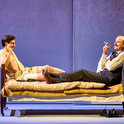
Here a towering masthead, there a ravaged hull, productions of the past have often been designed to throw the human drama into perspective. Not so in Cardiff, and come the interval, there were mutterings. This is a production stripped back to all but a metal-framed bed, some oil drums and a scattering of chairs; in the place of a ship we have the male chorus assuming a prow-like formation, headed by the merchant Daland (a silver-bearded James Creswell).
“We wanted this to be a show about people and ideas rather than things,” director Jack Furness has said, and most of the time the minimalist approach is achieved to telling effect. Melting in and out of sea fog, the principals otherwise have nowhere to hide; the focus rather falls on instances of intimacy and estrangement, in one case beautifully realised as Senta (Rachel Nicholls) steps into the orbit of the Dutchman (Simon Bailey), only to turn her head and place an ear to his heaving chest.
Melting in and out of sea fog, the principals otherwise have nowhere to hide...
Such minutely drawn moments are subtly highlighted by designer Elin Steele’s littoral palette. A whirling flash of red, first seen during the overture in which Senta is born, gathers its own motivic logic in the fabric of the piece; having noticed its residue later in the seascape backdrop, I was reminded of the American musicologist Carolyn Abbate’s characterisation of the opera’s coherence: a “jostling” and not yet fully integrated structure, in which “certain beads are streaked with spots of identical color”.
Among the more jostling of scenes, in the Cardiff production, are the chorus numbers in which individuals find themselves crowded by a mob of one kind or another. Senta sits motionless, otherworldly, at the start of Act II, more or less encircled by the village’s women, fashioning their yarns.
Then again in Act III, in a setpiece that has the air of a flarelit rave, we see characters periodically sucked into the proceedings. The Steersman tries it on with a couple of young women; when that fails, he turns to a fellow sailor (a sailor with whom we might have noticed him exchanging a queer look in Act I) for a brash snog. Though glad to be ashore, the assembled party do somehow appear all at sea. And in the end, that must be chief among the achievements of a production that veers so strikingly between accident and calculation, whirling chaos and lyric control: in this murky, impressionistic hinterland, where does the sea end and its myths begin?
For all its echoes of Wagner’s opera—the darning, the drinking, the saltiness of intimate relations—Benjamin Britten’s Peter Grimes (1945) signals a point of departure from the Romantic voyage of discovery. Where The Flying Dutchman’s mob falls apart almost as quickly as it got its act together, the inhabitants of the seaside Borough are lingering and intractable, as set in their ways as surely as they’re set apart from the title character. He, too, sticks to his line, or else refuses to engage: when Grimes finds himself in the dock, accused of mistreating an apprentice, he lashes out at “interferers”, and then misses the chance—or passes on it?—to confirm some hearsay presented in his “favour”. Phyllida Lloyd’s production of this queasy, end-of-the-war opera is 20 years old this year, yet its fitness for revival by Opera North, and for reviving our curiosity in closed communities, is unmistakable.
Gathered to a point and suspended from above, an immense fishing net spreads across the Lowry’s stage; inside this taggy circus tent, buttressed by several poles, day-to-day business of various kinds plays out. It’s one of the crafty ways in which Anthony Ward’s design contrives to group and segregate: even as it enmeshes those who sing and gossip together, the net visibly keeps the outsiders out, but not in such a way as to spare them the leaking of rumour. Later, we see the community differently configured—in the pub run by Auntie (Hilary Summers) and her brilliantly vulgar nieces (Nazan Fikret and Ava Dodd)—this time simply achieved with the tessellation of some heavyduty palettes.
And yet, in another sense, nothing is achieved simply in this opera, which slips between orchestral interlude, church and pub ensemble and numbers as exquisitely envisioned as Grimes’s “Now the Great Bear and Pleiades” (sung here with sensitivity by John Findon). The tragedy of the stargazing Grimes is that he believes he can see things others can’t (“I can see / The shoals to which the rest are blind”). But it is a misperception; at least, it would be a mistake to suppose that the opera simply boils down to him and them, the visionary and the close-minded. For there are characters here—Philippa Boyle’s Ellen and Simon Bailey’s Balstrode, each of them impeccably controlled—who pass between those poles, hopeful until the very last that ways can be mended. To see them poring over the latest incriminating evidence—an embroidered jumper, washed up without a body—is to speculate, and crucially not to know, whether this will be the turning of the tide.
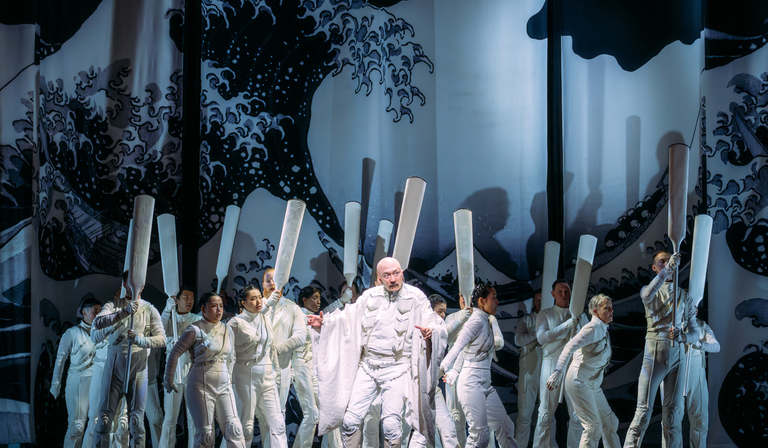
The sonority of a lonesome tuba rises from the depths of The Flying Dutchman, and it returns in Peter Grimes. Its passage from one opera to another might prompt us to wonder at the challenge of writing differently about the sea. A response of sorts has arrived with The Great Wave, a world premiere at Scottish Opera, in coproduction with Kajimoto. Instantly, you sense, we’re in different territory: a hayaoke coffin sits on stage, attended by mourners, and the shakuhachi (a longitudinal flute) punctuates a texture of shimmering strings. This is the end of an artist’s life—Katsushika Hokusai’s—seen through the eyes of Ōi, his no less talented daughter; and it is the beginning of a story that will rewind in time to the clap of a thunderstorm. It is the story of the making of the world’s most famous seascape: The Great Wave off Kanagawa.
‘Hokusai is a bit of a misfit, but he’s a beautiful misfit’
The idea came to composer Dai Fujikura in 2017, like a strike of proverbial lightning, but it took a global pandemic to bring things into focus. Virtual working and Covid inspectors populate the tale Fujikura and librettist Harry Ross now tell of their creative journey, and though these have no visible place in the final piece, The Great Wave does speak to the patient making of art by one who knew, by ones who know. “Grimes and Dutchman are both about misfits,” Ross tells me. “We like opera about misfits, don’t we? Hokusai is a bit of a misfit, but he’s a beautiful misfit. He sees his creativity as a gift that just needs sharing. He’s not this tortured soul.”
Strong performances from Daisuke Ohyama (Hokusai) and Julieth Lozano Rolong (Ōi) provide The Great Wave with a shifting centre of gravity. In a gently iconoclastic way, we see then the creation of an icon from different points of view and through different dramatic techniques. Digital projections play their part in the spectacle, as so often these days, but the opera is most compelling when classically conceived: the ripple of water effects through white sheets; costuming transformed, as though tinted by the all-important Prussian Blue pigment; the weaving flight of dragon and tiger puppets in a climactic dream sequence.
In its blending of song, dance and visual art—opera at its most collaborative, its most dynamic—The Great Wave joins a tradition that’s not ebbing away, but decidedly on the move.
Welsh National Opera’s production of The Flying Dutchman is touring the UK until 15th May