On the train to Zurich I read a piece in the Times predicting that arts subjects will soon disappear from state schools altogether and will end up the preserve of private schools alone.
There’s been a dramatic drop-off in teacher training in arts subjects. Dozens of music and creative arts courses have been slashed. “The cull,” wrote Richard Morrison, “could now become a full-scale slaughter.”
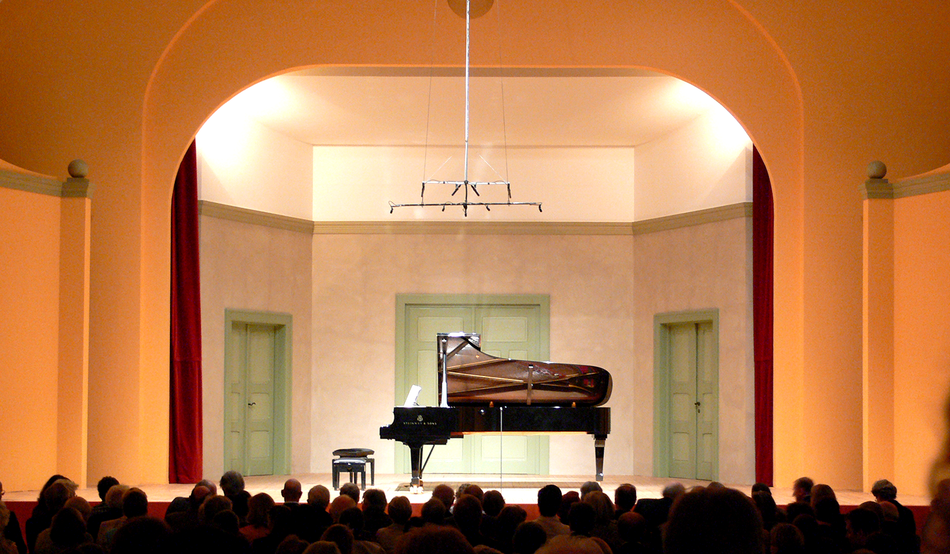
We were travelling to this year’s Schubertiade, the smallscale but world-class festival held each year in the villages of Hohenems and Schwarzenberg in the western tip of Austria. It is celebrating its 50th birthday this year: a half century of glorious chamber music and singing by some of the best musicians on the planet.
Some people carp that it has become something of a museum for the preservation of the canon of music composed between, roughly, 1700 and 1900. But reading Morrison’s piece as we sped through the French countryside, I thought, well, maybe soon we will need such museums for this music. Maybe this is repertoire which needs to be maintained, interpreted, conserved—occasionally extended—but no longer replenished at anything like the rate or cultural centrality it once enjoyed.
So it was in a mellow frame of mind that I sat down the first evening to hear the sublime Romanian-German baritone Konstantin Krimmel perform a medley of Schubert songs, along with Schumann’s Dichterliebe with the Israeli-South African pianist Ammiel Bushakevitz.
In addition to an effortless tone, Krimmel has a natural stage presence. A white, untucked shirt and black trousers. A few hand gestures, but only a few. An expressive use of his eyes to convey wonder, grief, despair, jealousy or humour. Bushakevitz was a sensitive partner, blossoming in the extraordinary solos that dovetail many of the Schumann songs.
The following evening it was Elisabeth Leonskaja with six Schubert pieces, including the penultimate sonata, D 959. She is far from a museum piece, though; at 80, she is one of the last links with a school of Russian conservatoire teaching from the post-war years. Her performance of the late sonata was magisterial—as you might expect from someone who studied and played with Sviatoslav Richter and who has lived with these pieces for longer than the Schubertiade itself has existed.
A programme of piano trios followed, with Veronika Eberle, Julia Hagen and Lukas Sternath. Sternath is a very powerful player indeed and, to my ears, rather overwhelmed Hagen’s subtle cello tones at times. But the Shostakovich trio, op 8, was delightful.
The revelation was the remarkable piano playing of Middleton
Next up was the Austrian mezzo Sophie Rennert, singing Winterreise with the British pianist Joseph Middleton. Rennert took a little while to settle in, but was, overall, totally convincing in a song cycle that is still mainly the preserve of male singers. But, for me, the revelation was the remarkable piano playing of Middleton, who has performed this piece maybe a hundred times. Everything about his approach—the tone, phrasing, attention to detail—felt assured and fresh.
In a way, the last concert we heard—a medley of two- and four-voice-part songs by Schubert—felt truest to the original mission of the festival. These are, if you like, museum pieces—belonging to a now largely vanished world of informal semi-private drawing room music-making. It would be a brave promoter to try and find an audience for these works in most concert halls around the world. In Schwarzenberg, a full house roared and stamped their appreciation and demanded more.
The following morning, I strolled up the road past the concert hall to meet a budding young architect, Julius Häusler. The Bregenzerwald region of Austria is an intoxicating mixture of mountains and meadows—and buildings that blend the traditional with the modern.
The 33-year-old greeted me at the door of his airy and exquisite open-plan office on the first floor of a family home which seems, from the outside, just like any of the other shingle-clad farmhouses (often incorporating cow barns) in the area.
He padded around this modernist space in a T-shirt and barefoot, delighted that I almost walked past the building without noticing that it was different as well as the same.
Julius talked about how architects and local craftsmen have come together to create something new out of old ways of living and building. How much is preservation and how much is reinvention?
The Schubertiade enters its next 50 years asking a similar question. Is it a form of heritage art: a mix of conservation, reconstruction and reinterpretation? Lieder, like Noh, Kabuki or various forms of puppetry, might increasingly depend on institutions that celebrate the canon. Or can the festival evolve into a form of repertoire art blending interpretation, rediscovery and new creation?
Driving back to Zurich train station, our car was jolted to a standstill by a freak hailstorm that shattered the windscreens of hundreds of cars. All of that Schubert certainly helped mitigate the misery of being stranded by the side of the motorway for two hours. The healing power of music.