One of the very few iron laws of politics was laid down by Ronald Syme in his great work of ancient history, The Roman Revolution (1939): “In all ages, whatever the form and name of government, be it monarchy, republic, or democracy, an oligarchy lurks behind the façade.”
In the award-winning Oligarchy (2011), Jeffrey Winters, a political science professor at Northwestern University, Illinois, established himself as the contemporary laureate of rule by the few. That book now sits comfortably alongside James Burnham’s The Machiavellians (1943), C Wright Mills’s The Power Elite (1956) and G William Domhoff’s Who Rules America? (1967), together with shorter texts such as CS Lewis’s classic 1944 lecture “The Inner Ring”.
In his excellent follow-up, The Blind Spot, Winters insists first upon precision of language. Oligarchy, in his eyes, is not the same as the influence of elites, discreet global networks of the mighty or the rule of the administrative state, but refers specifically to “a distinct group… empowered by wealth ranging from familiar figures like George Soros to recluses like Timothy Mellon”.
More radically, he argues that the very idea of democracy challenging oligarchy is not only naive but the opposite of the truth. The lethal talent of the very rich has been an enduring capacity to engineer representative politics to their advantage.
“[T]he inability of modern democracy to address wealth inequality is not a flaw,” Winters writes. “The failure is by design.” To be clear: “The rich dominate us not despite democracy but through it.”
In practice, our politics is sharply divided into “vertical” and “horizontal” contests. In the past decade, the latter has taken the form of a three-way scrap between the populist right, technocratic social democracy and the woke left. But what Winters shows is that this is but a sideshow to the “vertical” story.
The objective of the very rich is to steer the democratic gaze away from the scandalous imbalance of wealth and power between themselves and the rest—the core “vertical” issue—and towards everything else: public service provision; fiscal and economic policy for those who play by the rules; law and order; culture wars; and so on. The primary objective of the system is to “keep the masses focused on each other rather than looking upward”.
The eponymous blind spot, therefore, is “our belief that democracy, as it currently stands, will give us the change we need. What we fail to see is that we live in a peculiar system that combines democracy with oligarchy: we have equal political power as voters, but our votes must contend with the unequal wealth power of oligarchs that is also built into the system.”
There is a sinister ingenuity to this situation: “Extreme inequality is not just imposed on us. We participate actively in its imposition.” What Winters characterises as “domination by democracy” is also, he concedes, “by far the most elegant mode of exclusion ever created”.
In the post-Cold War era, the reflex response of the Davos class and those whose bible is the Financial Times has been to dismiss any reproaches directed at the super-rich as the “politics of envy” or economically illiterate, undermining the very wealth creation that subsidises employment, welfare, education and public health. In a speech in Silicon Valley in 1998, Peter Mandelson spoke specifically for New Labour, but also for this broader consensus, when he said: “We are intensely relaxed about people getting filthy rich, as long as they pay their taxes.”
As Winters shows, this account of the social contract is no longer remotely defensible—if indeed it ever was. For a start, tax evasion has now reached stratospheric levels: in the United States, the Internal Revenue Service (IRS) estimates that the “tax gap”—the difference between what it assesses to be due and what it actually collects—was $696bn for 2022; more than the combined 2024 budgets of the State Department, Department of Homeland Security, Department of Education and Department of the Treasury.
Though Winters focuses upon the US, a useful British comparison is HMRC’s estimated tax gap of £47bn for 2023–24: more than the total allocated spending for the Home Office, Ministry of Justice, Cabinet Office and Department for Culture, Media and Sport.
Wealthy Americans live 10 to 15 years longer than their poorer compatriots
The deeper pathology is one of grotesque structural inequality. In ancient Rome, the top 600 oligarchs were, on average, 16,000 times wealthier than ordinary people in the empire. According to the Forbes list, the equivalent proportion for the US in 2024 was 136,000. Wealthy Americans live 10 to 15 years longer than their poorer compatriots. Globally, the top 1 per cent lives almost a quarter century longer than the four billion people in the bottom half.
The narrative heart of The Blind Spot is the story of how this came about and—more to the point—how the rich get away with it. In the 250th anniversary year of US independence, it will be painful for Americans who believe in equality of opportunity to read the chapter on the 1787 constitutional convention in Philadelphia, at which Alexander Hamilton conspired to give the rich a “permanent share in the government” in the Senate and to “check the unsteadiness” of the masses.
By this reckoning, the US Constitution was not only an elaboration of the Declaration of Independence but a restraint upon the original text’s authentically democratic potential. This was the basis of an insidious pattern that persists to this day.
Perhaps the most striking episode that Winters describes is the remarkable work of IRS investigator Richard Jaffe, who, thanks to a gumshoe intelligence operation, got hold in 1973 of the secret client list of Castle Bank in the Bahamas. On the trail of mob and drug cartel money, what he found was a facility for many prominent American public figures—Hyatt Hotel billionaire Abram N Pritzker, Henry Ford II, Hugh Hefner, automotive tycoon Lee Iacocca, the actor Tony Curtis—to stash their money where the government couldn’t see it.
No less astonishing was the speed with which the establishment moved to cover it up. In May 1973, Richard Nixon appointed Donald Alexander, a tax lawyer, to head the IRS. Even before he was sworn in, the new boss insisted upon removing the checkbox on the tax return form indicating whether the declarant had any foreign accounts—on the absurd pretext that it took up too much space.
After slashing the service’s intelligence budget, Alexander went after the agents who had done such remarkable work on behalf of the US taxpayer—including Jaffe, who faced a series of inquiries, relegation to desk work and a loss of pension rights. In less than four years at the helm of the IRS, Alexander was able to quash all but one of the 483 criminal tax cases against US oligarchs that were in pre-trial preparation.
In the same decade, what Winters calls the “Wealth Defense Industry” was built by a series of ruthless legal pioneers, notably Burton Kanter and Harry Margolis, whose knowledge of the tax code was second to none. There were and still are three key elements to the industry’s operations: complexity (ensure that your clients’ money is buried in such arcane, multilayered structures that it will take years to track down); secrecy (lobby government relentlessly to ensure that the privacy of oligarchs trumps transparency); and infiltration (embed tax lawyers in key government departments).
As Winters shows, since September 11 this industry has proven especially creative in its nimble response to national security measures that give federal authorities greater powers of financial investigation. Its current instrument of choice is the “large partnership”, a private agreement between multiple parties that can metastasise into an arrangement so complex that it is virtually impenetrable. These structures enjoy a 99.95 per cent chance of beating any attempt by the IRS to detect anything untoward—or even to complete its investigative work.
As detailed and data-driven as The Blind Spot is, it is much more than a history of tax evasion. It sheds disturbing light upon a political and social landscape that is underpinned by a lie, and which prioritises the accumulation of wealth and the impunity of the super-rich over fairness and public accountability to an extent that is now positively dangerous, as well as grossly inequitable.
In this respect, The Blind Spot is an indispensable guide to the new world in which Elon Musk aspires to be the first trillionaire; Palantir chairman Peter Thiel tours the world giving lectures on why Greta Thunberg may be the antichrist; and venture capitalist Marc Andreessen, a key member of Trump’s transition team at Mar-a-Lago, boasts to the podcaster Joe Rogan that an AI coding agent or bot, unlike a human employee, “never gets drunk, never gets sick, never gets high” and never files “HR complaints”.
As a counter-strategy, Winter proposes a “politics of preparation” that begins with basic steps—unionisation in readiness for AI-driven layoffs; radical simplification of tax codes; regulation to enforce financial transparency; much stronger revenue agencies; meaningful reform of campaign finance—as a prelude to more audacious measures.
I doubt he will find many takers for his suggestion that the election of our representatives is now so contaminated that it should be replaced with selection by lottery. The least persuasive claim in the book is that “our sense of being represented is grounded too much in the expressive act of choosing itself rather than in the results it produces for us from government”. It is precisely this “expressive act” that continues to bind the public—just—to the democratic system.
To be fair to Winters, however, he does not pretend that his prescriptions are definitive. His greater (and irreproachable) objective is to make the reader alert to the scale of the problem and quite how much is at stake.
The reckless visibility of today’s oligarchy is ‘a harbinger of its vulnerability’
And there is all to play for. The reckless visibility of today’s oligarchy is, as he writes, “a harbinger of its vulnerability”. Even as the public’s fixation with the “Epstein class” grows, tycoons have lost the habit of discretion, engaging instead in theatrical contests to conquer and privatise outer space; swaggering wildly on social media (which they own); and entangling themselves very publicly with the populist right.
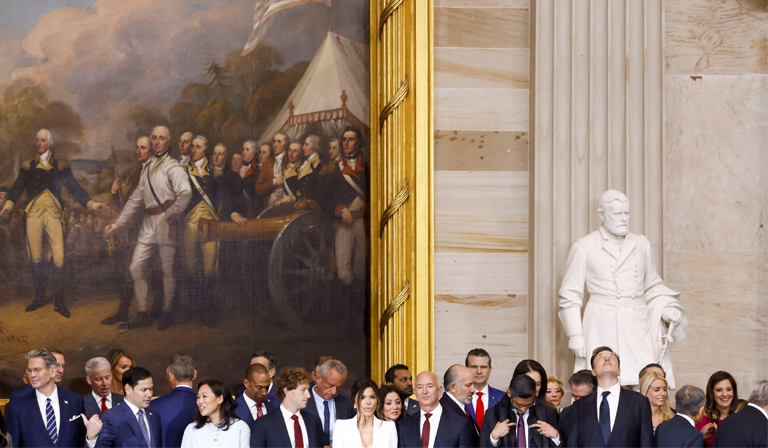
Remember that brazen gang of plutocrats at Trump’s inauguration last year? There they all were: Musk (of course); Mark Zuckerberg, the chairman of Meta; Sam Altman, CEO of OpenAI; Jeff Bezos, the founder of Amazon; Sundar Pichai, CEO of Google, and Sergey Brin, its cofounder.
There will be other presidents, other inaugurations. The question is whether the oligarchs will still be standing alongside them, their ferocious accrual of power unchecked. The point of The Blind Spot is that it need not be so, that democracies free of delusion could thwart their relentless march. We need only have eyes to see.