John le Carré’s spy novels have long been adapted and embellished by others. The intelligence officer-turned-author’s books, which present an anti-James Bond vision of espionage as unglamourous, amoral and destructive, are literarily ambitious plot-driven thrillers—an enticing prospect for any would-be director.
Although it’s noticeable that the extended le Carré universe has expanded at an especially rapid rate since 2011. That year saw the release of the film adaptation of Tinker Tailor Soldier Spy, in which Gary Oldman starred as the writer’s most famous protagonist, the ageing British spymaster George Smiley, who unmasks a traitor working for the USSR.
In 2016, the BBC released its adaptation of The Night Manager, starring Tom Hiddleston and Olivia Colman, with le Carré himself as an executive producer. Based on the author’s first post-Cold War novel, it helped bring le Carré’s storytelling genius to a new audience, for whom the Soviet threat was already a distant memory. It was, for the BBC, a return to form in adapting le Carré’s work, having produced two legendary TV series in the late 1970s and early 1980s in which Alec Guinness set the standard for on-screen portrayals of Smiley.
(Whether something similar can be said of the second season of The Night Manager, which launched at the start of this year, is as yet uncertain—it concludes on 1st February. But so far, in necessarily going beyond the novel exhausted in the first season, it is cinematically gripping yet increasingly more Hollywood than the author’s original material.)
Oldman then starred in the very le Carré-esque TV series Slow Horses, which even borrows his invented spy lingo such as “Moscow rules” and “joes”. And there’s even more to come: HBO Max is reportedly developing a series based on several of le Carré’s novels, under the leadership of Slow Horses producer Graham Yost and starring Succession’s Matthew MacFadyen as Smiley.
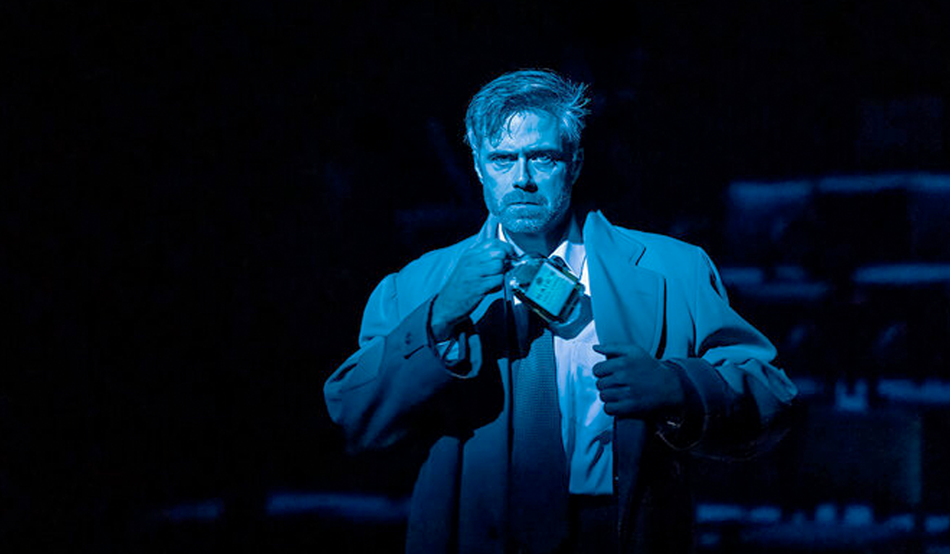
There was a glaring omission in the list of le Carré adaptions, however: his work had never been staged. Until now, that is: first in a soldout run in Chichester and now at Soho Place in London, playwright David Eldridge has brought Le Carré’s breakout hit The Spy Who Came in from the Cold to the theatre. It’s a good choice—and not just because so many other recent adaptations have focused on his later work. It also suits the moment.
The defining theme of le Carré’s work is the moral ambiguity of espionage, and thus of western diplomacy. But an important shift occurs part-way through Smiley’s timeline. Whereas The Spy Who Came in from the Cold shows Smiley (and, through him, Britain’s intelligence apparatus) making unpalatable moral compromises, the subsequent books leaven his character by letting his more decent qualities shine through. Despite knowing his capacity for cruelty, one cannot help but admire the flabby and understated protagonist; much as Gary Oldman’s foul-mouthed, flatulent Jackson Lamb in Slow Horses is ultimately redeemed by his paternal feelings for his muck-up underlings.
As Sam Adler-Bell has noted, paraphrasing Slavoj Žižek, le Carré’s Smiley is perhaps more effective propaganda for Western intelligence agencies than Ian Fleming’s Bond ever was, since le Carré’s gritty realism is more believable yet ultimately still redemptive. Smiley is endearingly fallible and steadfastly loyal—one of the traits le Carré values most of all, having been dismayed by the real-life British double agents known as the “Cambridge Five”. Smiley may be a ruthless bastard, but he is our ruthless bastard.
After various geopolitical ructions, the faith many had placed in Western alliances has been shaken
But after various geopolitical ructions—Israel’s genocide in Gaza and western governments’ flaccid response to it; the United States’s seizure of Venezuelan president Nicolás Maduro and Britain’s effective acquiescence to it; Donald Trump’s neocolonial threats against Greenland, signalling Nato’s obsolescence—the tacit faith many had placed in Western intelligence and the alliances on which it is premised has been shaken. Spooks, diplomats, home affairs ministers... most do not feel deserving of redemption right now. Circling back to le Carré’s unflinching rendering of postwar skullduggery, in The Spy Who Came in from the Cold, feels concordant with the present mood.
In the play’s dramatic conclusion, the moral corruption underpinning Smiley’s ploys is laid bare. He has manufactured a crisis to protect double agent Hans-Dieter Mundt, who is feeding information to Britain from inside the Soviet security establishment. Mundt, however, happens to be an unreconstructed Nazi, who opportunistically became an East German Stasi agent after the war. Presumably, he finds common cause with the British in the fight against the communism that now surrounds him. But Mundt’s flagrant antisemitism, delivered onstage with chilling venom, drives the moral compromise home. This man is a monster. Does it really matter if he is our monster?
We learn in le Carré’s 2017 novel A Legacy of Spies, which revisits the events of The Spy Who Came in from the Cold via a present-day historical lawsuit, precisely how Mundt was captured and “turned” by Smiley—and that the latter felt squeamish about it. “Control”, Smiley’s boss, was the true enthusiast of the plan. But many theatregoers will view Smiley without this context and without exculpation—as they should. The show’s protagonist, Alec Leamas, who initially reveres Smiley as a sage, is literally haunted by his betrayal—as the elder spy hovers over him from Soho Place’s overhanging second-floor balconies.
Doddering onto the stage muttering something about the ends justifying the means in the play’s final moments, Smiley’s words land not as a shrewd assessment of realpolitik but an unconvincing excuse. Perhaps even to himself.