In a prisoner-of-war camp in western Ukraine, a former miner from the east is being interviewed about how he ended up fighting for Russia. His speech is slurred and one arm paralysed: the results not of combat injuries but of two strokes. His hands are scarred from years of work in illegal and extremely dangerous coal mines. From 2014, his town was in the lawless zone of the “Donetsk People’s Republic” (DPR), a breakaway territory rife with criminality and run by Moscow-installed leaders.
Two days before the full-scale invasion of Ukraine on 24th February 2022, he was among the many mine workers mobilised and sent, barely trained, to join the Russian invasion, he tells the researcher sitting opposite him. He’d shown officials his disability documentation, and they’d ignored it.
His son was also a miner, also conscripted, taken right off the street. He survived just two months in the Russian army. The father was allowed home to bury his son, then taken straight back to the front. He had one stroke, then another, but this didn’t spare him.
“What kind of soldier could you be like that?” the researcher asks.
“For meat, what else?” he replies.
This man’s story is not unusual. Nor is his bitter cynicism about the way men from the Donetsk and Luhansk regions—often referred to as Donbas—were used by the Russians. His prison sentence, too, is standard: 15 years for high treason against Ukraine. He hopes to be sent by Kyiv to Russia, where his daughter lives, as part of a prisoner exchange. But from there he aims to make it back to the occupied and wartorn part of Donbas he calls home.
The researcher asks what he’ll do when he gets there. “Honestly?” he says, and flicks the side of his neck in answer. Drink.
“I understand,” the young woman replies. “Because of what you saw and lived through? Or because of grief?” He begins to sob. The interview concludes.
In war, as a rule, neither side publicly reveals how many prisoners it has, just as neither side ever really admits how many soldiers it has lost. Over the past four years, prisoners have periodically been swapped between Russia and Ukraine, hundreds at a time, and Ukraine says more than 10,000 Russian soldiers have surrendered since 2022. They’re held in POW camps in undisclosed locations, though foreign media has often been allowed to tour a large camp near Lviv.
The Ukrainian authorities are keen to demonstrate that they hold their prisoners in accordance with international law: decent food, no abuse, adherence to the strict rules around publicity. Interviews with POWs cannot be conducted under duress and cannot be used to humiliate the prisoners; they must be protected from “insults and public curiosity”, according to the Third Geneva Convention of 1949. These are all standards to which Russia absolutely does not adhere: the stories from the Ukrainian prisoners who make it out are uniformly horrifying. A recent Human Rights Watch report notes the systematic “physical and psychological torture” they face.
This disparity illustrates the moral and legal conundrum facing Ukrainians: the need to maintain exacting international standards—to uphold the laws and norms which govern armed conflicts—when the enemy upholds none of them. The writer and disinformation expert Peter Pomerantsev calls it the “agony of human rights”: it is painful to constantly consider the rights of the enemy when stories appear every day of unspeakable abuse in Russian captivity, and when Russian missiles, aerial bombs and drones deliberately destroy blocks of flats and hospitals in Ukraine, night after night.
That agony is particularly acute for researchers coming face to face with prisoners who are, like them, Ukrainian, but who fought as part of the army which invaded Ukraine: the conscripts and volunteers from the occupied east.
Are they traitors or victims? Compatriots or foreign enemies?
With war correspondent Janine di Giovanni, Pomerantsev founded The Reckoning Project (TRP): an international NGO which trains journalists to document war crimes to a legal standard, so that the evidence can be used in prosecutions. The NGO’s researchers have interviewed about 50 men held in Ukrainian POW camps—and Prospect has been given exclusive access to some of these testimonies. They tell a complicated story: lives shaped by poverty and propaganda, by occupation and war. Are they traitors or victims, compatriots or foreign enemies?
“He will join the front again,” says Inna Kubai, the researcher who took the testimony of the grieving miner. She describes the process: a man is sent to Russia in a prisoner exchange, interrogated by Russia’s domestic intelligence service, the FSB, and if he is physically able, he is sent back to the front line.
“You feel empathy because you realise how hard life has been, how difficult that work is. You also understand that Russia squeezed so much out of these people, and will continue using them as cannon fodder. Russia doesn’t care.”
Kubai previously documented some of the worst crimes committed by Russian forces—she spent two weeks talking to survivors in Bucha, close to Kyiv, after the town’s liberation in March 2022. More than 450 civilians were massacred there. Corpses lined the streets, their hands bound. Women and girls had been raped. Later she gathered testimonies from Izium in the northeast, and worked on stories from Mariupol, on the sea of Azov, which endured a three-month siege and has been occupied since May 2022. As a result, Kubai is well acquainted with stories of what Russian soldiers do to Ukrainians. But often she’d hear that it wasn’t the Russians that people were most scared of.
“Whenever I asked locals ‘Who treated you the worst?’… I was surprised that they said it was the DPR people who were most brutal,” she said.
When The Reckoning Project began to investigate forced mobilisation in the occupied territories, Kubai found herself entering a POW camp with huge trepidation. Could the men she was about to meet have been responsible for some of the atrocities she’d documented? Could she keep her cool, or would contempt, even hatred, overtake her?
Another researcher, Nataliia Sirobab, was similarly conflicted on her first visit to the camp. On the journey there, she pointed out the city cemetery to her colleague. “I said that whenever I’m talking to the POWs I’ll see these images of growing cemeteries in Ukraine, and I will probably see enemies in their faces, nothing more.” But once you’re in the room, you “see a human being”, Sirobab says. “You start thinking, how do I engage this person? How do I establish contact?”
Kubai’s curiosity about their lives and the psychological factors involved in their decisions stands out. “Did they have a choice? It’s a question that still bothers me,” she reflects, talking over video call from western Ukraine.
“Maybe yes—you always have a choice. But human beings always choose the easiest path. If you’re used to something, if you’re over 30 years old, you don’t change. You just go with the flow… Did they have a chance to escape? To change their life? Yes. Did they want this? Probably not.”
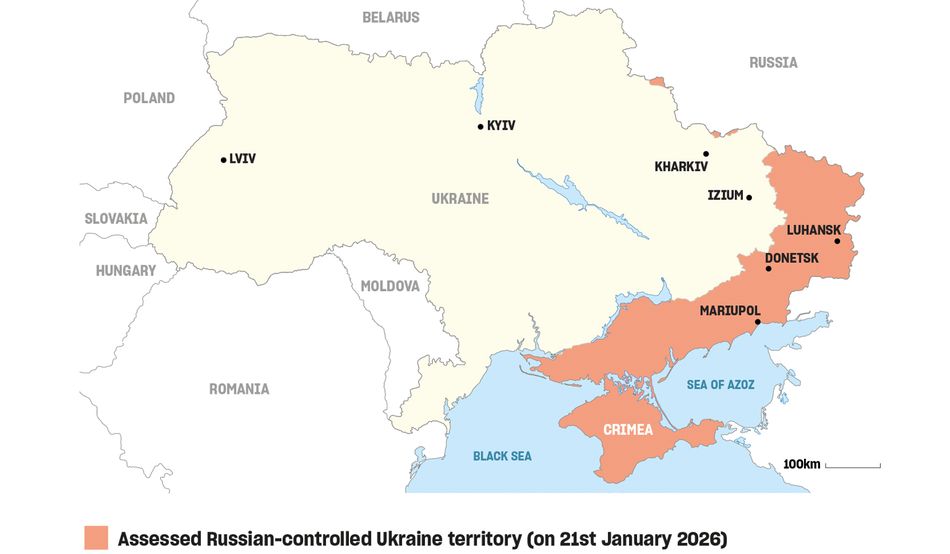
The mass conscription of Ukrainians in the occupied territories—not just Luhansk and Donetsk, but the southeast and Crimea too—has been well documented, but estimates of the numbers vary: Dmytro Usov, secretary of Ukraine’s Coordination Headquarters for the Treatment of Prisoners of War, said 46,000 were forcibly conscripted, while the Eastern Human Rights Group, an NGO which documents human rights violations in the occupied territories, gave the total number mobilised as 300,000. The latter figure would include those who went voluntarily. Usov recently revealed that 16 per cent of POWs held in Ukraine are from the occupied territories, indicating that they form a considerable chunk of Russian forces.
Some of the men interviewed are clearly victims of forced mobilisation into the Russian army, and their testimonies are therefore evidence of a war crime: Article 51 of the Fourth Geneva Convention prohibits conscription of inhabitants by an occupying power.
In one account, a truck mechanic from the city of Donetsk describes what happened when he was told to appear at the military enlistment office, just before the 2022 full-scale invasion.
“We thought, all right, like responsible citizens, we’ll show up so they stop bothering us,” he said. He too had an exemption on health grounds. “We walked in, the door clicked shut behind us and from the other side they pushed us straight into a bus.”
He quickly found himself in the role of platoon commander. The researcher asked what gear they were given before deployment.
“I swear, there was no body armour, and the helmets were from the 1945 model,” he replied—they were made of steel. He was later captured near the city of Bakhmut, having taken part in hostilities around Kharkiv and Horlivka. He was awaiting trial at the time of the interview, but expected to receive the standard 15-year sentence for treason.
A young man, who had previously worked as an electrician, recalled an advert broadcast on TV back in 2014: “Join the DPR forces to defend the country.” He was still a schoolboy at the time. Ten years later, in 2024, he felt he couldn’t escape the Russian military any longer: “They began rounding people up from all over the city—from stores, from bars, they even went apartment to apartment… I thought, ‘They’re going to come for me anyway,’ so I went to the military enlistment office.
“I would’ve been found anyway, walking down the street,” he insisted. “Why hide from the army?”
At the enlistment office, he said, he and others were “locked in a room” and then transported by bus to another town. Within a matter of days, and with absolutely no training, the new recruits were sent into combat in the southeast, he said. He escaped after 13 days, was caught, and escaped again. He got back to his hometown for a while, but was caught there too—when his wife broke her leg, he took her to hospital and was spotted. The Russian military took him straight from the hospital back to the front.
“Did you ever think about refusing to serve, trying to avoid service?” asked the researcher.
“Nobody asked me if I wanted to [serve],” he replied. “They just took me, drove me away, and after that… You can’t run.”
Similar stories recur throughout the testimonies. A former security guard from the Donetsk region told interviewers: “They basically dragged me in by force… Drove us to a meatpacking plant, gave us weapons, sent us to guard the position.” He considered going Awol, but thought better of it: “Where would I run? And to have them chasing me all the time…”
It wasn’t just miners and mechanics who were rounded up and forced to fight: the testimonies include a witness to the conscription of students—some taken from their dormitories directly to the enlistment office. Kubai interviewed a young man, now studying in Germany, over the phone, and he described the time he spent hiding indoors, trying to avoid the draft: “It felt like the commissars were everywhere, almost in the stairwell.”
All the musicians at the Donetsk Philharmonic Society were mobilised, he told her; this is confirmed by subsequent reporting, which details how they were sent to Mariupol during the siege. At factories, “they just took the whole shift”. And then there were his classmates who didn’t escape.
“Ilya was a pacifist,” the student said. “I don’t mean pro-Ukrainian or pro-Russian, just a pure pacifist who refused to take up arms. But due to the mobilisation he ended up there against his will. He was turned into a so-called ‘DPR Hero’—even though he never wanted that role.”
These accounts of forced mobilisation raise a difficult question—one often voiced by POWs themselves in the interviews: Why are they being prosecuted if they had no choice?
“The law doesn’t discriminate, whether you were mobilised as a miner or whether you are a volunteer for the Russian army,” Kubai says. “This imperfect system equalises all of the people, and I don’t think it’s right.”
It’s an issue raised by the UN Human Rights Office too, which noted that the courts should consider intent when trying someone for the crime of high treason. And it’s part of a larger argument in Ukraine about how to deal with collaborators. These POWs are prosecuted under Article III of the Ukrainian Criminal Code; an amendment to this law, hastily passed in March 2022, has been used to sentence thousands of Ukrainians for collaborating with occupying authorities, drawing heavy criticism from civil society and human rights groups.
The treason charge can seem particularly counterintuitive, given the Ukrainian government has prosecuted commanders and commissars for conscripting men in this way; there have been several in absentia convictions in Crimea and Luhansk.
Much is made of the fact that forcible conscription is a Russian war crime—one in a very long list. But arguably, in prosecuting the victims of this crime, the government undermines its own argument—and sends a mixed message to conscripts who may wish to surrender. Ukraine’s Ministry of Justice and Dmytro Lubinets, the human rights ombudsman, didn’t respond to requests for comment.
Benjamin Farley, an international lawyer and academic who has worked on the issue of foreign fighters, agrees that there could be a “fundamental unfairness” in prosecuting those who were forced to fight: “My hope is that, at the very least, demonstrating compelled service would form a substantial duress basis or be a strongly mitigating factor.” However, he adds, “You can imagine it from the perspective of the Ukrainian government, faced with thousands of these cases. If everyone claims they were compelled, and some volunteered, there’s a real challenge there. And a real threat to the state.”
Kareem Asfari, legal analyst for The Reckoning Project, echoes this point. “The degree to which the conscriptions are ‘forcible’ is questionable,” he says. “TRP researchers have found a number of Ukrainian nationals whose participation was voluntary. This is not to rule out that some will have been forcibly conscripted.”
He’s right: though some testimonies describe forced conscription, other POWs appeared willing to join up. Of the 12 cases Prospect had access to, the only interviewee with a clear pro-Ukrainian position was the student in Germany; the rest largely identified with Donbas rather than either Russia or Ukraine. Several echoed Kremlin propaganda lines, blaming the war on nefarious global elites and western “imperialism”. Some were in it for the salary, or to “defend Donbas” against perceived Ukrainian attack. What is evident in every case is that the messy reality of identity, allegiance, propaganda and economic hardship in eastern Ukraine simply does not align to the neat categories we might want to apply.
“What I find quite frustrating is this argument of ‘Oh well, they’re all pro-Russian,’ or an argument that goes: ‘cut them and they bleed blue and yellow,’” says Jade McGlynn, academic at King’s College London and author of Russia’s War. “I find it really simplistic because the conditions in the occupied territories are really just ones of various interlocking forms of entrapment.”
From sweeping up men in forced mobilisations to militarising children and instilling Russian nationalism, Moscow has created a dystopian and deeply colonial regime in the occupied territories. It’s estimated that there are tens of thousands of prisoners—not just POWs but civilians arrested for speaking out against the occupation or merely holding pro-Ukrainian views. Abduction and torture are widespread. In such conditions, it seems reasonable to ask what choice or agency people really have when it comes to “collaborating” or even fighting.
Rarely in life are individuals entirely blameless or guilty, good or bad. Reading the POW testimonies, you can feel sympathy for the man weeping over his broken life, the loss of his son, his bleak future; you can perhaps bear in mind the context of occupation and coercion. But another context is impossible to ignore: the war crimes and atrocities committed by the Russian army in Ukraine and especially, it is thought, by the Donetsk and Luhansk recruits.
Kubai recalls that people living in Kharkiv region told her, after it was liberated, that “DPR people were the most brutal”. McGlynn found the same in her research. “They all hated the men from the DPR and LPR [Luhansk People’s Republic] most of all… because they said they were the most brutal, or because they felt a special form of betrayal.”
Given the scale of atrocities and looting committed by the invading Russian army, it is likely some of the POWs now held by Ukraine took part in, or at least knew of, these crimes. In the interviews, they all claim innocence. A young father of two who served as a contract soldier in the DPR and then the Russian military, earning around £1,700 a month, said he didn’t see any civilians being mistreated. “I did not notice anything, I was in a security battalion, we guarded facilities, that’s all,” he said. It’s barely credible; he was a machine gunner.
The closest any of the men get to admitting civilians were harmed is in the testimony of a man who fought in Mariupol. “I heard the guys talking about stuff, but I didn’t see it myself,” one said. They did take civilian property, he admitted—“but only if they had weapons or something”.
Asking if they had killed someone would be “very naive”, Kubai says. “Of course they would say, ‘No, I was only helping, I was only carrying the ammo, I was only digging trenches.’”
Much of what the prisoners say is impossible to verify—a problem for the justice system too, if the mitigating factors Farley describes are ever introduced to these treason cases. And judging guilt is made more complicated by the shifting picture of power and control in eastern Ukraine over the past 12 years: many of the POWs joined the so-called “DPR People’s Militia” back in 2014, when the Russian-backed separatists—terrorists, from the Ukrainian perspective—seized control in the cities of Donetsk and Luhansk regions. After the 2022 invasion, Putin declared the annexation of not just these areas, but Zaporizhzhia and Kherson too, despite the fact that Russia didn’t fully control any of these territories. The DPR militias were subsumed into the Russian army and, in Moscow’s eyes, the territory was Russian.
“They attacked Ukraine, occupied territory, set up a puppet regime that is a nullity in international law. And then had the puppet regime ask to be annexed, and the Russians, under their domestic law, annexed them,” says Farley. “It’s a chain of plausible legal steps to paper over an illegality. But fundamentally, it’s illegal.”
Therefore, conscription in the occupied territories remains illegal, whatever the Kremlin says—a grave breach of the Fourth Geneva Convention. That fact doesn’t necessarily help those who are compelled to take Russian passports and often, as McGlynn puts it, “feeling abandoned by all sides”. Enlisting them to fight against Ukraine means “putting desperate people in an impossible situation”, Farley notes. “This is exactly why this type of conduct has been prohibited for at least 130 years.”
Some of the POWs realised Russia ‘only needed them for cannon fodder’
The long history of Russian propaganda is part of this story too, and not just the line that Kyiv is run by a neo-nazi junta. Several of the POWs interviewed by The Reckoning Project insisted that they were defending their homeland, Donbas, from genocide, from an onslaught of “fascists”, or from the entire western world. Allegations that Kyiv has committed a genocide against the residents of eastern Ukraine are baseless, but have been relentlessly promoted by Russian media and state TV, and were the “justifications” given by Russia for killing tens of thousands of Ukrainian civilians in an invasion which many argue is itself genocidal. Kubai and Sirobab had to listen to these men trot out such lines again and again.
“It brought me back to reality,” says Kubai. She’d been caught up in their stories, especially the miners—“their eyes lit up when they talked about mining”—and she saw them as diligent, responsible, hard workers. But as soon as they started putting blame onto Ukraine and denying their own guilt, she felt differently. “Being a good worker doesn’t make you a saint. Being a diligent worker doesn’t absolve you from the crimes you committed,” she says.
The testimony of the former security guard vividly demonstrates the power of that propaganda, and how fragile the reasoning is when it’s probed. In the interview, he’s asked why he first joined the DPR militia, back in 2014.
“To defend Donbas.”
“From whom?”
“From those who attacked.”
“Who attacked?”
“Honestly? I didn’t see.”
He ended up being conscripted by force in 2022: pulled off a bus in Donetsk and sent to positions without training. Full of contempt for Russian commanders and their tactics, he nevertheless maintained Russian justifications of its occupation.
Russia, Sirobab points out, “has been targeting these people in particular”—cultivating through propaganda a sense of grievance, and a hatred of Ukraine, for many years—“so they could fight against their own citizens with extreme brutality”.
Some of the POWs realised Russia “only needed them for cannon fodder”, Sirobab adds, and “changed their attitude towards Ukraine”. But in general, she struggles to see them as fellow countrymen. “I think people see them for who they are: murderers, who killed citizens of Ukraine.”
This is a common view in Ukraine; with the war raging on, it’s fair to say sympathy for any “enemy” soldier, whatever their origin, is limited.
Kubai, though, is resolute: “They are definitely not Russians. Despite what they did, I still saw a difference between them and Russians… They thought in Ukrainian categories, they could remember certain Ukrainian things that Russians never know.
“They are my compatriots who, for an extended period of time, were in occupation, in isolation, brainwashed by propaganda… To resist this is very difficult. And they didn’t manage.”
She was surprised, she adds, that she didn’t feel hatred towards them—the hatred you might expect to feel towards an enemy as the fourth year of war grinds on. But it wasn’t there.
“I’m just trying to get to the essence of their life. And I realised that it’s a tragedy.”