China’s president, Xi Jinping, likes to assert that the world is undergoing “changes unseen in one hundred years”. He borrowed the phrase from a Chinese political scientist named Yuan Peng, who first articulated it when Chinese analysts began to see serious flaws in the western economic model after the 2008 financial crisis, though Yang may himself have borrowed it from the late Henry Kissinger.
In a later book, Yuan reflected on the decay of an era that began with the Peace of Westphalia in 1648, which defined the nation state and the power relations between them. The next phase in global politics, he argued, was being defined by the shift of economic power eastwards—and with it, the capacity to shape world affairs. Xi’s favoured phrase, therefore, is also shorthand for the rise of the China and the relative decline of the United States, and since 2017 the Chinese premier has embraced it as the foundation of his global diplomacy.
That diplomacy has been highly visible in recent weeks, when he has embarked on a series of set-piece trips that contrast his own leadership with that of an increasingly embattled Donald Trump. China is at pains to treat fellow leaders with courtesy and respect, and to promise to share with them the benefits of its own successes in trade and advanced technologies. The mission is to offer an attractive alternative to the image of a violent, disruptive and declining superpower led by a president who is given to humiliating visiting heads of state.
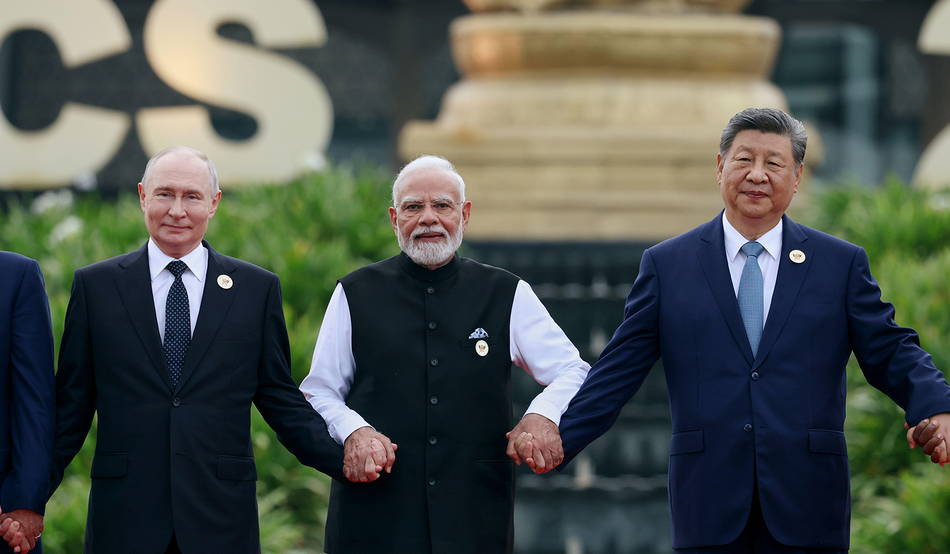
This approach is yielding benefits, with Xi showcasing China’s central role in a growing list of international meetings and processes. Last weekend, he completed his first visit to India in seven years to attend the 18th Brics summit, shortly after attending the gathering of the Shanghai Cooperation Organisation (SCO) in Bishkek, Kyrgyzstan, on 31st August. Both forums have expanded their memberships lately—Brics now represents 40 per cent of the global economy.
These organisations have no binding collective foreign policy or expectation that they will act as a bloc, and their interests can diverge sharply. The UAE, for example, which hosts US bases, came under retaliatory attack from Iran just days before the Brics leaders’ meeting, and on 19th August announced that it had halted all trade and financial transactions with Iran until further notice. Both countries supported the Brics call for de-escalation of tensions. The summit last weekend managed to squeeze out only a bland exhortation in favour of peace in the Middle East, while avoiding assigning blame for the lack of it, after its meeting of the foreign ministers in May failed to agree a joint statement.
The lack of strategic alignment in the Brics should not be taken as evidence that it is a meaningless entity. It is one of a series of institutions and relationships that China uses to stake its claim to leadership of the majority world. In this narrative, the west has historically exploited and slighted the Global South and China is leading a historic global rebalancing.
The claim is bolstered with practical measures, including the approval of billions of dollars in infrastructure and development projects by the New Development Bank, formally launched by the Brics in 2014. Many of these projects are in precisely the countries of the Global South that China argues have been unfairly neglected by the existing multilateral development banks.
In the same spirit, Brics has promoted practical initiatives between its members aimed at reducing the influence of the US dollar, such as easier cross-border payments, resilient supply chains and more trade in national currencies, or supporting China’s push to reform global institutions such as the International Monetary Fund. In a week resonant with dire warnings about the dangers of AI, Xi told the Brics summit on Sunday that China will initiate the creation of a Brics open-source AI ecosystem, disseminating Chinese AI models at low or no cost, and support cooperation on the development and application of large language models, hold AI seminars and training courses, and build an open artificial intelligence ecosystem.
Xi has been building influence in the Global South ever since he came to power in late 2012. As president he has visited more than 70 countries, beginning with Russia—still his most frequent destination and evidence of his close relationship with Vladimir Putin. But that same year he also visited Tanzania, South Africa and Congo, in an early sign of China’s determination to build leadership in the Global South. He attended and co-chaired the Forum on China Africa Cooperation (FOCAC) in Johannesburg in 2015 and subsequently hosted more than 50 African leaders in Beijing during FOCAC summits in 2018 and 2024.
Similarly, early visits to Brazil, Argentina, Venezuela and Cuba, Ecuador, Chile and Peru established a pattern of interest in Latin America that has helped to build a strong Chinese position in the US backyard.
Trump, in contrast, has never visited Africa and has rarely entertained African leaders in Washington. He has only visited Latin America once as president, attending the G20 meeting in Buenos Aires in December 2018, and recently despatched secretary of state Marco Rubio in a belated attempt to counter Chinese influence in the region.
China’s active participation in multilateral organisations such as the G20, the Asean Economic Community, SCO and Brics, and its continuing support for the United Nations and its agencies, allows Xi to appear as a steady, reliable player and, increasingly, a peer competitor with Trump. And in the series of organisations that China has founded and cultivated, including Brics and SCO, the exclusion of western powers leaves Xi centre stage.
Xi is expected to meet Trump twice before the end of the year—first at a bilateral summit on 24th September, when the Chinese premier will bring a large business delegation to Washington, and again in December when the US hosts the G20 summit in Miami. Since the start of Trump’s second term, China has weathered the worst of the president’s tariffs and forced the US to a standstill through its control of rare earth and strategic mineral supplies, and is widely considered to be a close competitor with the US on AI.
It is a clear sign of Chinese confidence that it reportedly threatened to cancel the Washington summit if the US were to approve new arms sales to Taiwan. (In May, after Trump’s visit to Beijing, the US paused $14bn of planned arms sales to the island nation, citing the material demands of its war with Iran.)
Xi could be justified in thinking that a US president bogged down in a pointless war and tanking in opinion polls needs the summit more than he does, and China can afford to play hardball over Taiwan. That does not indicate that Xi is ready for a military assault on Taiwan, but it is one sign among many that, for the US, the game has got significantly harder.