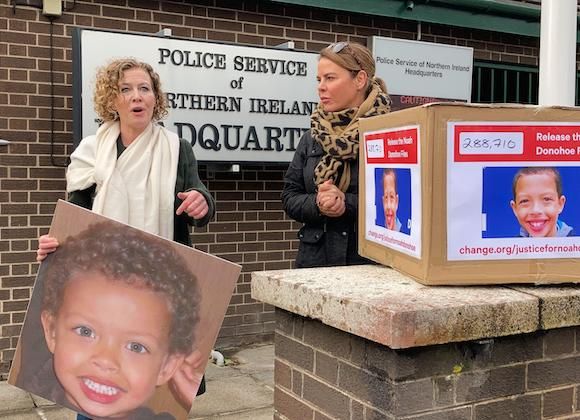
On 21st June 2020, 14-year-old Noah Donohoe took off on his bike, leaving his home in south Belfast to make a short trip across the city centre to meet his friends. When he didn’t return home, his mother, Fiona, reported him missing to the Police Service of Northern Ireland (PSNI). But it would be another six days before Noah’s naked body was discovered in a storm drain, in an area of his home city that he was unfamiliar with.
Over the past two years, his family’s grief has been compounded with anger over the bizarre decisions taken by the police following Noah’s death. An internal PSNI review into his disappearance revealed that police chiefs refused to pay overtime to officers assigned to the search investigation, citing “financial constraints” and, bizarrely, “missing person fatigue.” One veteran police officer in Northern Ireland described Noah’s disappearance as “the most unusual missing person case” they’d encountered in a 30-year career—even though cases of missing black and mixed race children often remain unsolved.
Noah’s case is one example of repeated failings by police in cases of missing black young people in the UK, including Harvey Parker, Richard Okhoghere and, most recently, Blessing Olusegun. Several Metropolitan Police officers working on Richard Okhoghere’s case were recently handed misconduct notices after they were found to have failed to pass on “new and relevant information” of his whereabouts. His mother, Evidence Joel, later said she was treated as a “nuisance” by police, and that when her son was first reported missing, the authorities “did nothing.” A study published last year by the charity Missing People revealed “patterns of discrimination” and “racial bias” in cases where young people of colour had gone missing (data from the National Crime Agency found black people accounted for 14 per cent of missing people in England and Wales between 2019 and 2020, over four times their relative population). Even in Northern Ireland, where young people go missing with worrying regularity (around 30 people are reported missing to the PSNI every day across the region), 80 per cent of those reported are found within 24 hours.
“At the beginning we were expected just to sit down like good wee girls and grieve, and to trust the police, trust the legal system, trust the coroner. If we’d done that I don’t know what would have happened.”
“He was our nephew and we adored him,” says Noah’s aunt Niamh. “And we’ll never stop fighting. One thing I’m sure of is that regardless of what we’re up against we’ll get justice for him.”
Despite their grief, Fiona and Niamh have campaigned tirelessly for answers on what exactly happened to Noah in the six days he was missing, and why his body was found without his clothes or bike (in 2020 the police released a theory that the teenager had suffered a head injury while cycling, causing him to abandon the bicycle and his clothes). Their grassroots campaign has grown, and is known as “Noah’s Army.”
In the past few weeks, Fiona has met with local politicians to exert more pressure on police. She is doing so due to the controversial decision by the PSNI to push for a Public Interest Immunity (PII) certificate on some material currently held in evidence, which would allow the police to withhold information from the inquest into Noah’s case scheduled for 28th November this year. PII certificates are relatively rare in British policing, generally only reserved for criminal law against large organised criminal outfits and drug dealers where the identity of paid police informants could be at risk.
“We were just brushed under the carpet,” says Niamh. “At the beginning we were expected just to sit down like good wee girls and grieve, and to trust the police, trust the legal system, trust the coroner. If we’d done that I don’t know what would have happened.”
Last month Fiona began working with Change.org on a petition to release police files into Noah’s investigation, which quickly gained thousands of signatures. “My son, Noah Donohoe was an intelligent, smart, gentle boy. He was 14 years old and he was my only child and my everything,” Fiona wrote, questioning why police chose to announce a remarkably quick verdict of “no foul play” on the day her son’s body was discovered. “I believe that someone harmed my Noah and that there have been serious and repeated failings in the police investigation of his death. I will never get justice for Noah if I do not get all the information.”
As we get closer to the two-year anniversary of Noah’s death, the Donohoe family’s petition continues to gain traction: it currently has just over 300,000 signatures from across the country. “It was one of the fastest growing petitions the week that it was started,” says Honor Barber from Change.org. “A petition reaching over 300,000 signatures isn’t common—it’s a clear indication of just how many people across the UK and Ireland support the family and want to see justice for Noah.”