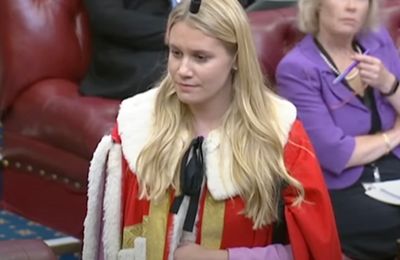
Since Matthew Doyle lost his job in charge of comms at Downing Street nine months ago there hasn’t exactly been a stampede to snap him up. The main offer of paid employment appears to have been a part-time role with the Malta Film Commission.
But Doyle needn’t lose much sleep about having to log on for Jobseeker’s Allowance. Just before Christmas, Keir Starmer announced that Doyle would henceforth be afforded a perch on the plump red seats in the upper chamber. Doyle is 50, so he’s looking at maybe 30 years of making, amending and passing laws for the rest of us with a daily attendance allowance of £371. Nice work if you can get it.
There may be some who regard the early months of Starmer’s time at Number 10 as a triumph of communications. A more general view is that the messaging was a bit of a shambles, and in March last year Doyle was shown the door. You might almost call his subsequent peerage a reward for failure.
Actually, it feels rather more cynical than that.
It was a little over three years ago that Keir Starmer was promising to do away with the House of Lords altogether as part of his plans to restore trust in politics. In November 2022 he told Labour peers of his revulsion at the way Boris Johnson had been appointing “lackeys and donors” to the upper House.
You may remember the row at the time over Johnson’s decision to elevate two backroom advisers, Ross Kempsell, 30, and Charlotte Owen, 29. Well, it would all be different with Starmer, or so he promised. He said in his first term he would strip politicians of the power to make appointments to the second chamber. And then he would move to abolish the Lords altogether, replacing it with a new elected chamber.
And here we are, tottering into 2026 with the prospect of Lord Doyle.
If the name is unfamiliar, it will be because Matthew Doyle is something of a blank sheet of paper. His LinkedIn profile records a 27-year career in spin and communications. He works in the shadows. There is virtually no public record of what he himself thinks or believes about anything.
“He’s very good at repeating ‘lines to take’,” says one former Labour party colleague. Another former Labour colleague agrees: “He’s really not very competent. His entire capacity is the ability to receive a line and repeat it.”
No fewer than three colleagues from his time in the Labour press operation before the 2005 election described Doyle to me as a serial bully. “I don’t think I’ve ever worked with someone less pleasant or less collegiate,” said one. On at least one occasion, I was told, his behaviour was reported to the senior leadership in the party. Doyle says he is surprised to hear of such claims and asserts that he never had an allegation of bullying investigated or upheld.
After leaving politics, Doyle founded and ran his own advisory company, MLD Advisory Ltd, for nearly nine years. There is no public record of who his clients were.
There was a six-month spell during which he advised the Commonwealth Secretariat. Challenged by a BBC journalist about the apparently lucrative fees (£15k a month) he was charging, he denied them. The Guido Fawkes website duly published a copy of his contract, which showed initial payments of at least £15k a month. Doyle says the average payment was lower.
And then, in July 2021, he took his spinning skills back into the Labour party as executive director of communications. He briefly broke into public view when it was claimed that he had been briefing against the Labour MP Rosie Duffield. He denied it. The Guido Fawkes website duly produced a recording of him apparently doing so. Doyle says he had no intention of briefing against her and disputes that he did.
Ms Duffield announced she would be leaving Labour to sit as an independent MP, citing the “sleazy, grubby, sexist boys’ club” that the party had become under its then management.
Last Sunday, we learned that No 10 nominated Doyle for a peerage despite having investigated his continued support for Sean Morton, a former Labour councillor in Moray, northeast Scotland, after the candidate was charged with possessing and distributing indecent images of children in December 2016. Morton later admitted to crimes, including possession of several pictures of naked girls as young as ten.
Despite the charges, Doyle campaigned for Morton when he ran as an independent candidate in local elections, knocking on doors wearing a T-shirt with the slogan “Re-elect Sean Morton”. Doyle says he now regrets supporting Morton.
None of this appears to be an obstacle to him taking his seat in the Lords. To Starmer, it seems to be a pragmatic question of maths. Under the preposterous system he once pledged to abolish, his Tory predecessors showered peerages around like confetti. David Cameron appointed 245 peers during his time in office; Boris Johnson, 87; Theresa May, 43; Rishi Sunak, 51; and Liz Truss, 29, despite being prime minister for just 49 days.
The result of all this incontinent patronage was that, before the recent Doyle cohort, the Conservatives had 282 peers, compared with Labour’s 209 and the Liberal Democrats’ 75. There are 177 cross-benchers and 40 non-affiliated peers. A bill to remove 91 hereditary peers is currently going through parliament, yet we are still lumbered with the second largest legislative chamber after China’s National People’s Congress.
So the cynical case for ennobling Matthew Doyle is that—in a deeply flawed, if not actually corrupt system—he will unquestioningly show up in the voting lobby and thereby redress the historically rigged numbers. It doesn’t matter that most of us could, off the top of our heads, name a dozen more worthy legislators. That’s not the point of him. He’s not there to have a value: he’s there to vote.
The pattern keeps repeating. More than a century ago Asquith, and then Lloyd George, threatened to swamp the House of Lords with new appointments in order to neuter a stacked upper House. Clement Attlee changed the rules, Blair banished most of the hereditaries and flooded the House with a further 374 peers. Still, the place lumbers on as an affront to any idea of accountability or democracy.
Since everyone can see the threadbare nature of what’s going on, wouldn’t it have been better for Starmer to signal these appointments for what they are? He could have said, “I still believe this place is rotten and I will hold to my word to abolish it and replace it with a chamber that has democratic legitimacy. But in the short term, I need the votes to redress an unfair system.”
In other words, bunging Matthew Doyle a peerage is squalid, but it has to be done.
But Starmer, being Starmer, didn’t say any of that. As a result the ennoblement of Matthew Doyle simply looks squalid.
If only he had someone to give him good comms advice…