Let’s be optimistic for once. After 17 months of alarming freakery, the international order appears to be settling back to roughly where it was when Donald Trump and his Maga hordes reoccupied Washington.
The G7 leaders of the west, including Trump, met collegially this week, at a summit in the French lakeside resort of Évian-les-Bains, just as they have in different locations almost every year since 1975. There was no empty US chair or serious destabilisation. And none of the other G7 member states has yet succumbed to government by the populist hard right, despite at times outrageous interventions by Trump, his deputy JD Vance and Maga more generally. Over the past 17 months reassuringly mainstream new leaders have taken power and/or won re-election in Canada, Germany and Japan, while Giorgia Meloni of Italy has sided with European allies on all that matters.
The G7’s two big subjects were a peace deal with Iran to return the Middle East to roughly the position it was in before Trump and Benjamin Netanyahu’s mass aerial bombing campaign this year in Iran; and how to keep imperial Russia at bay after four years of its invasion and partial occupation of Ukraine, the extent of which has barely changed despite Trump’s attempted appeasement of Vladimir Putin. Volodymyr Zelensky was present, but of course Putin was not (Russia was expelled from what was then the G8 in 2014 over the annexation of Crimea).
The Nato alliance remains intact, including more than 80,000 American military staff located in Europe, despite Trump’s threats of withdrawal. Greenland remains uninvaded. The open international trading system has also survived Trump’s tariffs, which—touch wood—have been contained and stopped oscillating wildly week-by-week. Relations with China remain tense but orderly, and Taiwan, too, remains uninvaded.
Meanwhile, Trump’s tentative deal with the terrorist regime in Tehran looks to be a repeat of Barack Obama’s deal of 2015 for slow learners—that is, sanctions relief in return for verifiable restrictions on Iran’s nuclear programme. If there was a moment when Trump seriously contemplated a ground invasion of strategic locations in Iran, egged on by Netanyahu, it appears to have passed.
In Ukraine, meanwhile, Zelensky remains resourceful and resilient while Putin is unable to annex more than about a fifth of the country. There is still no opening to an early peace, but nor—despite Trump’s intermittent hostility to Zelensky—is there likely to be a Ukrainian collapse. On the contrary, European aid to Kyiv has now largely replaced US support, while Ukraine is making modest advances against a massively over-extended Russia. Putin may rue the day he didn’t seize on Trump’s appeasement manoeuvres last year to bring about a ceasefire on now-defunct battle-lines.
Israel remains an especially unstable piece of the Trump jigsaw. At different times, egged on by pro-Netanyahu relations and advisers, the US president has given the Israeli military free rein in Gaza, the West Bank, Iran and Lebanon. In each case, as the belligerent Israeli leader has dangerously over-reached, an exasperated Trump has sought to pull him back, in conjunction with Arab neighbours, to prevent a complete regional breakdown. Putting an end to Israel’s latest invasion of southern Lebanon will be critical to any stable Trump deal on Iran.
Internationally, if Iran is settled from Trump’s perspective, where does he go next? He has all but said it’s Cuba. With the current secretary of state, the Cuban-American Marco Rubio, in the driving seat, it will probably be a repeat of the leadership decapitation strategy the US deployed in Venezuela. No one beyond the Americas will be much affected by that, for good or ill, and whatever the legality of such a move, it could be a genuine liberation for destitute and oppressed Cuba itself.
Closer to home, the Starmer government’s ructions over defence don’t have strategic significance. John Healey’s resignation as defence secretary was about Keir Starmer’s leadership, and any potential successor going into Number 10 in the next few months will carry on much as before vis-à-vis Trump, Nato and Ukraine. In terms of what it might mean for foreign and security policy, given Nigel Farage’s anti-interventionism and alliances with populists and extreme rightists worldwide, his rise is the international crisis issue for this country, rather than precisely when in the next parliament (in other words, after 2029) defence spending might exceed 3 per cent of GDP. And even Farage is keeping his distance from the Maga Trumpites on both Israel and Russia.
Meanwhile, economic growth in the UK is as elusive as ever, which is the biggest recruiting sergeant for Reform and other populists across Europe. So maybe it’s time to recognise that the biggest US threat to growth and prosperity in Britain and Europe isn’t fag-end Trump but rather the burgeoning American AI revolution. A national strategy to put Britain in the AI vanguard alongside the US is now at least as important as the preservation of Nato and the containment of Russia.
Reasons to be optimistic
With the G7 leaders meeting collegially this week, the world order seems to have settled back roughly to where it was pre-Trump 2.0
June 17, 2026
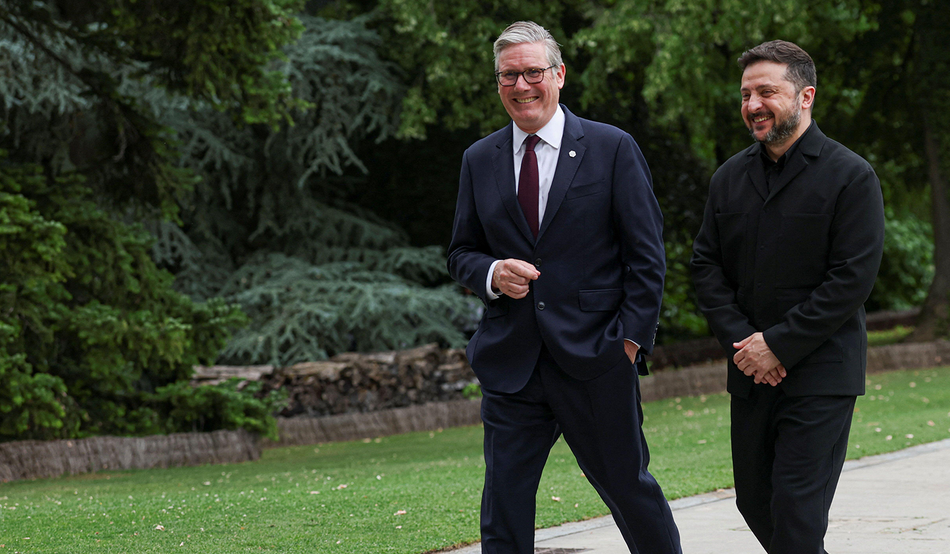
Keir Starmer and Volodomy Zelensky at the G7 meeting in France this week. Image: Alamy