Keep calm and carry on supporting Zelensky. Stay firmly resistant to Trump’s pro-Putin diplomacy. Step up military aid to help Ukraine hold its own on the battlefield. Ensure that security guarantees are robust enough that Russia can’t mount a renewed military attack on the 80 per cent of Ukraine that remains unoccupied after a ceasefire. And, as a matter of urgency, help ensure the EU seals the deal on allocating around €200bn of seized Russian state assets—or getting a loan backed by these assets—to help fund Ukraine’s military and reconstruction costs.
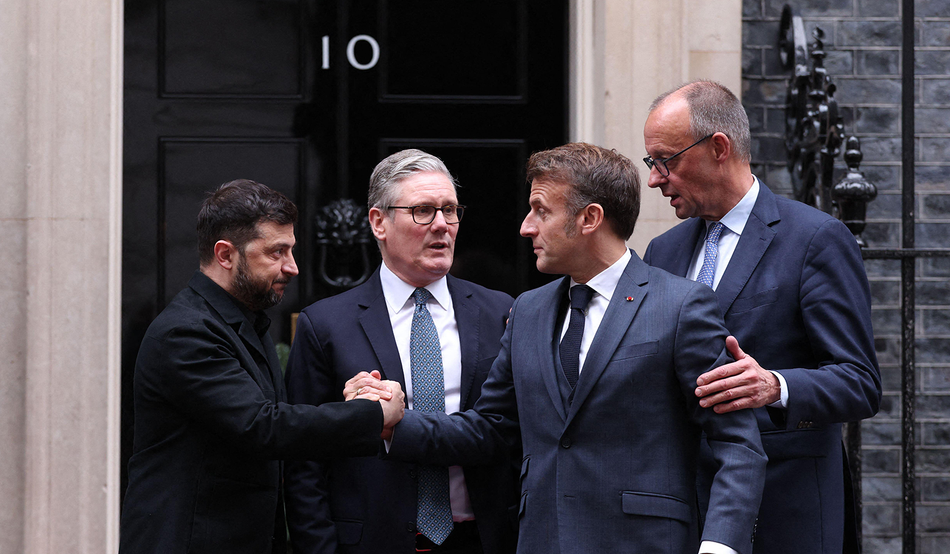
These are the vital European responses required to counter Washington’s latest attempt at encouraging Ukraine to surrender to Putin, together with the anti-European potshots contained in the new US National Security Strategy published last week. Fortunately, this appears to be precisely the policy of Starmer, Merz and Macron, Europe’s security troika. Regardless of how transatlantic relations ultimately pan out, there is no need to panic.
Europe also needs to increase substantially its defence capabilities, independent of the US. This has already been agreed in principle by Europe’s some 30 Nato members—it was the conclusion of the Nato summit in the Hague this June. What’s needed now is resolute follow-through.
For us liberal Europeans, it is obviously unpleasant and distracting to be the subject of constant insults and taunts from Trump, Vance and their associates. But provided we plough sufficient resources into Ukraine’s defence and reconstruction, and steadily backfill the US contribution to Nato, this is a case where “there is nothing to fear but fear itself”, to apply Franklin D Roosevelt’s great maxim.
Why am I not joining the alarmism about “Europe in danger” that has become so fashionable across the liberal media? First, because the threat level does not justify it. The economic and military imbalance between Russia and “European Nato” is so great, and in our favour, that there is no serious threat of a wider Russian invasion even if the US withdraws entirely. Unless, that is, we fail to deliver on increased defence spending and preparedness.
The situation is entirely different from the immediate postwar decades when the Soviet Union controlled central and eastern Europe and was far stronger than today, while most of southern Europe, including Spain and Portugal, was in the grip of capricious dictatorships. Provided today’s Europe acts its size, it can easily contain Putin.
Furthermore, in Nato and the EU, Europe has perfectly viable supra-national defence and economic institutions 70 years in the making. The key reform required is for Nato’s European members to be capable of acting collectively, and implementing its Article 5 mutual defence guarantee, without the US. In this respect the reported US threat to cease providing a senior general as Nato’s Supreme Allied Commander Europe is actually a welcome step. It would underline the credibility of “European Nato” if this key post were held by a senior military leader from the UK, France or Germany.
Even the wholesale withdrawal of US forces from Europe, were it to happen (and Trump hasn’t yet made any move to do so), could easily be made up for by European replacements. Since the end of the Cold War, the US has reduced its forces in Europe to around 80,000 military personnel. Free Ukraine, with a population of 30m, has some 900,000 in its wartime military forces; it ought not to be hard for the 500m people of free Europe to provide a few hundred thousand more military personnel to replace and enhance the protection currently provided by the US. Crucially also, with two nuclear powers (Britain and France) among Europe’s Nato members, the continent can withstand nuclear blackmail even without the US.
The real danger is that Europe is corroded from within by Trumpist populist parties who undermine Nato and the EU, and go soft on Russia when in power. However, populism in Europe doesn’t necessarily translate into pro-Putinism when in power. Meloni of Italy and Nawrocki of Poland are reliably pro-Nato and pro-EU. Bardella, in France, is shaping up to follow on the same path if he wins the presidency in 2027. Even Orbán, for all his pro-Trump grandstanding, has made no move to withdraw the small European state of Hungary from the EU or Nato. Orbán may want to pose with Putin, but he doesn’t want to be impoverished or conquered by him.