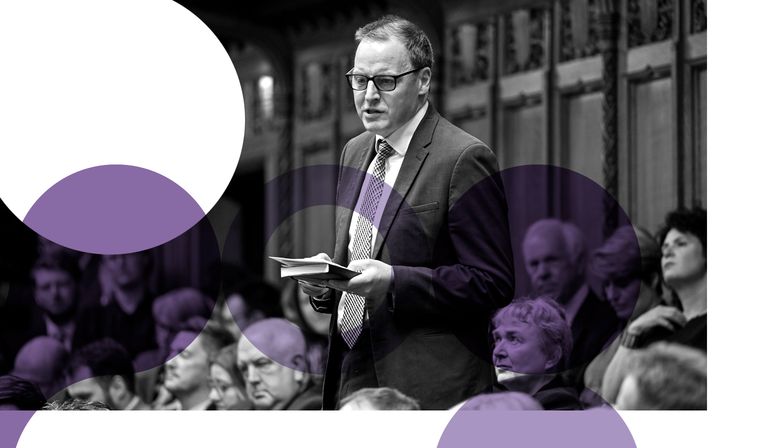
The first time Scott Arthur suspected that his private members’ bill ballot entry had been successful was when his inbox started “pinging”. Emails from lobbyists were incoming. Lots of them. Interest groups representing every cause imaginable knew the result of the ballot before Arthur did, and each was keen to get their pitch in early.
The newly elected MP for Edinburgh South West hadn’t expected to win. After all, the odds are long in a chamber of 650 MPs, most of whom do not hold government roles and are eligible for entry. “I didn’t watch the draw. I forgot all about it,” he says of the events of Friday 5th September 2024. Forgot about it until he heard the volley of pings from his computer.
The private members’ bill process is archaic—Arthur compares the ballot to a “church raffle”—but it does offer backbench MPs the chance to introduce and guide legislation through parliament. Not only was Arthur successful, he was placed sixth on the ballot list giving him a reasonable platform for success. Among the advantages, his bill would be given priority over the time set aside for private members’ bills—13 Fridays in every parliamentary session. (Fellow Labour MP Kim Leadbeater, sponsor of the Terminally Ill Adults (End of Life Bill) came top of the ballot list.)
Winning is step one. Selecting a worthy—and achievable—cause is step two. “I had two weeks to choose a topic,” he recalls when we speak over video call. He is in his office sporting a blue shirt, red tie and the obligatory lanyard that allows him to move smoothly across the sprawling parliamentary estate. Weighing up his options, Arthur, a civil engineer by education and trade, was attracted to the Climate and Nature Bill. He was “kicking about” other ideas, too, including a pavement parking ban (mirroring work he had completed as a councillor in Edinburgh), a cruise liner and ports pollution bill and a third initiative related to concessionary travel for older people.
A suggestion by another Labour colleague, Siobhain McDonagh, changed his thinking. McDonagh had lost her sister to brain cancer a year earlier. Margaret McDonagh was the party’s first female general secretary and subsequently a life peer. She died aged 61 after being diagnosed with glioblastoma, a fast-growing brain tumour. It is the same cancer that took the life of Arthur’s father-in-law, Ivor Hutchison. “I was sitting in the café at my local Tesco’s reading these emails and the glioblastoma title jumped out,” Arthur says. “At that point, it felt like the decision had been taken out of my hands.”
A plan was coming together. As part of her campaigning efforts, Siobhain McDonagh—MP for Mitcham and Morden since 1997—had introduced a 10-minute rule bill that allows a backbench MP to make the case for a new bill in a speech lasting, as its name implies, up to ten minutes. (Few succeed and it is seen as an opportunity to highlight an issue rather than necessarily introduce new legislation). McDonagh proposed a target for the number of patients who should take part in brain tumour trials. Arthur took McDonagh’s campaigning position and folded it into a broader Rare Cancers Bill. It was introduced on 16th October 2024.
According to the bill’s long title, conceived within weeks of the ballot win, the prospective legislation is designed to “incentivise research and investment into the treatment of rare types of cancer; and for connected purposes.”
A necessary precursor to fulfilling the bill’s core objectives, says Arthur, is a proper designation of rare cancers, defining it into law for the first time. To illustrate the blurred lines, the bill follows the UK Rare Diseases Framework that defines a rare cancer as one that affects fewer than 1 in 2,000 people. Elsewhere, it is defined as a cancer for which fewer than six in 100,000 people are diagnosed each year. Despite their infrequency, Arthur says that those with rare cancers collectively “account for 45 per cent of people who are diagnosed [with any form of cancer] each year, but around 55 per cent of the people who die each year.”
You’ve got people with a diagnosis desperate to go on a trial and pharmaceutical companies desperate to get people on a trial
Rare cancers are more “deadly”, says Arthur, in part because of the lack of past investment. He points, by way of example, to the £40m committed to research into brain tumours by the previous government following the death of Tessa Jowell, the former Labour cabinet minister. Five years after the initial commitment, less than half of the money has been allocated. “Rightly people are angry,” says Arthur. “We’re told that there was a lack of quality [applicants] coming forward to justify spending the money. My reply to that was, ‘If you feel you haven’t got the people with the capacity in UK institutions to deliver the research, why not let those institutions use the money to recruit and train people, something that will actually start to build capacity?’.”
If passed into the law, Arthur’s bill will require the government to review the current regulations for orphan medicines (drugs used to diagnose and treat rare diseases) and examine how other countries regulate and licence these medical products. It is hoped that this requirement will incentivise drug discovery and development and encourage research around repurposing drugs, although the bill doesn’t explicitly legislate for either of those things.
There are echoes here of a piece of proposed European Union legislation that would provide tax incentives to extend drug discovery into potential paediatric treatments. “It will be for Wes [Streeting, the health secretary] to do the research, to look at what’s happening with the paediatric approach and see if it works [when applied to rare cancers],” notes Arthur. Extending a patent of an existing drug so it can be applied to a rare cancer, would be a boon for cancer sufferers and beneficial for pharmaceutical companies, too.
The other big barrier preventing rare cancer breakthroughs is the nature of clinical trials. By definition, the cohort available for these is far smaller than it is for more common cancers. A lack of joined-up thinking only compounds the issue.
In an effort to address this problem, the bill would provide NHS England—and subsequently the health department when NHS England is disbanded—with the power to share information for the purpose of convening clinical trials for rare cancers. It would do so by amending section 261 of the Health and Social Care Act 2012. Importantly, this would apply to England only, as devolved nations and governments work under different data regulations and legal structures. It is understood, however, that all are keen to explore how to take on the bill’s objectives and apply them.
Meanwhile, exactly how this information will be shared in England remains up for debate. The bill doesn’t legislate for a database but this appears to be the most likely outcome. If that becomes the tool of choice, and in order to encourage participation, anyone with a rare cancer diagnosis would be placed on the database by default and would need to actively opt out of membership.
To underscore the urgent need for change, Arthur uses the example of the disease that touched his family directly. “Glioblastoma treatments haven’t changed for 20 years. The average life expectancy, after diagnosis, is nine months. My father-in-law lasted six months after diagnosis.”
“It’s a crazy situation,” he continues. “You’ve got people with a diagnosis desperate to go on a trial and pharmaceutical companies desperate to get people on a trial.” The thought occurs that pharmaceutical companies might be inclined to direct funds towards diseases that—to apply economies of scale as a crude measure—are likely to prove commercially more attractive. It’s in this context that I ask Arthur if he believes that such firms are acting in good faith. “I hope so,” he replies. “What this does is make it a little bit easier and cheaper to run a trial here in the UK.”
Glioblastoma life expectancy, after diagnosis, is nine months. My father-in-law lasted six months
He also believes that the lack of past investment and research, paradoxically, could produce some quick wins. “There might be some low-hanging fruit that could really make a difference.”
As we discuss the changing make-up of the bill and Arthur’s day-to-day involvement, I ask how he balances his work here with that of a constituency MP, a member of the transport select committee and an academic, to say nothing of being a husband and a father. The corkboard behind his head, visible as we speak, is illustrative of his split duties: on the right-hand side is a poster, oversized white text on a blue background, which reads “Back the Rare Cancers Bill”; on the left is a ward-by-ward map of his Edinburgh constituency.
The first thing Arthur realised on becoming a Westminster MP was that his day job and his academic career—he has been a professor at Edinburgh’s Heriot-Watt University specialising in urban water management since 2000—were incompatible. “I had this dream to teach one day a month. But, honestly, it’s not possible.”
As for work-life balance, he points out that he has adult children and that his wife, as a former nurse used to working 12 hour days, understands the demands of a job with long hours. “It’s not like we were the kind of couple who were sitting together every night, holding hands and watching Coronation Street.”
His long Westminster days are likely to get longer, should his bill prove successful and progress into law. He is aware, however that most fail. According to the Institute for Government, of the 2,500 bills introduced in this fashion between 2010 and 2024, only 110 have received royal assent. That’s a success rate of less than 5 per cent.
This bill makes it a little bit easier and cheaper to run a trial here in the UK
Nevertheless, Arthur is quietly confident. This is due, in part, to the fact that the bill has the tacit endorsement of the government. He describes its creation as a partnership between his office, a cohort of rare cancer charities and the ministers and officials of the Department of Health and Social Care. He has been in dialogue with Streeting and departmental parliamentary under-secretary Ashley Dalton. Both, incidentally, have first-hand experience of cancer. In 2021 Streeting revealed a kidney cancer diagnosis while Dalton was diagnosed with breast cancer in 2014.
His confidence comes, too, from the bill’s relatively smooth passage through parliament thus far. The proposed legislation is due back in the Lords in January 2026 for its second reading. A third reading could follow two weeks later. When the bill did face problems, supportive charities—a list that includes The Brain Tumour Charity, Brain Tumour Research, Pancreatic Cancer UK and Neuroendocrine Cancer UK—came to the rescue. That point came last summer when Conservative MP Christopher Chope, while declaring himself a sympathetic supporter, nonetheless moved an amendment that could have halted the bill’s progress. A number of charities mobilised. According to Arthur, within two or three days of Chope’s intervention, they had sent out 120,000 campaign emails to their supporters, initiating an intensive lobbying campaign.
Arthur is full of praise for the third sector’s involvement. In turn, they have Arthur’s bill to thank for raising their collective profile. “There are a lot of really, really small charities who just never get the coverage they deserve,” he points out. “When the bill came to the commons, it’s been a vehicle for MPs to talk about them.” He acknowledges that some charities might harbour private frustrations that the bill does not go far enough and, he admits too, that the involvement of so many interested parties has led to an “unsteady” partnership. Nevertheless that experience has been overwhelmingly positive and he knows compromise remains essential in shaping successful laws. “This is the negotiated settlement and it’s well balanced.”
Speak to charities representing those affected by a range of rare cancers and they are mostly optimistic about the bill’s capacity to effect change. They welcome the action on clinical trials and orphan drugs and believe it will bring much-needed leadership, accountability and focus.
Arthur’s main fear is that Wes Streeting will co-opt the bill and incorporate it into the National Cancer Plan
Arthur’s main fear, as we speak before Christmas, is that Streeting will co-opt the bill’s main features and incorporate them into the National Cancer Plan, thought likely to be published on 4th February 2026 to coincide with World Cancer Day. “I’m slightly worried that the government might say, ‘Well, it’s in the cancer plan so we don’t need [the bill] anymore.’” While this wouldn’t be a disastrous outcome, Arthur prefers to retain control. Wes Streeting might be a “great guy”, he says, but a new secretary of state may choose to take what’s in a cancer plan and “undo it on a whim”. An act, on the other hand, can’t be changed without the endorsement of parliament.
Technically, the bill is now out of Arthur’s control. He’s handed it over to Julie Elliott, a Labour peer, who is taking it through the House of Lords, with the help of cross-bench peer Ilora Finlay. He describes both as “fantastic” and “super supportive”. Elliott is the former MP for Sunderland Central and a close friend of Siobhain McDonagh. Meanwhile, Finlay, is a practicing oncologist providing her with an “emotional connection to, and understanding” of the bill’s intent. She previously helped drive through legislation that imposed time limits on public sunbeds and salons to help combat the increasing prevalence of skin cancer.
McDonagh, meanwhile, is supportive of Arthur’s efforts so far (see page 20). She describes his pragmatism as key if a private members’ bill is to succeed. In contrast, she describes herself as “not a person who knows compromise”. McDonagh adds: “Scott has done a great job. He’s shone a light on rare cancers. If we can improve the outcomes of any rare cancer, that’s a great thing.”
So, does Arthur feel his Rare Cancers Bill is in a safe place? “Yes,” he offers. “The Tories in the commons have been really good, as well. Apart from Christopher Chope—and I think he was just messing about.”