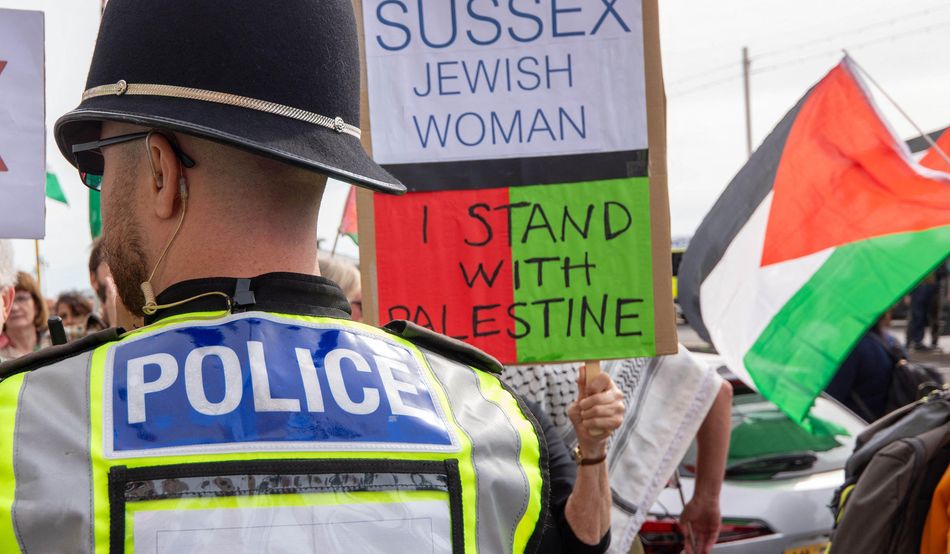
Despite concerns from former Green party leaders and colleagues across Europe, a motion equating Zionism with racism passed amid acrimonious scenes at the Greens’ annual conference on Sunday. The motion defines Zionism in terms a minority of its adherents would recognise: as “a political ideology which called for the creation—and, now it exists, the continuity—of an ethnonationalist Jewish State in historic Palestine to the exclusion and/or domination of the non-Jewish population.” The Green party will now treat Zionism “as any other form of racism.”
This places the Green party at odds with the vast majority of British Jews. According to the Institute for Jewish Policy Research (JPR), 64 per cent of British Jews identified as Zionist in June 2025 and an overwhelming majority supported Israel's right to exist as a Jewish state.
Sam Alston, a Jewish member of Oxford Greens, proposed an amendment to the motion protecting members from complaints arising from members belonging to or attending a synagogue or prayer group with links to Zionism. Without it, he warned, the party risked indirect religious discrimination. Three quarters of those at the workshop where the amendment was mooted voted it down.
On the day of the actual vote, another amendment to include protections for Jewish members was also defeated. More than 1,000 members voted against ensuring an ostensibly anti-racist motion did not inadvertently discriminate against an ethnic minority. A party that declares Zionism racist, yet declines to protect members who attend UK synagogues, most of which do support Zionism, risks putting ideology before the equal treatment of Jews.
Criticising Israeli governments, demanding an end to war and occupation, and indeed racism, and campaigning for Palestinian freedom are all legitimate. As chief executive in the UK of an Israeli organisation that supports equality and human rights groups, many of them jointly led by Jews and Palestinians, I support all three.
My Palestinian colleagues and many of the Palestinians we work with take a more considered approach than the Green party. The same motion not only dictates to Jews how to understand their history or express their culture but, despite many Palestinians supporting a state alongside Israel, makes it party policy to seek a “single democratic Palestinian state in all of historic Palestine.”
The broader Jewish community often makes similar mistakes regarding anti-Zionism. Many supporters of Israel treat all anti-Zionism as antisemitism. At a rally in London in May, I saw people carrying posters that read “Anti-Zionism = Terrorism”.
So, while one side says Zionism equals racism, the other says anti-Zionism equals terrorism. Both take a word that means different things to different people, choose its worst possible meaning, and pin it on everyone who uses it.
Zack Polanski, the leader of the Greens, has acknowledged that definitions of Zionism differ, while also defining it himself as the displacement and genocide of Palestinians. That is, the worst assumption, applied to everyone.
Zionism is the national liberation movement of the Jewish people. Like every national liberation movement, it has had many leaders and ideas, none of whom would recognise the Jewish supremacists in Israel's government who claim to be their heirs. Less than a month before an Israeli election, parliamentary representation for Palestinian citizens has come under attack. Eight years ago, those claiming to strengthen Israel as the nation-state of the Jewish people downgraded Arabic from an official language to one with “special status”. Sadly, many Israelis and Zionists who do not advocate these policies still say too little when others undermine Israel's founding ideals.
My Zionism, and my determined support for equality, human rights and Palestinian liberation, draw on early 20th-century socialist, humanist and even revisionist thinkers: Labour Zionists who wanted a society built on shared work; Martin Buber, who argued for a binational future with the Arabs of Palestine; and even Ze’ev Jabotinsky, founder of the Zionist right, who envisioned a Jewish state where Arabs would have guaranteed parliamentary representation and Arabic and Hebrew would both be official languages.
It is useful to compare attitudes to Zionism with how other struggles for self-determination are remembered. As the son of an Indian immigrant, I found Sam Dalrymple's Shattered Lands, a history of the five partitions of Britain's Indian empire, intriguing and devastating. It is unsparing about British racism and violence, and equally clear about the brutality of Japan, a non-western empire. It shows that Hindu, Muslim and Burmese struggles for freedom also contained nationalist, ethnic and religious hatred that killed and uprooted people on an immense scale.
Nobody reading Dalrymple’s book would conclude that Indian or Pakistani nationalism is inherently racist, nor that those states should be undone. Those peoples had a right to self-determination, and terrible crimes were committed in its name. But Jewish nationalism is treated by many progressives as uniquely illegitimate.
Anti-Zionism is just as complex. For much of the 20th century, some Jews opposed Zionism: socialists in the Bund, a secular Jewish political party that originated in the former Russian empire, sought autonomy for Jewish communities, not a nation-state in ancient Israel; ultra-Orthodox rabbis held that only the coming of the Messiah could herald a return to Zion; and liberal Jews saw their future in the countries they lived in. Some Jews still oppose Zionism. In the same 2025 JPR survey, 12 per cent of British Jews identified as anti-Zionist. Opposing a Jewish state in principle is not, in itself, hatred of Jews.
Equating anti-Zionism with antisemitism or terrorism is both wrong and self-defeating. It tells Jewish dissenters they are traitors. It tells Palestinians that opposing the state that governs, occupies or wages war against them is inherently violent, or terrorist, or racist.
But anti-Zionism also has a history many of its supporters ignore. "Zionism is racism" was not coined by the British left. The Soviet Union drove it through the UN General Assembly in 1975, after years of state propaganda that recycled old antisemitic tropes under an anti-Zionist label, amplified by its proxy war with the United States in the Middle East. The UN revoked the resolution in 1991. Hamas's 1988 charter cited The Protocols of the Elders of Zion, the notorious and hateful Tsarist forgery. Some anti-Zionism is a response to what Palestinians endure. Some has absorbed an older prejudice.
Those who care about Israel must stop treating every anti-Zionist as an enemy. Those who oppose Zionism must stop treating every Zionist as a racist. And those who care about the Palestinians and Jews still suffering in this conflict, over one land claimed by both peoples, could focus less on misunderstood labels and more on pursuing justice, safety and equality for all.