Politics often has a way of burying the real question—like “can the leader survive?”—under a deluge of pernickety detail. It even happened with Watergate. But when Keir Starmer is involved, process and procedure seem to stand in for passion and raw power more than is usual.
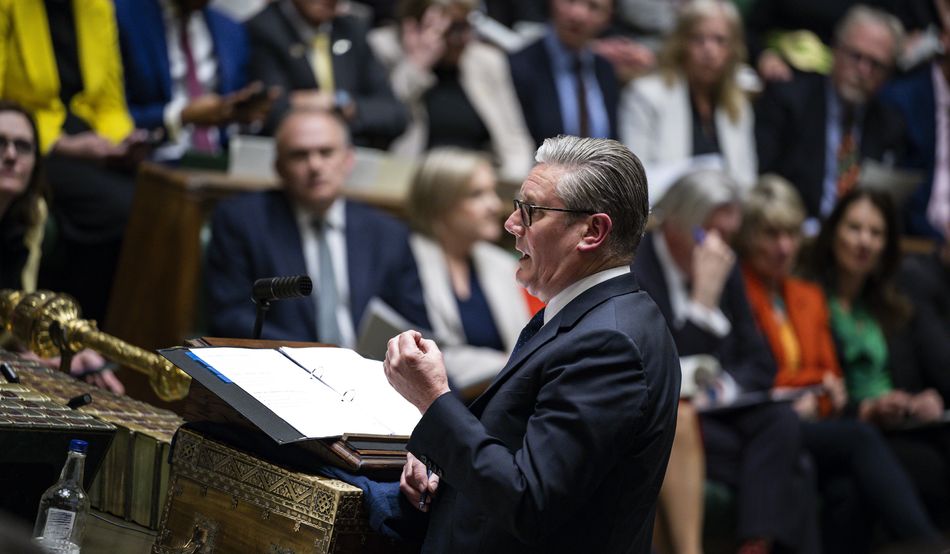
In the Commons on Monday, the prime minister sought to defuse the explosive revelation that Peter Mandelson had “failed” his vetting before being waved through as US ambassador. In doing so, he catalogued arcane distinctions between due diligence, the conclusion of vetting enquiries and the final award of “vetted” status. Despite the hard-right Lee Anderson and the hard-left Zarah Sultana both getting kicked out of the chamber for levelling the “unparliamentary” accusation that Starmer had lied, the PM did enough to explain the untruths he did previously utter about the appointment as being the product of ignorance rather than mendacity.
Deflecting the blame for that ignorance from himself to Olly Robbins, the mandarin whom Starmer immediately sacked when news of the troubling vetting report emerged, was a considerably more difficult task—even before Robbins’s testimony to a parliamentary committee on Tuesday. Let’s be generous to the PM, and grant what is disputed between them: that Robbins was empowered to let him know that the spooks were worried about Mandelson. The question still needs to be asked as to why Robbins, an official whom Starmer himself acknowledged had heretofore been a “dedicated public servant”, would suddenly manoeuvre to keep the national leader in the dark regarding the diplomat about to be placed at the heart of the UK’s transatlantic intelligence network.
For all Starmer’s indignation—“staggering,” “unforgiveable,” “beggars belief”—his own political operation had made it clear at the time that this appointment was well beyond the point for discussion and debate. Downing Street had, after all, already, and with some fanfare, announced Mandelson’s name, weeks before the vetting was due to conclude. This cart-before-horse ordering was, as a newly released document lays bare, in direct contradiction to the sequencing suggested by Simon Case, then the highest civil servant in the land, and as such not a man whose advice is liable to be ignored by accident in Whitehall. Even before this week we knew that Jonathan Powell, Starmer’s experienced national security adviser, had worried that the Mandelson appointment was being “weirdly rushed.” We knew, too, that No 10 had already glanced at its own briefing file, which included Mandelson’s Jeffrey Epstein connection, and nonetheless resolved to press ahead.
So it is credible when Robbins insists that the Foreign Office was under “constant pressure” from Number 10 to get the appointment finalised. It is believable, too, when he relays that voices from the Cabinet Office—the part of Whitehall most directly controlled by Downing Street—were arguing that Mandelson didn’t need vetting at all.
As it happens, long ago I witnessed Robbins at work, dealing skilfully with a bully in the political operation of the last Labour government. I’m not surprised if he viewed the Mandelson appointment as a political fact established in full awareness of the general risks, and decided it was not a civil servant’s job to disturb it. Starmer spent a lot of time on Monday performing anger about what happened later. Amid the various post-mortems he had instigated after the Mandelson appointment blew up, why on Earth weren’t the problems with vetting finally shared?
Well, for one thing the Independent had last year somehow established and exposed the fact that Mandelson didn’t pass security vetting, and indeed put it to Downing Street last autumn. As to why Robbins himself kept shtum, it wasn’t just a case of rigid deference to protocol. In the face of retrospective questioning, he said on Tuesday: “the direction from Number 10 was that we must make clear that these decisions were made entirely independently of ministers, and they were not consulted, other than being told the outcomes.”
The real mystery, then, is not why Robbins kept his mouth shut, but why Starmer kept his eyes shut to the palpable risks of appointing a twice-sacked lobbyist known to be obsessed with money, and known to retain links to Russian oligarchs. To unravel why, forget about the intricacies of the security clearance drill. The root cause of this disaster—and indeed of the wider collapse in support for this government—lies in Labour factionalism.
In seeking to tidy up the dysfunctional party that he inherited after Jeremy Corbyn’s heavy defeat in 2019, Starmer—a relative political novice—alighted on Morgan McSweeney. An operator with contempt for all of the party’s more idealistic traditions, McSweeney saw the route to redemption as being an unending series of purges, designed to reassure so-called “hero” voters by making the Labour base squirm. Core Labour policies, including things it has now done like ending the two-child benefit limit, were performatively dropped. Pretexts were found for blocking strong parliamentary candidates with deep local roots, such as Jamie Driscoll and Faiza Shaheen. MPs lost the whip not, in keeping with the usual custom, for misconduct, but for rebelling on policies where they stood with Labour’s mainstream.
McSweeney also had longstanding connections to Mandelson. He was no doubt aware that Tony Blair had once said that the New Labour project would not be complete until Labour had learned to love someone like Mandelson. Where Blair had the lightness of touch to reflect that he had “set the bar a little too high” with this test, McSweeney, and it seems Starmer, decided that a third or fourth coming for Mandelson would be the ultimate proof that the “grown-ups” were back in charge. Robbins dropped yet another bomb on Tuesday when he revealed that Number 10 had also enquired about an ambassadorship for the former prime ministerial press chief Matthew Doyle, another veteran partisan of the right in Labour’s internecine wars. Doyle was recently driven out of the Labour party in the Lords over links to someone who turned out to be a sex offender. This putative scheme, Robbins said, was so secretive that he was asked to keep the foreign secretary in the dark.
To grasp the zealotry of Labour’s ruling clique, compare the cavalier disregard for convention in advancing Mandelson and, potentially, Doyle, with the stance applied to Starmer’s first transport secretary, Louise Haigh. Haigh was widely seen as a success in her job, but never regarded as “one of us”. Before becoming a frontbencher, Haigh had judged she had better fill Starmer in on an embarrassing old conviction—albeit one so minor the court had left her unpunished—regarding a company mobile phone. Someone or other dug this detail out of a desk draw and handed it to the Times, before it was decided the story had become such a distraction that Haigh would have to go.
The McSweeney strategy of defining a Labour government against its own base has run out of road. This week YouGov polling puts the ruling party in fourth place, overtaken not just by the right but by Green populists who welcome in disaffected past Labour supporters. Ironically, Starmer’s government is now adjusting to these changing electoral realities, including by distancing itself from Donald Trump, a shift which has achieved a modest bounce in the prime minister’s terrible personal ratings. Labour’s interests just now are probably best served by this newly post-factional Starmer staying at the wheel for another year or even two.
And yet it is not only the Mandelson affair, but the wider wounds from the infighting of the McSweeney era that put this outcome at risk. Starmer faced testing questions yesterday not only from opposition politicians, but also from a range of Labour figures such as Rachael Maskell and John McDonnell whom he kicked out of the party while he was strong. They are now disinclined to show him much generosity when he is weak. Even Ed Miliband—whom he recently tried and failed to reshuffle out of a job that he loves—now sounds decidedly token in his pledges of fealty.
Shrewd politicians are careful with process, but care far more about people. They keep their distance from those that can’t be trusted, and cultivate loyal friends with a wide range of opinions. The deepest revelation of the Mandelson affair is that the prime minister is out on a limb, having done none of these things.