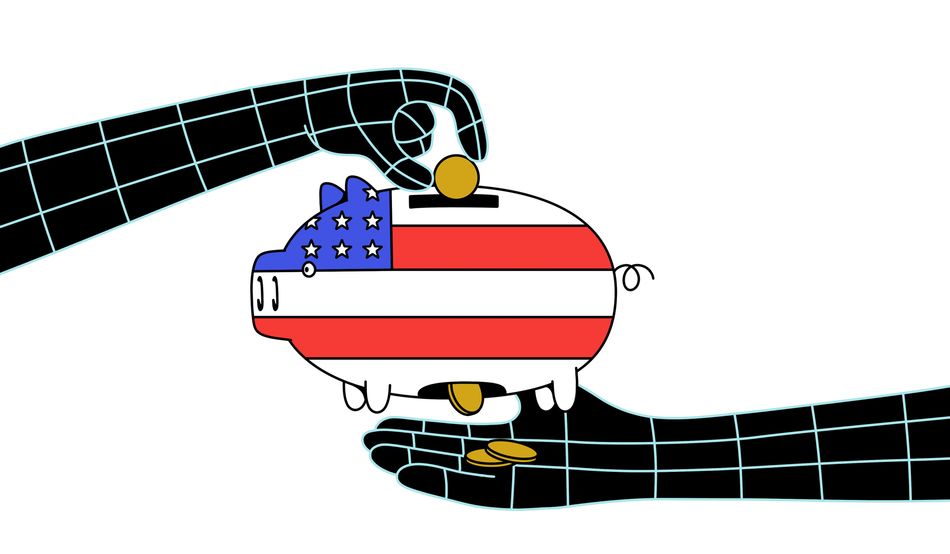
In June 2026, the Vermont senator Bernie Sanders proposed a bill that sounded like just another one of the veteran independent’s non-starters in the land of laissez-faire: a 50 per cent levy on AI companies paid to the US government in shares. Because AIs are built on the collective cultural production of the nation’s (and world’s) creators, Sanders reasoned, US citizens should be able to share in the wealth being created by these new fiscal giants.
Sanders is the patriarch of America’s fragile but rising left, and so an interest in redistributing AI wealth is par for the course. Far more surprising, perhaps, is Donald Trump’s apparent shared enthusiasm for the idea. In an Oval Office appearance in June, Trump announced he planned to hold a meeting with AI executives to talk about “giving back something to the public”, promising that “the public will become very rich”.
And thus the commentariat rushed to Wikipedia to brief ourselves—a pattern that repeats every time Trump has a “new” economic idea. This time it’s the sovereign wealth fund: a state economic instrument created to manage a budget surplus or windfall, often generated by commodities, and help an economy weather price shocks.
The first sovereign wealth fund was created in Texas in the mid-19th century to fund schools with the proceeds of sales of federal lands. The British empire helped the instrument to become mainstream in the next century as Kuwait and Kiribati set up sovereign wealth funds in the 1950s, supported by the export of oil and phosphates respectively, prior to them gaining independence.
Norway’s Oljefondet—initially the “oil fund”, but now the “Government Pension Fund Global”—was established in 1990 to invest petroleum sector revenues. It now manages well over $2 trillion in assets, or more than $390,000 per Norwegian citizen.
Funded by oil revenues, which are shrinking as stocks are depleted, the fund diversifies the nation’s commodity dependence by investing in thousands of companies around the world. It owns more than 2 per cent of all European shares, making it the biggest stock owner in the European market.
Trump wants something similar. In 2025, he ordered the departments of Treasury and Commerce to draft plans for a wealth fund, speculating that it could be used to buy TikTok from its Chinese owners. And while economists from left and right have warned that, because the US government runs at a deficit, any such venture would be funded by going further into debt, the president seems drawn to the idea of the nation having stakes in commercial businesses.
In Trump’s second term, his government has taken significant holdings in Intel, Global Foundries, US Steel and an array of companies involved with mining rare earths and quantum computing. (This may also prove an innovative source of sustainable energy if engineers can find a way to harness the movement from Margaret Thatcher spinning in her grave.)
Viewed one way, the AI boom resembles exactly the sort of economic windfall that has funded past sovereign wealth funds. “The Magnificent Seven”—seven publicly traded US tech companies each significantly invested in the AI economy and worth at least $1 trillion—represent roughly a third of the value of the S&P 500 index of the largest US-listed companies.
They represented just over a fifth of the index’s value in 2022, indicating that the lion’s share of overall market gains in the past four years is concentrated in AI-related stocks. As OpenAI and Anthropic prepare to go public, they too could be valued at $1 trillion plus.
Or maybe not. Over time both appear to have struggled to turn a profit, attracting tens of billions in revenue while spending hundreds of billions of investor money on computers and the energy to power them. Anthropic proudly declared a profitable second quarter of 2026, to the extreme scepticism of many industry watchers, who suspect some very carefully managed accounting for the period leading up to a public offering of shares in the company.
The Magnificent Seven are all profitable, but not from their AI businesses per se: Apple sells phones, Microsoft sells software and Amazon sells, well, everything. The most curious of the bunch is Nvidia, which sells chips to everyone in the AI industry, uses its funds to invest in those same companies, which then use those funds to buy Nvidia’s products. In 2025, Nvidia invested $100bn in OpenAI, which committed to use those funds to buy millions of Nvidia’s chips.
This circular economy makes it difficult to determine whether AI is booming, or whether huge sums are simply being shifted from one balance sheet to another. If Sanders and Trump want the state to capture a piece of the AI boom, they could merely be accepting a share of wildly expensive businesses that are spending billions to collect millions.
This also might explain why Sam Altman, CEO of OpenAI, has proposed handing 5 per cent of his company to a US sovereign wealth fund, suggesting that Anthropic, Meta and Google do the same. If the US government held hundreds of billions in shares in AI companies, it would have a strong incentive to ensure those companies succeed, and a strong disincentive to aggressively regulate them.
This is one of the major dangers of sovereign wealth funds: that countries become reluctant to bite the hand that feeds them. While Norway has made strides in environmental sustainability, it has also maintained a commitment to “not dismantle but develop” the fossil fuel industry. It also continues to issue licences for oil and gas projects in the rapidly warming Arctic.
Altman may see 5 per cent as a bargain price if it buys him insurance against regulation that slows his company down or, better yet, encourages the US to ban the use of Chinese competitor models on national security grounds.
But even if shares in these and other US companies represent an opportunity instead of a risk, and even if the federal government could work out how to responsibly regulate a field that it’s invested in, there’s a question of what an AI-fuelled sovereign fund would be for.
Norway’s supports a lavish welfare state, while Alaska’s much more modest oil- and mining-fuelled Permanent Fund provides a payment to each resident of the state annually of around $1,000.
A sovereign wealth fund could help insulate against the employment shock that the AI companies promise is coming soon, thanks to their technology. If they are to be believed, we are facing economic upheaval in the next five to ten years that could lead to societal unrest.
That this issue is not dominating every political debate in every developed economy suggests two things: we take for granted that AI’s projections are overhyped, and that we sense how difficult this problem would be to meaningfully address.
US workers earned almost $12 trillion in 2024. If AI displaces even a small fraction of that, the amount needed to replace incomes will quickly outpace wealth generated by an AI boom. Enormous sums would be needed to ensure millions of programmers, web designers and court reporters—job categories where studies of AI disruption project a 50 per cent or greater loss of jobs—find new careers or receive a universal basic income.
But ultimately, any idea that brings Donald Trump, Bernie Sanders and Sam Altman together in agreement is likely to be too good to be true. It’s not clear any such fund would ever benefit Americans or compensate in an AI-ravaged economy. Maybe it is best understood as a way for AI companies to fend off regulation, maybe even as a bribe.