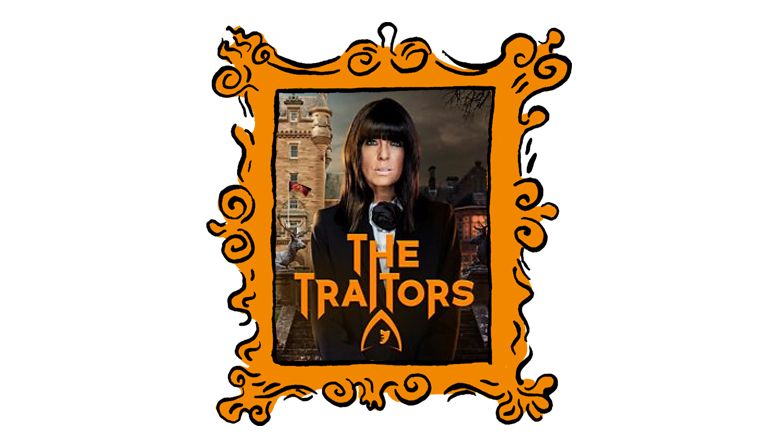
“If you’ve not seen series two, there will be spoilers. If you’ve not seen series one, get a life!” Next to a seven-foot poster of Claudia Winkleman, at the enormous Toy Fair in Kensington, a presenter is introducing new The Traitors card game with two not-very-successful contestants from the BBC show—faithful Anthony and traitor Ash. The Traitors is the UK’s most-watched entertainment programme, similar in its premise to the party game Mafia (or Werewolf). It’s won a Bafta and it’s bigger than Love Island. Labour leader Keir Starmer is a fan. “It’s sort of like the 1922 committee—they all get together in a crumbling historic building, they take lumps out of each other, before regular, secretive votes,” he said at a drinks reception earlier this week, ahead of the second season’s finale tomorrow.
Anthony, a chess teacher who was voted off in the third episode, was “the angriest faithful I’ve ever seen,” the presenter says. “I wasn’t angry,” Anthony responds, “I was livid!” He mimics his final, heated words on the show: “You’re going to be 8-1 down. Let… that… sink… in.”
On The Traitors, 22 Brits are put in the beautiful Ardross Castle in the Scottish Highlands, secretly assigned the roles of “faithful” or “traitor”, and tasked with killing off the opposing group in “round table” voting sessions each night. All for a cash prize. The show is, of course, absurdly camp. Winkleman, a magnificent host, leads the black-clad contestants through a lengthy funeral procession for one contestant, Diane, after she is “poisoned” by a glass of fizzy rosé. Her real-life son Ross watches as his mother is lowered into her coffin. It could be ghoulish—but it’s delightful.
Lying is encouraged. Upon being selected, the traitors take an oath to “commit to lie and deceive throughout the game”. This season’s most compelling traitor, Paul—some call him the “ginger godfather”—burst into fake tears at one point to try to win over the other contestants. He missed his “little boy at home” and was ready to leave the show, he said, in a perfect parody of every reality TV sob story. When asked to describe himself in three words, Paul came up with: “Competitive, cruel, and… traitor.” It’s hard to imagine that kind of branding going down so well on Love Island. But Ash and Anthony bear him no ill will. “He’s a wonderful guy,” says Anthony. “He’s amazing! He was my bestie,” adds Ash.
Ash was the first traitor to be exposed, in episode four. At the Toy Fair, the presenter turns to her pityingly. “Let me ask you a polite question: do you think you would’ve been a better faithful?” She nods. “I was constantly uptight… I should have been better prepared.”
The logic for identifying a traitor is often faulty. Anthony was targeted early on, after retired teacher Diane accused him of refusing to move out of her way—and thus displaying traitorish behaviour—outside the castle, before the roles had even been allocated. “That smacks of somebody who is out for themselves,” she intoned, shaking her head. “Absolutely not having that.”
It’s very easy to lose your head at the round table, the windowless room where contestants face each other at the end of the day. Shy Brian crumbled under the pressure and interrupted his fellow contestants to demand: “Can I ask, who thought I was a sheep and who thought I amn’t?!” When Charlotte, a recruitment manager from Coventry, was banished in the ninth episode, she declared: “I’m passionate about this… I love the bones off every one of you.”
“Someone was saying to me, ‘How can you say you love these people after like a week or two?’” Ash tells me. “But we’re spending 16 hours a day together.”
“You can’t play the game without becoming emotionally invested, especially if you’re a competitor,” agrees Anthony. “And I make no bones about it—I’m a competitor. I’m here to compete.”
But although emotions run high in the castle, the stakes are pleasingly low. Unlike Love Island—or even more intense iterations like Married at First Sight—there’s no heartbreak or love rats (although, last season, poor Matt cried when he found out that Alex, whom he’d boldly described in a confessional as his “future wife”, was secretly dating magician Tom). The cast is diverse, with a wide age range, and most have pretty normal jobs and normal faces. While some enjoy brief fame after the show, there is no suggestion of million-pound brand deals and Instagram stardom—with all the exploitation and personal risk that would entail.
The most refreshing part of the show is that The Traitors really is just a game. Backstabbing only means you’re playing it well. There’s no incentive to try and prove you’re a wonderful person and the nation’s next sweetheart. We consume reality TV shows like modern morality plays. They exist to create outrage. People are torn to shreds online for what would be a minor misdemeanour in real life—like kissing someone and then fancying someone else more, or overreacting to a joke, or coming off as a bit unfriendly or uptight or shifty. But no one in the castle expected loyalty, Anthony explains. “It’s a game of survival, it doesn’t matter what side of the fence you’re on. Faithfuls will push out other faithfuls; traitors will take out traitors.”
On The Traitors, everyone knows the deal.