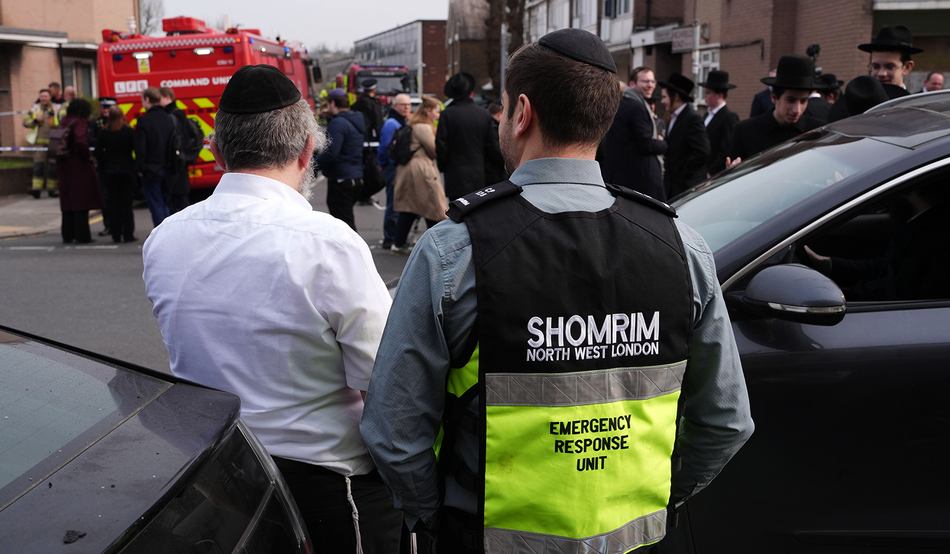
We are living in circular times where events and responses repeat. Wednesday’s attack in Golders Green was the third incident targeting Jews in one small part of North London in five weeks. It was the fifth in that wider area—which is home to the largest concentration of Jews in the United Kingdom—since the end of March.
In the spring sunshine, at around 11am, two men were stabbed in the quiet streets only minutes from where I lived as a child. Footage of a man armed with a knife appears to show him lunging at a victim again and again, right at the bus stop. A 45-year-old man has today been charged in connection to the attack.
On Wednesday, the Met police commissioner, Mark Rowley, noted that “We have seen a rise in racist and antisemitic hate crime” in the UK. Jonathan Hall, the government’s independent reviewer of terrorism and state threats legislation, described anti-Jewish attacks as “the biggest national security emergency” since 2017.
This week, the responses that always follow after such violence have done so again. Keir Starmer said that “the antisemitic attack in Golders Green is utterly appalling”. The chief rabbi, Ephraim Mirvis, said “words of condemnation are no longer sufficient”. The Israeli prime minister’s official X account posted a demand for “action by the British Government to protect the Jews of England and bring antisemites to justice”. Once again, there have been calls to ban pro-Palestinian “hate marches”.
While the Jewish minority of the UK is small, around 0.5 per cent of the country’s total population, the attacks against it are relentless. Like other British Jews, I wonder whether any of us are safe. The Jews who were stabbed in Golders Green are visibly Jews, Jews in religious garb. How Jewish do I look? How Jewish do my children look? When will I need to tell them not to let on too easily that they are Jewish, just in case. The language we speak at home is Hebrew. I have lost count of the times I have thought twice about speaking it with my young daughters in public, or of how, when reading a book in Hebrew on the tube, I have wondered whether I should hide the cover.
Do those who call for banning political protest truly believe this is the key that will unlock safety for Jews? We say, and rightly, that Jews are not responsible for the actions of the Israeli government. We say it’s wrong to conflate an individual Jew or a Jewish communal organisation with Israel’s wars in Iran or Lebanon or Gaza—that doing so is antisemitic. And in the same breath we say that we must outlaw marches against Israeli policy in order to protect Jews. Meanwhile, the Israeli state accuses people who criticise Israel of antisemitism.
Don’t forget that, only a month ago, a major festival in London invited a musician who openly expressed support for Nazism to play for three nights in a row, and it was up to Jews to call attention to why that might be wrong or dangerous. Let’s not forget, either, that Nigel Farage, who has written in the Jewish press attacking the government for failing to act on antisemitism, allegedly sang antisemitic songs to Jewish schoolmates when he was a boy. (Farage has said he “never directly racially abused anybody”.) And let’s not forget that, for nearly three years now, people have been traumatising themselves watching video after video on their phones of violence in the Middle East, from the wars in Gaza, Iran, Lebanon, from the West Bank, from Hamas’s attack nearly three years ago. Nor that, more often than not, if you post online about attacks against Jews, the response is some mindless variation on the theme, “Well, what about Israel?”
The day after the attack, the Jewish News published an editorial that said: “This is a message to the rest of the country. Where are you? Why are so many of you so silent?” Some people look around and say that the UK has an antisemitism problem. Others dismiss fears as down to a mere “perception of unsafety”. Stabbings and arson attacks seem as literal a representation of unsafety as can be.
I try to live with the parallel tracks that shape life here as a Jew: the trend of violent attacks and online antisemitism and the knowledge of what the Israeli state is doing. I try to square the circle of seeing what Israel does with the knowledge that by writing about it or talking about it, of feeling shame and anger, I am contributing to a widening abyss in our society that has allowed its Jewish population to be so endangered. The recent attacks show that, alongside the antisemitic rhetoric that has become so commonplace, there are people who want to hurt Jews, and who will look for Jews in places or parts of the country where they knew they will find them.
“Jews are rendered before they are encountered,” Rabbi Charley Baginsky, the co-leader of Progressive Judaism, wrote recently of the limits of antisemitic prejudice. “Our responses are interpreted before they are heard. Complexity is flattened into position… Antisemitism, in this sense, is not only hostility. It is a failure of perception. It produces a portrait and mistakes it for a person.”
And so, five months after two Jews were killed in an attack on a Manchester synagogue, and after weeks of fires lit, bricks thrown and now men stabbed, there are still too many people who don’t quite see Jews as people. They are instead rendered as symbols of atrocities committed by another state.