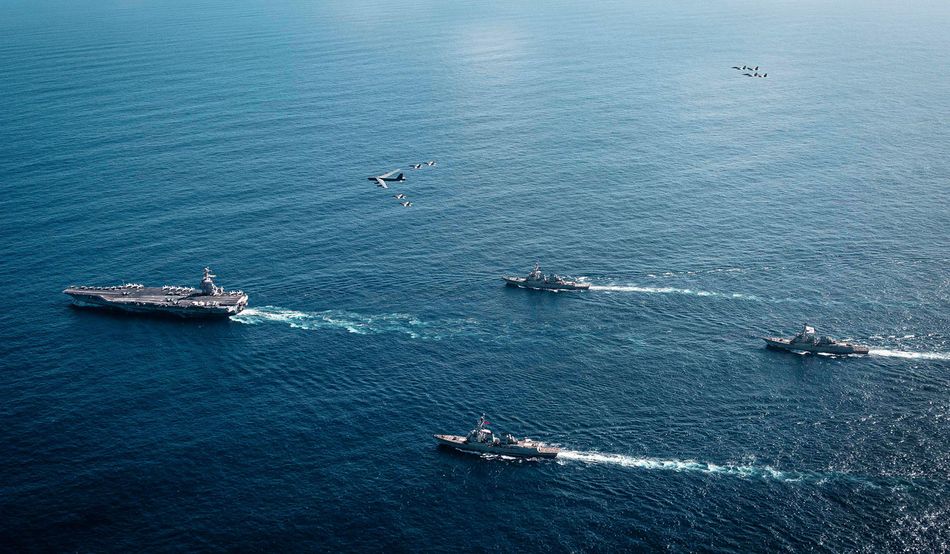
The $50m bounty placed on the head of President Nicolás Maduro and the enormous build-up of US military forces in the Caribbean—the largest since the US invasion of Panama—make one thing clear: the United States wants regime change in Venezuela. Whether it will seek to achieve this by direct military intervention or by creating the conditions for Maduro’s overthrow by forces in Venezuela is blurrier. More opaque still is Washington’s motivation.
It seems unlikely that restoring democracy and human rights are the central driver, given President Trump’s apparent soft spot for strongmen rulers like Maduro elsewhere in the world. The Trump administration maintains that it is targeting Venezuela as part of the “war on drugs”: it accuses Maduro of running a drug-trafficking organisation called the Cartel of the Suns (Maduro denies this). Yet that explanation has many experts in the drugs trade scratching their heads. Venezuela is a relatively minor player in the huge business of trafficking narcotics to the US (Mexico and Colombia are far bigger exporters).
Maduro himself, meanwhile, claims the military build-up is an American attempt to secure control over Venezuela’s natural resources, including its oil reserves. On that point, Colombia’s left-wing president Gustavo Petro recently came out in hearty agreement. Oil “has to do with everything”, he explained this week to CNN. “In general, all wars of this century have had to do with oil.”
Could Maduro and Petro have half a point? On the one hand, Maduro is a repressive autocrat who has wrought economic devastation on Venezuela in recent years. There are good reasons to distrust his views and generally to want him gone. Likewise, wars are rarely exclusively about natural resources—even if conspiracy theorists, and others who like to oversimplify and tar the motivations of their opponents, claim that they are.
But in this particular case, and amid all the competing explanations, oil does appear to be a significant factor motivating America’s confrontation with Maduro. There are two main reasons for thinking this.
First, Venezuela has the world’s largest proven reserves of oil—and freeing those reserves from Maduro’s grasp would serve a powerful set of strategic US interests.
Many of the reserves are of so called heavy crude, a form of oil which is expensive and energy-intensive to extract and refine, but which represents a globally important store of hydrocarbons. Years of underinvestment, mismanagement and sanctions had slowed Venezuela’s actual production from these reserves to a mere trickle (see chart). It will take time to revive the country’s oil industry but, under different conditions—namely a new regime which is economically competent and able to attract significant foreign investment—Venezuela’s oil production and exports have the potential to soar.
The United States likely sees both economic and geopolitical opportunities here.
On the economic side, a key attraction is the big concessions that will probably flow to US oil firms able to help drive the revival of domestic production, particularly from a new regime that feels it owes its existence to American muscle. Looking further ahead, growing exports from Venezuela could help keep a lid on oil prices globally, providing a boon to US consumers, and generally supporting US energy security. Trump is of course unworried about the climate impacts of more fossil fuel production and use, so it can be assumed that that doesn’t currently constrain US thinking in this area.
On the geopolitical front, US-induced regime change will help the Trump administration assert its influence over fossil fuel developments and flows in America’s “backyard” (as some in Washington still see Latin America), with all the regional and global leverage this brings.
The US is likely worried that Caracas has been turning increasingly to China, which is now both a major buyer of its crude and a significant investor in its oil fields. Venezuela also currently sends subsidised oil to Cuba, helping prop up the economy of another Caribbean nation deemed by Washington to be hostile to US interests. Maduro, meanwhile, has previously threatened to take over an oil-rich region of neighbouring Guyana, where the US oil giant ExxonMobil is operating a consortium developing huge, recently discovered reserves. The US has a clear interest in putting paid to such threats.
The second basic reason for believing that oil is driving the current confrontation is that Trump, perhaps more than any other US president in recent history, sees foreign policy through the lens of securing strategic natural resources. The US may say that its military build-up is primarily about tackling drugs and other non-oil issues, but it would be odd if Trump’s enthusiastic practice of resource geopolitics had been forgotten when it comes to Venezuela.
Recall, for example, the emphasis he has placed on the US securing access to Ukraine’s “critical minerals” in his interactions with President Zelensky earlier this year. Likewise, his eagerness to acquire Greenland has been driven partly by his belief that resource wealth lies under its frozen ground. And his administration’s recent brokering of a peace deal in the Democratic Republic of the Congo has been justified partly by reference to the mineral resources this could help secure for US (as opposed to Chinese) interests.
As for Venezuela itself, Trump has occasionally let slip just how important the US securing and profiting from its oil is to his thinking. In a campaign speech in June 2023, prior to his most recent election, he claimed that, “When I left [by which he presumably means left office in 2021], Venezuela was ready to collapse. We would have taken it over. We would have gotten all that oil. It would have been right next door.”
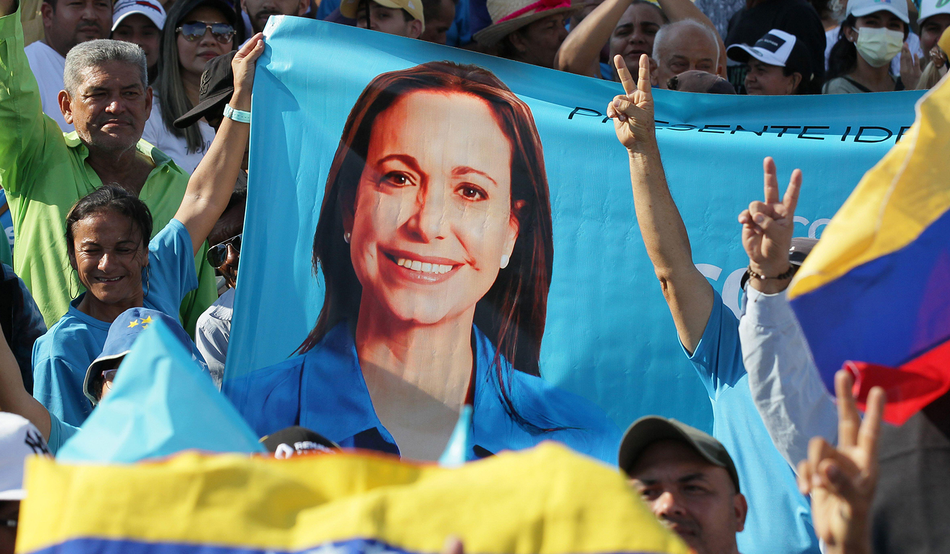
No doubt sensing these motivations in the White House, Venezuela’s political opposition has promised to open up the country’s oil industry to foreign investment. “Our message to the oil companies is ‘we want you here’,” proclaimed opposition leader (and recent Nobel Peace Prize winner) María Corina Machado, speaking in June to a partly American audience. “We want you here producing millions of barrels a day.”
Even Maduro himself is reported to have recently offered up more of Venezuela’s oil wealth to the US in an apparent attempt to forestall regime change efforts. But, even with such flexible thinking on his part, it seems unlikely the US will see him as the genuinely amenable partner in joint resource development that it seeks.
For a brief period in recent years, when international momentum for climate action was mounting and the clean energy transition seemed unstoppable, the risk of wars and conflict driven by oil appeared to be receding. But with fossil fuels still supplying some 80 per cent of the world’s energy, it is perhaps unsurprising that they continue to cause geopolitical tensions.
It would be fitting, if tragic, if a US president so avowedly in favour of fossil fuels were to trigger yet another of the oil-fuelled conflicts that have long been a feature of the fossil fuel age.