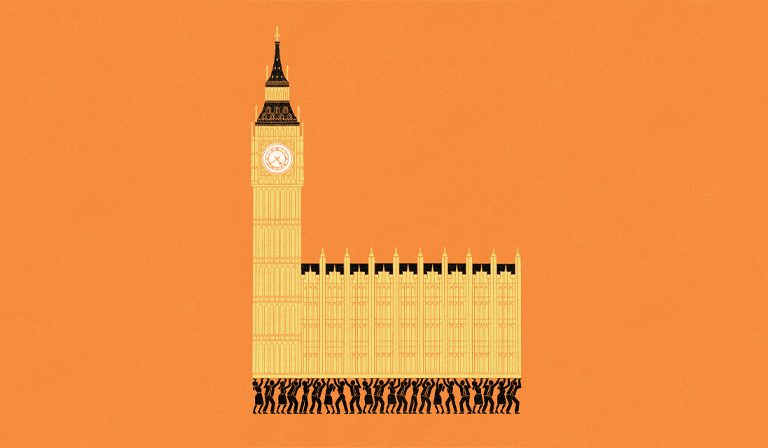
Apolitically neutral civil service was, according to the historian Peter Hennessy, “the greatest single governing gift of the 19th to the 20th century”. But is it a gift suitable for the 21st century?
Dominic Cummings, a former adviser to Michael Gove when he was education secretary, and later to Boris Johnson as prime minister, believes that the civil service needs radical reform. In 2014 he argued that the principle of a permanent civil service was “an idea for the history books”.
Reform UK appears to share his view. Last year, the party said that it would expand the ability of ministers to appoint and dismiss senior officials and replace permanent secretaries with people more amenable to its programme. The Conservatives are also toying with greater political control of the service, since many believe—mistakenly, in my view—that officials did not serve them well over Brexit. But it is the permanence of the civil service which underpins its neutrality.
When former ministers accuse officials of blocking policy, it is sometimes because they themselves lacked clear policy priorities. For most civil servants respond to, and indeed welcome, clarity and decisiveness on the part of their political masters—although occasionally they are so anxious for their minister to succeed that they fail to warn strongly enough of the practical difficulties involved in implementing their wheezes. That is why we get policy disasters such as HS2, the Millennium Dome and Concorde. It is often forgotten that many of the policies blocked by Sir Humphrey in Yes Minister were quite foolish ones.
We are accustomed in the UK to a sharp separation of powers between politicians and civil servants. Officials enjoy security of tenure but must abstain from party politics. They are expected to be impartial and objective, serving governments of every political colour. Political decisions, we believe, are for those who have been elected, except for the very small number of peers who become ministers.
We tend sometimes to assume that our non-political civil service is a universal phenomenon. The UK, however, is among a minority of democracies which retain it. In most countries, the United States being but an extreme example, top officials change when the administration changes. In many European countries, the role of officials tends to be different from what it is in this country. Unlike us, they are familiar with the non-elected politician. Jacques Delors, for example, was not a member of the French legislature when he became finance minister in François Mitterrand’s government in 1981, nor indeed was he ever elected to it; and he was appointed, not elected by the public, to the powerful position of European Commission president in 1985. Similarly, Ursula von der Leyen, the current Commission president, was not elected directly by the public but nominated by the European Council and elected by the European Parliament. We often find ourselves bemused that such figures present their opinions on television, just as we would be surprised to see our own top civil servants airing views on policy. I was once at a meeting addressed by an EU commissioner from Denmark, and in a questions round a British MP in the audience referred to him as an “official”. The commissioner bristled. Delors and von der Leyen would have bristled even more had they been referred to as officials. But we find it difficult to understand the phenomenon of the non-elected politician; it is perhaps one of the reasons why we found it so difficult to accommodate ourselves to the European Union.
In Britain, by contrast, a trained civil servant will ask not, “Do I agree with government policy?”—Brexit, for example, which many officials were no doubt privately against—but rather, “How can I help to ensure that it is a success?” A British civil servant’s position is akin to that of a barrister, who asks not, “Is my client guilty?”—that is a question for the jury—but rather, “How can I present my client’s case most effectively?”
Civil servants work for the government of the day whatever it is. I remember Robin Butler, the former cabinet secretary, telling me many years ago of his time as private secretary for economic affairs in Number 10 in the 1970s. In the early years, he was working 14 hours a day on Edward Heath’s economic policies. But he then found himself working 14 hours a day for Harold Wilson, on completely opposed economic policies, after Labour won the February 1974 election. Anyone not prepared to do that, Butler added, ought not to be a civil servant.
Are there limits to the allegiance of civil servants if they conscientiously believe that the government is pursuing unwise or immoral policies? It is alleged that, in 1956, after British and French troops invaded Egypt in retaliation for the nationalisation of the Suez Canal Company, many British officials were worried by the Conservative government’s secret collusion with Israel. They called the former Labour prime minister Clement Attlee and asked him what they should do. His response was allegedly brusque: “You’re civil servants. Go away and do as you’re told.”
An official can, nevertheless, resign if his or her conscience is offended, though it is perhaps worth remembering that Attlee once said that conscience was “a still small voice and not a loudspeaker”. After resigning, a civil servant can give reasons for the resignation in general terms but must not reveal detailed confidential advice which was given to ministers, who are entitled to feel that internal advice should remain private. Revealing disagreements between ministers and officials would surely lead to the appointment of more pliable officials; good government would suffer.
In addition to career civil servants, there are of course special advisers such as Morgan McSweeney, the former chief of staff to Keir Starmer. They are explicitly political, their policy views generally well known and they are not bound by provisions of impartiality and objectivity. But constitutionally they are akin to civil servants, in that they speak for their minister, who is accountable to parliament for their activities. Everything that they do is under the implicit authorisation of their minister, so blaming special advisers for ministerial policies is pointless, as no one can tell whether ministers accepted or rejected their advice.
Special advisers preserve a politically neutral civil service by enabling a distinction to be drawn between partisan advice and the impartial advice of career officials. The appointment of special advisers ends when their minister leaves office.
The experience of the United States and many other democracies shows that there is no reason, in principle, why we should retain our non-political civil service. But to discard it would be a bad mistake. It is easy to be a good Conservative, Liberal Democrat, Labour, Reform or Green supporter. It is far more difficult to speak truth to power.
During the Second World War, the chief of the imperial general staff, Alan Brooke, was far ruder to Winston Churchill than he had any right to be. One of Churchill’s cronies told Brooke that the prime minister was upset and believed that Brooke hated him. Brooke denied that he hated Churchill and said that he in fact adored him, but added: “The first time I tell him that I agree with him when I don’t will be the time to get rid of me for then I can be no use to him.” Perhaps Brooke’s riposte should be pinned to the office wall of every minister and senior civil servant. The relationship between Brooke and Churchill was essential to winning the war, and the prime minister knew it. Indeed, as Churchill is reported to have said with some admiration, when he furiously banged the table, Brooke “thumped the table harder”.
Politicians have often said, when faced with a problem, that a business approach can ‘fix it’
The great danger for ministers—and particularly for prime ministers—is that they come to be cocooned. They are surrounded by flatterers and juniors in awe of and dependent upon them, so they come to think that they are infallible and indispensable. That is what causes a prime minister’s downfall, from Starmer going back to Liz Truss and Johnson in 2022, Margaret Thatcher in 1990, Heath in 1974, Harold Macmillan in 1963, Neville Chamberlain in 1940, David Lloyd George in 1922 and HH Asquith in 1916.
In recent years, however, politicians have been undermining the principle of security of tenure of career civil servants. It had been an accepted convention that the cabinet secretary, the senior civil servant advising the prime minister and cabinet, who is personally appointed by the prime minister, enjoyed security of tenure until retirement. But in 2020, in Johnson’s government, Mark Sedwill resigned prematurely. He was widely reported to have been forced out, with Dominic Cummings alleged to have played a role in his departure. Then in 2024, Sedwill’s successor, Simon Case, resigned, citing ill health. Finally, earlier this year, Chris Wormald, who had been Starmer’s personal choice for the post after Case’s departure, resigned after just 14 months in the job. He first learned that he would be required to resign from the newspapers. Even more dramatically, Olly Robbins, permanent secretary at the Foreign Office, was dismissed by Starmer in April amid the repercussions over the appointment of Peter Mandelson as UK ambassador to the US. Robbins recently received a six-figure sum in an out-of-court settlement with the government.
The attack on security of tenure has constitutional implications, since that is the principle underlying civil service neutrality. If an official can be arbitrarily required to resign by the prime minister, the fear of being sacked could inhibit him or her from offering candid yet unpalatable advice. The Constitutional Reform and Governance Act of 2010 provided a statutory basis for managing the civil service and regulating the appointments process. But it did not regulate dismissal, as the case of Robbins shows. That was a serious omission, which should now be rectified.
We should, then, retain and indeed strengthen our non-political civil service. But if we do, we must confront two fundamental and interrelated challenges.
The first is the excessive recruitment of outsiders. Such appointments are of two types. There are specialists who bring expertise not already available to the service, and the generalists who are put in charge of departments. It is in the latter that the danger lies.
If you join the civil service, you will inevitably be called upon to serve successive administrations of different political stripes. Recruits from outside will lack these traditional patterns of experience which help to socialise civil servants as impartial advisers. Such experience is gained, for example, by becoming private secretary to a minister early in your career. In addition, someone recruited from outside by virtue of his or her relevant knowledge may arrive with prior policy commitments making them unacceptable to a different government. From this point of view, there is a case for arguing that, before an outsider is recruited into the career civil service—as opposed to being brought in as an expert or special adviser—the leader of the opposition should be consulted. The civil service, after all, belongs not only to the government of the day, but also to any government which might take office at some future date. The introduction into the civil service of too many people with prior policy commitments sympathetic to those of the government of the day could, by stealth, transform the service into a quite different animal.
The second challenge to civil service neutrality is the philosophy of managerialism. Much of the impetus for reform has stemmed from the view that Whitehall needs to adopt business practices to become more efficient. No doubt there are some such practices from which the civil service could benefit. And the best way of introducing them may be to recruit people from business to help develop them. But the business and management paradigm has gone too far. Problems are bound to present themselves differently in government from the way they appear in the private sector. It is a great mistake to seek to assimilate the two cultures.
Politicians have often said, when faced with a problem—whether it be in the BBC, universities or the NHS—that a business approach can “fix it”. The outcome has been a lowering of morale in all of these institutions. That must not happen to the civil service.
Reformers argue that a “closed” civil service is an anachronism, their implication being that the civil service is a branch of management rather than a profession. But professions are almost by definition “closed”, in that they require a period of specialist training before you can be qualified to do them. None of us wants to be treated by a doctor or advised by a lawyer who has not undergone such specialist training. By analogy, civil servants are trained to be experts in understanding the workings of government and public administration. Such expertise is by no means easy to acquire.
The procedures of public administration and private business are in fact quite distinct. There is no analogy in the private sector to the central constitutional principle of ministerial accountability to parliament: the business of a government department is scrutinised quite differently to the operations of a public company. In the latter case, the net financial outcome of all of the firm’s operations over a period of time will be evaluated at the annual meeting of shareholders. Parliament, by contrast, can scrutinise any operation at any time, even some considerable time after the operation in question. Moreover, the board of a company does not have to defend its policies on a continuous basis before a body of critical shareholders constituted as a parliament, whose official opposition seeks to highlight the board’s mistakes. This has obvious implications for record-keeping and the avoidance of risk. Civil servants must always consider how their minister would justify their actions to parliament, for it is the minister who will be publicly blamed when things go wrong. An official, therefore, must be certain that a particular decision will not give rise to a precedent which might compromise the minister by, for example, incurring an unwarranted increase in public expenditure. This is bound to constrain the degree of “creativity” and “leadership”, concepts so beloved by management consultants. Under our constitution, it is for politicians, not civil servants, to display leadership. Marks & Spencer can show initiative by lowering prices in some branches when sales are poor. Were civil servants to show similar initiative, they could cost the country millions of pounds in public money. The concern with process and precedent is essential in a parliamentary democracy in which MPs can, at any time, question ministers on matters of detail.
Further, a government department, unlike the branch of a company, cannot simply go out of business when market conditions are unfavourable. Not too long ago, WHSmith sold off its high street shops to another business, which has rebranded them as TG Jones. An equivalent option is not generally available to government, which cannot pick and choose responsibility for tax collection, the distribution of benefits, law and order or the defence of the realm.
The civil service has long attracted criticism, if not derision. In a lecture delivered in 1950, Edward Bridges, head of the Home Civil Service, “confidently” expected “that we... shall continue to be grouped with mothers-in-law and Wigan Pier as one of the recognised objects of ridicule”. The service is still, to adapt a comment made of the Treasury by a former head of the Home Civil Service, Laurence Helsby, a “natural target of those with whom vituperation passes for knowledge”.
Then again, no one has ever suggested that the civil service is perfect. Earlier this year, in the King’s Speech, the Starmer government announced a wide-ranging review of the service to strengthen it while safeguarding its impartiality. The review is to be led by the new cabinet secretary and first female head of the Home Civil Service, Antonia Romeo. It can be expected to emphasise the vital need to reward high performers and manage poor ones, while getting rid of those who do not pull their weight.
While it has its share of incompetents, levels of professionalism and integrity in the British civil service are high. It has served us well. It would be folly to allow politicians to snuff it out.