If there was one victim in the Jason Arday affair, it is surely Dr Nathan Cofnas, the academic who reported the late Cambridge professor for alleged plagiarism. A distressing silly-season witch hunt followed and tragically culminated in Professor Arday’s suicide in August; multiple investigations have since failed to substantiate the allegations made against him.
Yet go to Cofnas’s Substack and you’ll find an image which he has reposted. At first glance, it appears to be an oil painting of Christ on the cross. Closer inspection, however, reveals that it is not Jesus, but Cofnas. It is a striking piece of iconography, presenting the academic as a Christ-like martyr, complete with a halo, golden celestial light and a reverential Renaissance-style composition.
The near-naked body looks fit (elsewhere on his Substack, Cofnas posts videos of himself attempting to pump iron). A loincloth flaps in the wind. But the bespectacled face is incongruous, wearing a smug, slightly content half-smile instead of agony. The result is a crucifixion with all the glory and none of the cost. There are no nails or visible suffering. Cofnas looks curiously pleased with his predicament.
As well he might be. Until comparatively recently, Cofnas was a rather pitiful and obscure figure, whose own collegiate association with Cambridge was severed in 2024 once he started using his Substack to promote what he calls “race realism”, and which many others call plain racism. A rigorous inquiry by Cambridge concluded in 2025 that his published views, while seen by many as offensive, did not breach the law and did not contravene university regulations designed to uphold free speech.
You may remember his theory that, but for woke Diversity, Equality and Inclusion (DEI) initiatives, there would be virtually no black professors in elite universities. Not clever enough. Indeed, black people would vanish from virtually all high-profile positions outside of sport and entertainment.
His work was denounced as shoddy stuff by fellow sociologists, who compared his “harmful” ideas to those of anti-vaxxers, creationists and climate change deniers. He turned up at Ghent University, where, once again, academic colleagues questioned his qualifications. Philosophy department academics suspected his appointment had been “an ideological choice … decided in advance”. There was “astonishment and indignation” over his role.
But all that was before the resignation, and subsequent death, of Professor Arday. Since then, the Martyrdom of Cofnas has emerged. This features our hero trying to explain to assorted podcasters and YouTubers why he’s right about racial differences in IQ—and why all the wokies are still wrong.
Next month he’s due to be feted at Oxford University, where he will ask the question: “Is DEI undermining higher education?” The event is at Oriel College and is being promoted by Oxford University’s Reform Society, and there are plenty of calls to cancel it (see under Martyrdom).
As far as the University of Oxford is concerned, the answer to the debate’s central question can be crisply answered: No.
If Cofnas is worried about too many DEI hires at venerable academic institutions, he can relax. Out of Oxford University’s 2,000-strong academic workforce, there appear to be just 14 academics identifying as black—or 0.7 per cent.
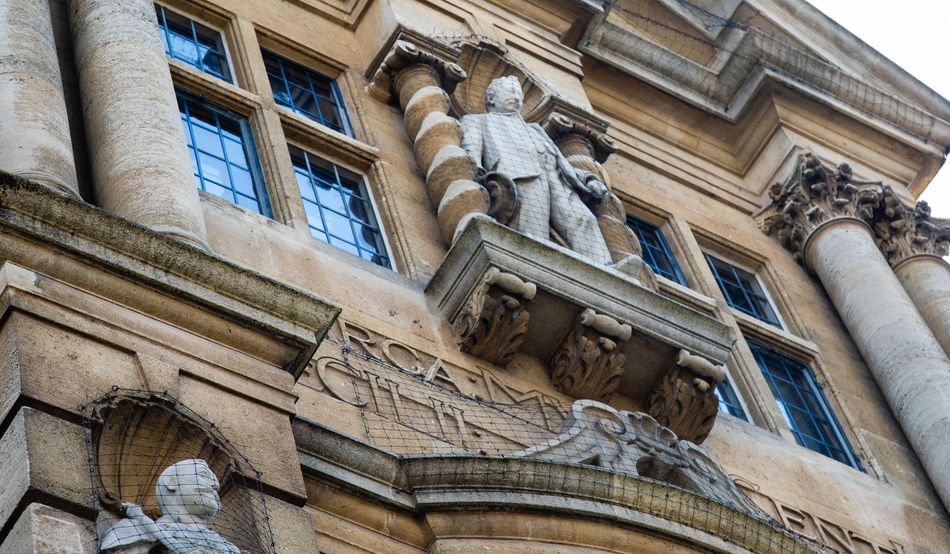
Oriel College should feel like safe ground for him. He will pass by the statue of the noted racist Cecil Rhodes. The college Governing Body voted six years ago to remove it, but it’s still there, along with a plaque meekly describing him as “a committed British colonialist”. Rhodes did not, in the end, fall.
Last year, out of an intake of 198 Oriel College undergraduates, just two were black, which fits a three-year pattern of 2.3 black students a year. Just 98 students came from state schools against a healthy 93 from independent schools—despite only 7 per cent of people going to private schools in the UK. Nothing to worry Cofnas there.
Of course, there has been hand-wringing at Oxford over the years. In 2009, the university set a “challenging” target of increasing the number of students from disadvantaged backgrounds. But Cofnas can relax, because in six of the subsequent eight years Oxford failed to hit it.
The university then set another target, pledging to recruit a further 23 students from low-economic backgrounds. But, again, no need for Cofnas to worry: that’s less than one per college—and fewer than the number of Wykehamists who typically arrive each year.
None of this will stop Cofnas venting his grievance that unqualified people are, as a result of ideological commitment, infiltrating higher education. Which is a touch ironic, since a significant number of his colleagues in the academy evidently think he’s pretty second-rate himself.
The 2020 letter to the editors of Philosophical Psychology by nine professors accused Cofnas of misleadingly presenting “racial realism” as science; of ignoring evidence that doesn’t suit him and of talking nonsense when he claims that research into race and IQ has been suppressed. The authors stop short of claiming they know his motives, but they say the article “can reasonably be read as pandering to proponents of scientific racism.”
Plenty of Cofnas’s colleagues at Ghent seem to feel the same way. After Arday’s death the university briefly suspended him. Trump’s State Department threatened to review funding. Cofnas has been allowed to resume his research, but not his teaching. Protest letters with thousands of signatories—both for and against—have been flying. And, yet, the podcast invitations keep coming.
I find the portrayal of Cofnas as some kind of martyr to be distasteful. The Jesus image, which he reposted, is loathsome. But of course he should be allowed to turn up at Oriel College and speak. If the university is doing its job it will ensure that he is both tolerated—and properly challenged.
Cambridge University got into deep water in 2020 when it muddle-headedly floated a free speech policy under which all academics must treat other academics with "respect”. That was robustly, and rightly, rejected.
There’s no cause for Oxford students to listen to Cofnas with respect. Scorn, derision, mockery, rebuttal and ridicule may all be in order. But it is right that he has his moment in the shadow of Cecil Rhodes. Perhaps, then, he will be soon forgotten. Making him a martyr will have the opposite effect.