Let me float a scenario so preposterous that you will want to stop reading. A well-known company is recruiting trainees, but there are certain hurdles to clear before a candidate can be offered a job. “First question: are you in a same-sex marriage? Because, if so, we won’t train you. Secondly, you should know that if you’re gay and hoping for a role in senior management, we’ll need your assurance that you won’t have sex. Finally, we like to warn women candidates that one or two of our top executives and funders are a bit funny about having females in positions of power. Don’t worry, we’ll still hire and promote you – we’ll just find a workaround so you don’t have to report to those guys. OK?”
As I say, preposterous. Could never happen. For one thing, it would be illegal. For another, the bosses would be named, shamed and generally held up to public odium and ridicule. Except this is how the UK’s established church behaves. Still.
Just recently, the bishops of the Church of England had the opportunity to move on from this bizarre pyramid of nonsense and hypocrisy, and they bottled it. The Church continues to treat gay people as second-class citizens. Which might matter less if this were a small sect or cult. But at the top of this weird pyramid of discrimination sits the King. He is, literally, the supreme governor. And the Church’s top 26 managers sit in the House of Lords, where they make laws for the rest of us.
So, yes, I think it matters.
This came to a head a couple of weeks ago at the General Synod, the CoE’s governing body. At stake was a proposal to allow priests to conduct standalone services of blessings for couples living in committed same-sex relationships. The issue has been under discussion since 2017 under the vague rubric of Living in Love and Faith (LLF).
This was, depending on your point of view, either a small step or a huge one. Gay couples can already have their relationship blessed with so-called “Prayers of Love and Faith” in the course of a normal church service. But, for some conservatives within the church, a standalone ceremony smacked too much of gay marriage.
The Bishops voted 34-0 (with two abstentions) to close down the LLF discussions. Instead, they have decided to replace the now-abandoned LLF working group with two more working groups. Since the days of Rowan Williams as Archbishop of Canterbury, as one theologian told me, the doctrine of the Church has been “Keep talking and never decide”. So, no change.
Meanwhile, the status quo in the CoE appears to be something like this. If you’re in a same-sex marriage, the Church will not accept you for training or ordination. If you’re already a priest and in a same-sex relationship, you have to promise (or pretend?) that you won’t have sex with your partner. And you can’t get married.
Thus, there are openly gay Deans (Canterbury or Southwark, for instance) in committed relationships. The Church can just about stomach that, on the premise that they are celibate. It’s all a bit “Don’t Ask, Don’t Tell”. But, famously, when the Dean of St Albans, a man called Jeffrey John, was appointed Bishop of Reading in 2003, it was all too much, and he was forced to withdraw. Gay enough to run a cathedral; too gay to run a diocese.
There are gay bishops, of course. In 2015, Nicholas Chamberlain was consecrated as Bishop of Grantham, even though it was known—by the authorities, if not the public—that he was living with another man. Williams’ successor, Archbishop Justin Welby, said in 2016, when a newspaper was threatening to “out” Chamberlain: “He lives within the bishops’ guidelines and his sexuality is completely irrelevant to his office.”
And yet, 10 years later, his fellow bishops voted 34-0 to block gay couples from being blessed in standalone ceremonies, even if they can be blessed during church services. Despite the top man saying that sexuality is “completely irrelevant”.
If all this strikes you as absurd, that’s certainly how it looks to Scottish Christians. The Episcopal Church decided in 2017 that clergy could officiate at a gay marriage, while respecting the right of anyone who didn’t want to. The Church of Scotland arrived at the same position in 2022. When last checked, they use the same Bible as the Church of England.
I asked the (gay) provost of Glasgow’s St Mary’s Cathedral, Kelvin Holdsworth, how he explained the difference.
“I think in England you have this thing about who really gets to exercise the power in the Church of England to appoint bishops, who sit in the House of Lords and are part of the state structure,” he told me. “And this debate is, I think, less about gay people than it is about who gets to hold that power.”
He was one of three knowledgeable observers I spoke to who drew attention to the powerful evangelical wing in the CoE. “It’s in the ascendancy in the CoE, partly because it’s better funded. I mean, the Holy Trinity Brompton thing has been growing and it’s been a deliberate policy to gain that power.”
Holy Trinity Brompton (HTB) is the well-funded powerhouse mothership of charismatic evangelicals and the Alpha movement, along with the Church of Evangelical Council (CEEC)—an umbrella organisation for evangelicals. The leaders of HTB have opposed greater equality for gay people within the Church.
Sir Paul Marshall, founder of GB News, has put huge sums into the creation of the HTB-based Church Revitalisation Trust, which says its aims are “The Evangelisation of the Nation, The Revitalisation of the Church, The Transformation of Society.” Sir Paul is said not to want to get drawn into this specific issue. He is said to support blessings of same-sex relationships, but will not say whether this should be allowed in a standalone service. It is also strongly denied that he has tried to influence the debate within the Church.
In order to force the CoE to abandon the Living in Love and Faith initiative, the CEEC proposed creating “a de facto parallel province”, even encouraging its associated parishes to contribute to a so-called Ephesian Fund—a “conscience fund” designed to stop dioceses from supporting parishes which support views they consider “non-Biblical.” In other words, a church within a Church.
“The tricky thing is that the conservatives have got all the money,” Andrew Graystone, a theologian who has studied the evangelical influence, told me. “And as ever, that’s what it comes down to in the end. So they’re always on the verge of taking the ball away and leaving the pitch, and are very good at threatening that.” Indeed, the CEEC can wield huge power through the Ephesian Fund by withholding it from “bad” churches and depriving the CoE broadly of parish funds.
The Rev Richard Coles, broadcaster and (gay) priest, told me he likened the conservative evangelicals to the Militant Tendency in Liverpool in the 1980s (In which Trotskyists infiltrated the Labour party). “They have got very organised and have come to get more of a grip and exert more power over the institutional bodies of the Church of England.” He asks why it was considered okay to reverse a ban on the remarriage of divorcees (explicitly forbidden in the gospels of Matthew and Luke) but not to treat gay people as equals. “It’s hard not to think, ‘Well, the reason is, it's about gays, and actually they think we have no place in the community of the saved.’”
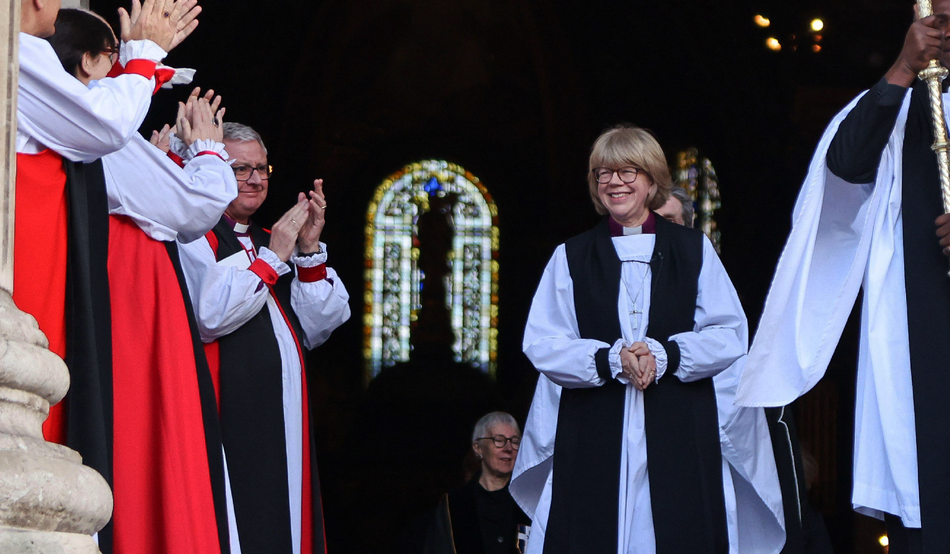
The new Archbishop of Canterbury, Sarah Mullally, was England’s chief nursing officer before becoming ordained. If she’d treated gay people as second-class citizens in the health service, she wouldn’t have lasted five minutes. Now she has a choice. “Keep talking and never decide?” Or show some courage?