When a great newspaper changes hands, it’s worth paying attention. Britain would be a different country without Rupert Murdoch. American politics is today less well scrutinised because of Jeff Bezos. The Financial Times has been blessed to have had wealthy hands-off, enlightened owners in Pearson and Nikkei. That’s good for the UK.
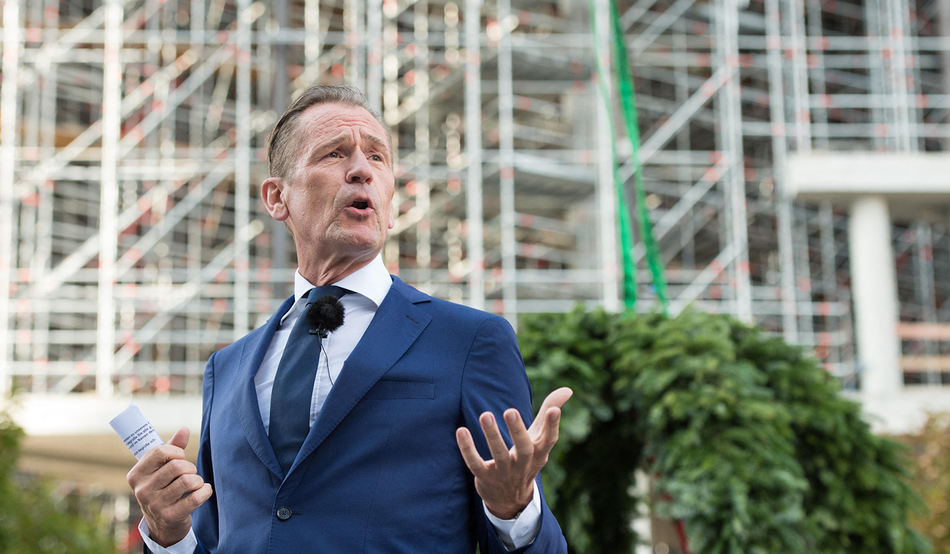
So we should pause and consider the significance of the Daily Telegraph falling into the hands of the German publishing giant Axel Springer, led by its powerful and charismatic CEO, Mathias Döpfner. The sale, for a reported £575m, ends a long period of limbo during which the paper fiercely fought off a bid which included funding from the UAE. Cue relief all round.
Well, to borrow Evelyn Waugh’s phrase from the classic Fleet Street novel, Scoop: “Up to a point, Lord Copper.”
Diligent Telegraph journalists will doubtless have turned to Google to find out more about their new boss. They will have stumbled upon a December 2024 article in… the Daily Telegraph, headlined “Pro-Trump German press baron ‘encouraged Musk to back AfD’.”
According to the story, Mr Döpfner encouraged Musk to tweet in support of Alternative für Deutschland, a party classified as “right-wing extremist” by Germany’s domestic intelligence agency. This, the paper reported, was part of a stratagem by Axel Springer’s CEO to get his own newspaper, Die Welt, to publish an article by Musk supporting the AfD, which duly followed. Musk called the AfD “the last spark of hope for the country.”
The paper’s editorial board was fiercely opposed. The head of the opinion section, Eva Marie Kogel, resigned. More than 40 editors condemned Musk’s contribution as “campaign advertising disguised as a guest article.” The German Journalists’ Association said that Die Welt’s reputation was “currently being thrown into the trash with a loud crash”. German media must not “allow themselves to be misused as a mouthpiece for autocrats and their friends”, it raged.
A comment piece, also in the Telegraph, explained how Döpfner had broken a very powerful postwar taboo by insisting on Musk’s piece. The German-British historian, Katja Hoyer, drew comparisons with the press magnate Alfred Hugenberg, who became a key enabler of Hitler: “Seeing the party promoted by the most successful businessman on earth in a mainstream newspaper might well lend them respectability of the kind Alfred Hugenberg once afforded the Nazi Party.”
Mr Döpfner insists that the publication of the article was “at the sole discretion of Die Welt’s Editors and that he didn’t influence the decision to publish the article”.
This was not the first time that Döpfner’s own journalists had sounded the alarm over his views and the prospect of editorial interference. The previous year Die Welt journalists formed a Redaktionsausschuss (editorial committee) intended to safeguard editorial independence. It was triggered by a cache of leaked messages, chats and emails from Döpfner which found their way into Die Zeit.
He is, to judge from these leaks, no fan of East Germans, describing them as “either communists or fascists. They don’t do in-between. Disgusting.” He appears to have urged his flagship tabloid, Bild, “to do more for the FDP” [the pro-business Free Democratic Party].
Writing of media coverage during Covid, he wrote: “Most [journalists]are just uncritical propaganda assistants.” He also messaged: “I am all for climate change,” seemingly arguing that human civilisation was always “more successful” when the climate was warmer. He summed up his foreign policy views as “Free west, fuck the intolerant Muslims and all the other riff-raff.”
Döpfner claimed that many of the messages were taken out of context and did not represent his true views. But he has made no secret of his admiration for JD Vance, praising his “inspiring” speech at the Munich Security conference last year.
So, Telegraph journalists will know by now that their new proprietor is a man of strong opinions and that he has a track record of using his own newspapers to promote them. How will they respond?
The paper has a mixed record of being open with its readers. In 2015 the paper’s veteran chief political commentator, Peter Oborne, resigned, claiming that articles were routinely suppressed, removed or commissioned for commercial reasons.
This was the unhappy period when the Barclay Brothers owned the title. Oborne laid out a sorry story of declining editorial standards, including knowingly publishing false stories and a demeaning pursuit of web traffic. He concluded that he had a duty to make his concerns public because the Telegraph’s coverage of certain issues amounted to a “form of fraud” on its readers.
The Telegraph’s response was to denounce Oborne and set revenge dogs on anyone who dared to question the paper’s editorial ethics. It was only when the Barclay Brothers turned out to be walking bankrupts that the paper started being more candid about some of the murkier episodes that had occurred during this period.
More recently, the paper has been reprimanded by the press regulator Ipso—albeit with a feather duster—for a story from May 2025 headlined: “We earn £345k, but soaring private school fees mean we can’t go on five holidays.”
This touching story featured investment banker Al Moy and his family, who had to switch from Waitrose to Sainsbury’s, cut the gardener back to once a month, and take fewer long-haul foreign holidays to make ends meet after VAT was added to school fees. There were touching photographs of the oppressed Moy family.
The problem with the story is that the photographs were stock pictures and there is no evidence that the Moy family exists. According to reporting by Press Gazette the supposed “case study” was set up by a PR working for a financial planning firm. A reporter was duped.
The Telegraph went into damage control, conceding that the pictures were fake and coyly saying that it had “lost confidence in the article.” An apology stopped short of admitting the whole article was fake. Readers were left in the dark.
And so was the regulator. An astonishing paragraph in the Ipso adjudication published this month includes the sentence: “The publication said it was not in a position to provide IPSO with further information about how the article came to be published, given this information related to internal and confidential investigations.”
In other words: piss off and stop bothering us.
This was the newspaper which, only weeks earlier, had worked itself into a huge lather over BBC editorial standards in a series of articles which led to the decapitation of the organisation and a $10bn legal action by Donald Trump.
Do as we say, not do as we do.
Now, Mathias Döpfner—an art aficionado known to have a large collection of female nudes—may turn out to be a brilliant, buccaneering publisher and could yet transform the fortunes of newspapers, which have been somewhat in the doldrums in recent times. Equally, he may find himself unable to resist interfering in the paper’s coverage—and thus, potentially, in British politics.
How would we know? Would there be principled souls like Eva Marie Kogel or Peter Oborne who’d resign and blow the whistle? Will Telegraph journalists—so vocal in rejecting other bids—demand some form of editorial board to ensure the paper’s editorial independence? Or will they, as the staff mostly did during the Barclay Brothers years, quietly keep their heads down? And attack anyone who asks awkward questions?
There’s one small act of reparation which Michael Gove, now editor of the Spectator, might do.
If there was one journalist who enshrined the integrity of the old Telegraph, it was its former editor, Bill Deedes, said to be a part-inspiration for the main character in Scoop. Before he died he described the Barclay Brothers as “a stinking mob”.
Peregrine Worsthorne, former Sunday Telegraph editor, referred to this in a 2008 piece he wrote for the Spectator, also then owned by the Barclay Brothers. He was told that the magazine couldn’t possibly be seen to attack its own proprietors. And so—wickedly—the phrase was altered to make it seem as if Deedes had been insulting his Telegraph colleagues rather than the reclusive owners.
I checked the piece today. It has still not been corrected, 17 years later.
So, Michael, honour Bill Deedes by finally setting the record straight. And, Telegraph journalists, be prepared to stand up for truth and openness. Bill Deedes would expect nothing less.
This piece was amended on 16th March to include Mr Döpfner’s denial that he influenced Die Welt’s decision to publish the article by Elon Musk.