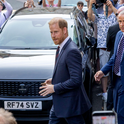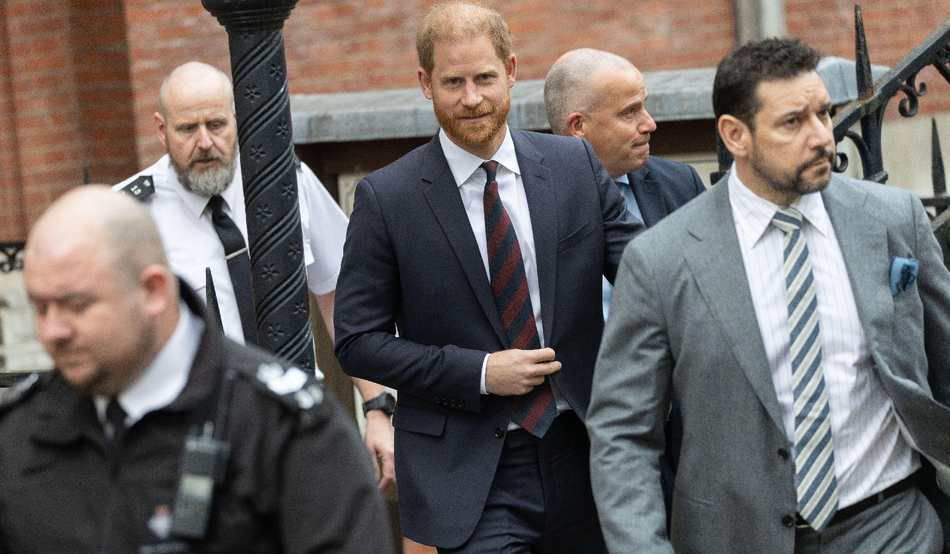
Oceans of ink have been drained in trying to explain what Prince Harry hopes to achieve in the quietly spectacular drama currently being played out in Court 76 of the Royal Court of Justice.
Is it about revenge, justice, grievance, truth, vindication? Belated retribution for what his mother had to put up with at the hands of tabloid journalists? A chivalrous attempt to protect his wife, Meghan, and his own children from suffering the same fate?
Whatever the motive—and whatever the truth of his claims against Associated Newspapers—there is something almost recklessly heroic in his dogged determination to obtain some form of accountability for a generation of Wild West lawlessness in Fleet Street.
His targets also know a thing or two about revenge. And, like Donald Trump, they have long memories.
In a way, Harry is singlehandedly doing what the second part of the Leveson Inquiry into press behaviour and ethics was never allowed to do. He has already humbled some of the biggest beasts in the Murdoch and Mirror empires. Now he has his sights on the Mail titles—and the stakes, both financial and reputational, are enormous.
Do you remember Matt Hancock, the perky little health secretary who was so out of his depth when he found himself having to respond to the greatest health crisis of our times?
You will doubtless have forgotten that he had previously briefly served as culture secretary. In that role, he quietly shelved the promised Leveson 2, which had been due to look into broader illegality in Fleet Street.
Editors and proprietors broke open the champagne and, in time, showed their appreciation by publishing CCTV footage of Hancock and his “adviser”, Gina Coladangelo, treating his own Covid social distancing rules with uninhibited abandon. Some gratitude!
But the celebrations were premature. Politicians may have decided that upsetting the journalistic establishment was not worth the candle. But two men who had suffered egregious front-page humiliation were not so easily cowed.
One was Max Mosley, the former Formula One boss, who found his exotic sex life splattered all over the front page of the News of the World in 2008. His son, Alexander, died of a drug overdose around a year later. Max Mosley—charming, determined and, above all, rich—devoted the rest of his life (he died in 2021) to turning the tables on his former pursuers.
And the other is Prince Harry.
It’s interesting to speculate whether these two avenging angels would have been quite so fixated on achieving justice had Leveson 2 gone ahead. The judge would have had extensive powers of investigation, discovery and subpoena, along with the ability to compel witnesses to give evidence under oath.
It’s likely that he would have come to the same conclusion as Mr Justice Fancourt, who oversaw Prince Harry’s attempt to prove that phone-hacking was as rife at the Mirror titles as it had been at the News of the World. “There is,” he found, “compelling evidence that the editors of each newspaper knew very well that [phone hacking] was being used extensively and habitually and that they were happy to take the benefits of it.”
Leveson would also have pursued the question of unlawful activity at the News of the World’s sister paper, the Sun. The civil claimants who pursued the Sun were all effectively forced to settle for significant damages but without any open scrutiny of what had gone on in the daily newsroom.
Prince Harry managed to extract a “full and unequivocal” apology and an admission that private investigators working for the Sun had behaved criminally. But Murdoch was willing to shell out more than £1bn in costs and damages rather than allow the full sunlight of a court action.
Leveson 2 would have examined whether all the witnesses in Leveson 1 had told the truth (spoiler: they didn’t). And he would doubtless have had a decent crack at solving the mystery of why quite so many millions of emails were deleted at the Murdoch titles at the very time that the police came knocking.
That’s a question that has vexed former prime minister Gordon Brown, who, for 18 months, has been pressing Met Police chief Mark Rowley to investigate whether his officers were obstructed and evidence destroyed. The Met tells me that material supplied by Brown in November 2025 is “being assessed”.
Leveson 2 would also have turned his steely gaze on Associated Newspapers, which is currently hoping to be allowed to add the Telegraph titles to its stable. Associated has admitted using private investigators but vehemently denies that they were ever tasked with anything illegal.
That may be true—though there is a Mandy Rice-Davies inevitability about such denials. And it is also the case that senior Murdoch and Mirror bosses vigorously protested their innocence right up to the moment that judges found otherwise.
Lord Leveson was unimpressed with Hancock’s decision to abolish his inquiry just as it was getting to the heart of the matter. “It must be in the public interest that the extent of the wrongdoing is publicly exposed,” he wrote to Hancock and the then home secretary, Amber Rudd, “not least because the press itself would have been the very first to do just that if it were to have occurred in any other organisation.”
He said he was confident that “a detailed and independent forensic investigation of compellable witnesses” would at last provide the answers to “who did what to whom”.
If collective editorial consciences had been clear, there would have been nothing to lose. But they weren’t. Fleet Street wasn’t having it—and, instead, has had to submit to a string of unedifying civil actions culminating in the current blockbuster drama in Court 76.
Journalism drapes itself in the crusading colours of morality and truth-telling. But too often the behaviour exposed by Prince Harry and other claimants over recent years has been revealed to be ethically bankrupt, criminal and dishonest.
Whatever the result of the current Associated case, Prince Harry and his fellow avengers have performed a useful public service—and one that arguably should have been shouldered by the state. The world desperately needs honest, professional witnesses who will hold power to account. It’s just a shame editorial leaders couldn’t have shown more openness, courage and truthfulness in facing up to some egregious past failings closer to home.