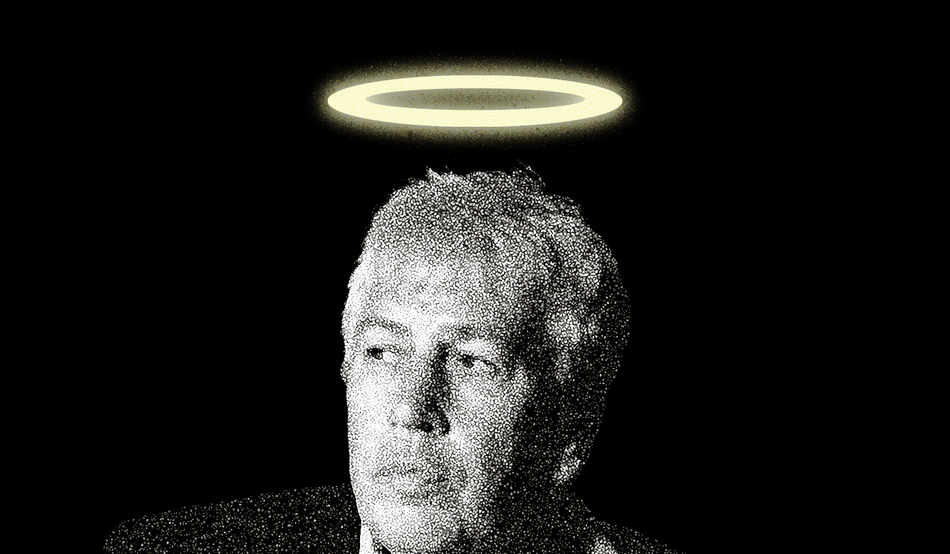
Let no one accuse the Spectator of letting the death of its longstanding columnist Rod Liddle, who died aged 66 on 2nd August, go unremarked. After decking out its homepage in black, the grand old magazine devoted the cover (masthead also in black) and much of the inside of its next issue to Liddle, with fulsome reflections from, among others, former editors Boris Johnson and Fraser Nelson, current editor Michael Gove, Toby Young, Douglas Murray and (former Spectator head of digital) Kemi Badenoch.
Much of the lionisation of their fearless free-speech warrior was amusingly macho. To Johnson, Liddle was the last gunslinger in town, “blazing away from his lonely but glorious redoubt”. For William Clouston he was “hilarious, irreverent and [took] no prisoners, he said what needed to be said”. Gove compared Liddle working at the BBC to seeing “Jack Sparrow at Henley regatta”, adding that: “Rod was strong meat for some. But it was because so many in society were intent on upholding nonsense that he knew he had to puncture it with a broadsword”.
Beyond the somewhat priapic tributes to Rod’s strong meat and big sword, we also had Rod the animal-loving romantic (“Cynics are often thwarted romantics”, noted Gove on the Edition podcast), Rod the devout, Rod the Renaissance Man who aced pub quizzes, and, most regrettably, Rod the Poet, via some sketchily metred doggerel entitled “London: A celebration” (sample sort-of-couplet: “A fat lady from Lagos looking quite glum / With five kilos of gak stashed away up her bum”). After Fraser Nelson declared him “the greatest satirist since Swift”, Gove ran with the comparison, also invoking George Orwell.
But, as Andrew Gilligan, who worked under Liddle at the Today programme, noted, “His only real mission was épater la bourgeoisie”—to provoke the liberals and lefties outraged on behalf of his ostensible targets, whether women, Muslims, gay people, Afro-Caribbean youths, or attractive schoolchildren. Gilligan added, “Thankfully, social media created marvellous new fountains of biens-pensants who could be utterly relied on to take Rod’s bait.”
But the Swift comparison is bait worth taking, not because it is egregious but because of what it says about the third, and most important, target of Liddle’s writing, his readers.
Satire, which most people take to mean “comedy about politics” or “lampooning public figures, especially politicians”, is part of our culture, from the licensed fools of medieval courts, through to Gillray and Rowlandson and Beyond the Fringe. The apparent tolerance of unsparing mockery and exposure is good for those in power, who can stand it as proof that we have no need for revolutions. And it is a limitation for satirists, who are apt to become a branch of the establishment, however ersatz, rather than authentic outsiders.
From Peter Cook and Private Eye to Rory Bremner and Yes, Minister, for all the scathing, clever stuff they contain, one never escapes the sense of one set of public-school boys—comparatively bohemian, but public-school boys nonetheless—flicking elastic bands across the common room at the preppier types who become head boy.
This was not true of Swift. Unusually, his pen produced real change: while working for the Tory ministry of Robert Harley his pamphlet “The Conduct of the Allies” helped turn opinion against the war of the Spanish succession. Once he was exiled in Dublin, his Drapier’s Letters stirred the Irish public against a scheme that would have flooded their economy with debased coinage. But more than that, his goal was to change his readers’ worldview. While working on Gulliver’s Travels, he wrote to his friend Alexander Pope that:
I have got materials toward a treatise, proving the falsity of that definition animal rationale, and to show it would be only rationis capax [‘capable of reason’]. Upon this great foundation of misanthropy, though not in Timon's manner, the whole building of my Travels is erected; and I never will have peace of mind till all honest men are of my opinion.
Any substantial work of art will enact change, however modestly, in those who encounter it; not necessarily in what we think, but in how we see the world. Comedy does this as well as any artform. The joke is itself a unit of change, where the punchline enacts an unexpected turn of thought or perspective.
Liddle’s job, by contrast, was nothing more radical than tickling his readers’ bellies. Like most columnists and comedians, he cultivated an in-group via excoriation of out-groups. As Tom Lehrer remarked of his own satirical songs, “It’s not even preaching to the converted; it’s titillating the converted”, and that applies whether it’s Stewart Lee on Ukip, James Acaster on Ricky Gervais, or Liddle himself. His purpose was not to alter his readers’ worldview but reinforce it, to reassure them that, whatever their foibles and prejudices, they stood on the side of common sense and humanity, while also giving them a flattering sense of their own liberality as they watched him demolish other people’s sacred cows.
He was good at this. He could weight a phrase, land a punchline and switch between registers. If you don’t believe me, compare him to those attempting something similar, as with Andrew Doyle’s feeble comic creation Titania McGrath. He also had some points to make about free speech, human nature and hypocrisy, but all ultimately in the service of saying: You’re all right, Jack. And you too, Henry, Charles, Alastair... To compare him to Swift and writers of like stature is to mistake a hack for an artist.
The excessive veneration is also an indictment of the modern Conservative party: an empty vessel led by an empty vessel; a movement that defines itself by what it is not. Not woke. Not net zero. Not in the EU and, now that that great benison has been secured, not in the ECHR either. A political tendency still in mourning for the certainties of Thatcherism; desiccated and sour, and thereby self-pitying and dull. Winding up the opposition is about all they’ve got, and Liddle was the best at that.
Consider also Badenoch’s new adviser on combating extremism, the former neo-Nazi Joshua Bonehill-Paine. One of his lesser-remarked offences is being handmaiden to the faux-satirical AI slop excreted by the YouTube channel the Crewkerne Gazette. To take one video, an AI-in-a-fatsuit version of Andy Burnham releases Pennywise the clown, who tries to eat him, because he’s fat. Chris Philp and Kemi turn up to arrest Pennywise. Hilarity does not ensue.
Measure him, perhaps, by that low bar, and Rod Liddle truly was a Brobdingnagian in Lilliput.