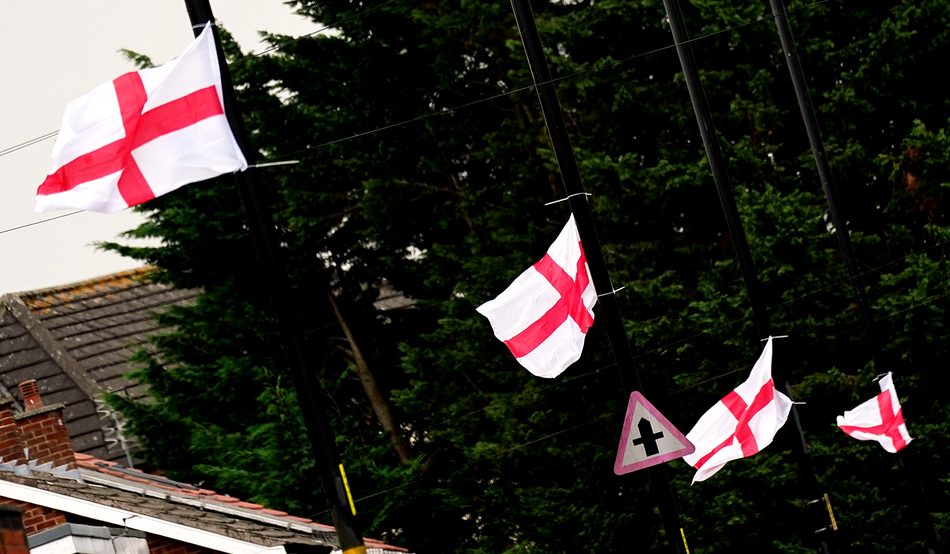
Last week Birmingham City Council obtained a judgment and an injunction in respect of the proliferation of flags in that city’s streets. There were about 20,000 attached to lampposts and other street furniture. Almost all these flags are union (“Union Jack”) flags and the flags of St George. In the south of Birmingham for example, one could see sometimes hundreds of such flags at any one point, from Quinton to Weoley Castle.
None of these flags had authorisation to be hoisted in this manner. Many quickly became eyesores, soiled by the inclement Midlands weather and the exhaust fumes of one of most car-intensive places in England. And although the flags had their supporters, other residents found them divisive. Some of those putting up the flags even intimidated those who dared complain. It was not a happy situation.
What was the city council to do? On the face of it, placing these flags was a criminal offence, but the mild fines and unlikelihood of being apprehended meant that the law was no deterrent. Something more had to be done. And so the council put together a complicated legal case for a High Court order to restrain those putting up these flags.
At first the judge was sceptical and said she was troubled by elements of the application. The court order was not given readily. And what ultimately made the difference was the conduct of some of the defendants. They themselves made it easier for the High Court judge to impose a court order. In a way they only had themselves to blame.
There was not just one legal basis for the court order. The council had to join various legal dots to get to where it wanted. The legal basis for what the court ordered was thereby akin to a Heath Robinson contraption. The council could not just go to a court and point to one discrete provision. It had to work for it.
First, the council had to show that the conduct complained of was unlawful. This is because generally a court will only restrain behaviour with an injunction if there is an arguable case that what is being done either breaches the law or has no legal basis. Here the council pointed not only to the prohibition on erecting such flags on street furniture but also the laws of harassment and public nuisance, which covered the alleged intimidation of bystanders and even of those charged with taking the flags down.
But that would not be enough. The council also had to show that the current criminal law was not enough, by itself, to meet the legal mischief. The court had to be satisfied that the normal workings of the criminal law were somehow not sufficient. The council also had to show that, unless restrained by a court order, such allegedly unlawful behaviour would continue.
Showing both these points is not straightforward. It would not be enough for the council to merely assert these things, it had to provide compelling evidence. The council therefore put together detailed witness statements with extensive excerpts from the social media accounts of those connected with the flag-raising campaign. The council also had to collate statements from those adversely affected. It was a resource-intensive exercise.
Even that would not be enough. The council also had to tie the evidence to the named defendants, and so in schedule after schedule the council particularised the connections between the individuals and the allegedly wrongful activities. Unless the council did this, the court was not going to grant any coercive order against the named individuals. This sort of injunction would not be given on the nod.
And then there was the highest hurdle of all, the one to which the court gave the most anxious scrutiny. This was a case which engaged the right of freedom of expression under Article 10 of the European Convention on Human Rights, which is given effect in United Kingdom law by the Human Rights Act 1998. Of course, there is a certain irony in the defendants in a case like this relying on European human rights law, but they were entitled to do so, and the court was obliged to conduct a balancing exercise.
It is on this human rights point that the court was most careful. Any order had to cover all flags, not just ones which were British or English. The order could not cover flags on private property. There must be some mechanism for gaining permission to hoist such flags in public spaces. The evidence of intimidation rather than inconvenience had to be compelling. The order would be subject to review and those affected would have the liberty to apply for its variation and discharge.
As it happened, almost all the named defendants offered undertakings to the court in lieu of a court order. They undertook not to do the prohibited behaviour. And the council and the court accepted all but one of these offered undertakings.
One exception was the person perceived as the leader of the flag-raisers who, in a sequence of unwise social media comments and live-streamed statements, seemed to indicate that he would carry on. This ringleader therefore not only had a court order made against him, but the order also had attached to it a power of arrest for breach of an injunction. Such attached arrest powers to an injunction are exceptional, and the court was satisfied that he presented an exceptional risk of breach of the court order.
The court also granted an injunction, with an attached arrest power, against “persons unknown” who also may flout the court order. This is more problematic legally, as it provides highly coercive powers against those who were not directly party to the litigation and may not have practical notice of the terms of the order.
Here the court said it was putting in place “robust” safeguards. The council is obliged to circulate the terms of the order as widely as possible. Anyone arrested under this power must be brought before a High Court judge immediately. One can see why the council and the court made such an order, but it is also a risk of abuse and overreach. It may be on this one point that the order may be tested on appeal.
The injunction is only a temporary order. None of the allegations have been subject to a trial. So far, the evidence is on the basis of witness statements and exhibits taken at face value. It would only be after a trial and judgment that this interim injunction may be converted into a final order. But unless there is a trial, this temporary order will stay in place until a court varies or discharges it.
Many “grassroots” campaigns rely on social media, but this case shows that such reliance is two-edged. A great deal of the evidence which the council provided to the court and on which the court relied was generated by the flag-raising campaigners themselves. The council simply and dutifully screenshotted the boasts and threats and used them against the campaigners. In a way, the flag-raising campaigners built their own case against themselves and made it far less difficult for the court to grant the order.
But such a court application is resource-heavy and also dependent on local information. The fact that Birmingham has now followed Oxfordshire in obtaining such an injunction does not necessarily mean any other council can easily obtain one. And the “persons unknown” element of the order may itself not survive appeal. For those who want to clap and cheer at these court orders being made, it is too early to put any flags out.