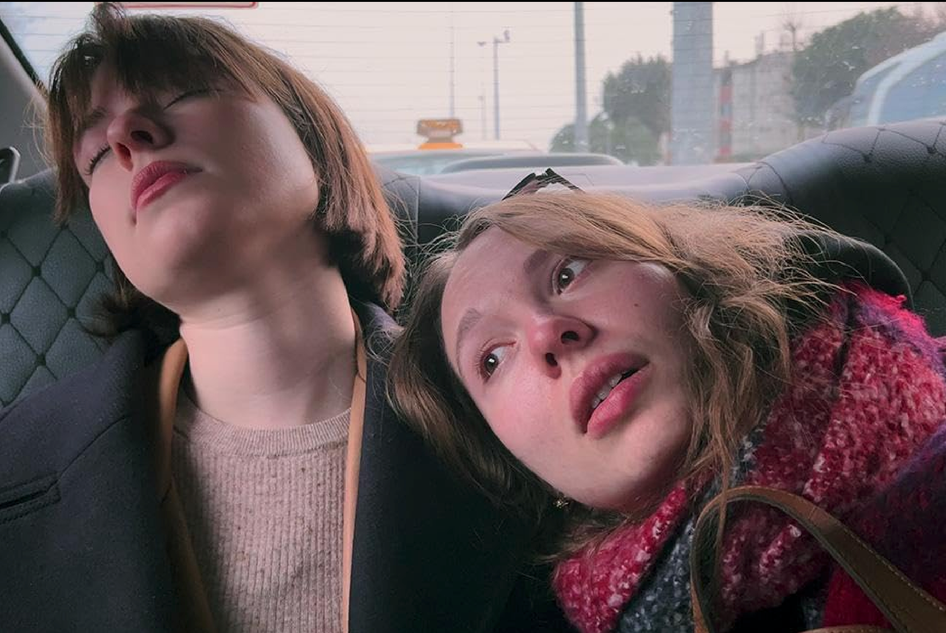
The last time filmgoers saw the female journalists of TV Rain, Russia’s sole remaining independent news channel, they were dashing to the airport. Julia Loktev’s My Undesirable Friends: Part I – Last Air in Moscow had spent five-and-a-half hours documenting their efforts to call Vladimir Putin and his apparatchiks to account. They logged example after example of state corruption, censorship and misinformation. In return, they were labelled “foreign agents”. Then, on 24th February 2022, Russia launched its fullscale invasion of Ukraine. TV Rain’s reporters and editors knew that, if they stayed in the country, they would almost certainly be jailed.
Now, in My Undesirable Friends: Part II – Exile, Loktev shows the women scattered across Europe and beyond, trying to pick up the pieces. Their bank accounts have been frozen. They’re separated from their loved ones. If they return to Russia, even to visit a sick parent, they risk arrest. One likens their psychological state to Valhalla—a “supposed paradise that actually is hell. You’re in this endless loop of time when you’re thinking only about the past, remembering your past exploits. And it’s very hard to overcome this feeling of life after death.”
Undimmed, for the most part, is their belief in the importance of holding Putin to account. They set up podcasts, private Telegram groups for the friends and families of political prisoners, alternative media archives. TV Rain itself is resurrected in a borrowed studio in the Latvian capital, Riga. They make ingenious use of anonymous cameramen and wedding videographers to capture damning footage. Many Ukrainians, though, refuse to talk to them; they’re seen as Russians, guilty by birth. Moscow, meanwhile, dubs them traitors and tries them in absentia. Mourns one: “You feel like it’s 1941 and you’re simultaneously the German and the Jew.”
They work tirelessly, glue themselves to their screens, chase leads around the clock. Yet, inevitably, they have doubts. If presenting the truth is so vital, why is Rashism—the term, popularised in Ukraine, for Putin’s brand of fascism—still in the ascendant? Are they preaching to the converted or do they offer hope to those Russians who pine for better? How should they talk about their countrymen: is a drafted soldier fundamentally an occupier or does he deserve empathy?
Are they preaching to the converted or do they offer hope to those Russians who pine for better?
Things blow up when Latvia’s media regulator, perhaps responding to pressure from Moscow, reacts furiously to the channel’s use of the phrase “our army” on air. Even though the channel was addressing a Russian audience—and its editor-in-chief argues that “our” simply acknowledges that Russians bear responsibility for their army’s war crimes—officials claim it is a threat to “national security” and “public order”. TV Rain has its licence revoked and decamps to Amsterdam.
“I feel like I’m in some low-budget Hollywood spy movie,” says one of Loktev’s subjects. “I hate this genre!” But the drama rarely stops. Irina Dolinina and Alesya Marokhovskaya, holed up in Prague, receive threats containing not only their passport details but some very particular facts about their dog; an ally—an apparent human rights activist—is shown in their apartment, only to be revealed as someone who had previously worked for the Russian police. Ex-Novaya Gazeta correspondent Elena Kostyuchenko, who would later write the critically acclaimed I Love Russia: Reporting from a Lost Country, falls ill in Germany with suspected poisoning. Back in what is no longer their home, opposition leader Alexei Navalny dies in an Arctic penal colony—poisoned, five European governments later conclude, with a toxin found in the skin of dart frogs.
As much as these “Undesirable Friends” are journalists, they’re also women. They’re frustrated daughters struggling to make their parents’ friends believe the news they’re routinely fed is propaganda. They’re the exhausted mothers of young children growing up in anxiety-ridden households. Their eloquence is intensely moving. Of her new romance, one explains: “Since we both have a really heightened feeling of loneliness now, we grabbed on to each other like life buoys.” She and her boyfriend aren’t easily able to be together physically, so they talk via Zoom. Is that enough? “You need some… someone. At least somewhere, in theory,” she says. “Sometimes you just need something to distract you from the feeling of endless catastrophe.”
Throughout, Loktev is their rock, their confidante. Using just a smartphone, she shows the work they put into presenting their public faces. She catches them at their most defiant as well as their most beleaguered. Kostyuchenko, asked what Russia has taught her about authoritarian creep, gives what might be the film’s key lesson: “Stay alarmed, be hysterical if you need to, and know that it’s very easy to lose your country.” My Undesirable Friends, both parts, is truly a magnificent achievement.