If there’s one thing Dracula is good at, it’s rising from the dead. But the vampire’s latest feat of revenance is perhaps his finest yet.
Depending on how you, ahem, count, there have been around a hundred cinematic outings for the blood-sucking aristocrat introduced in Bram Stoker’s 1897 novel. One of the best is surely the 1958 effort from the legendary horror studio Hammer, starring Christopher Lee in his first performance as the vampire (Hammer would make nine Dracula films, Lee starring in seven of them) and Peter Cushing as his crucifix-wielding nemesis, Abraham Van Helsing.
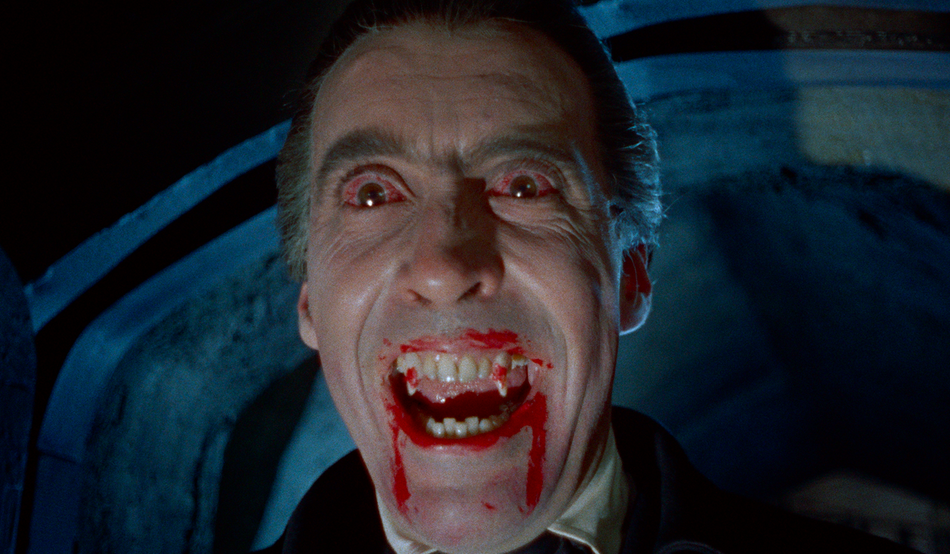
What Hammer brought to Dracula that, say, Bela Lugosi’s portrayal for the equally iconic Universal horror movie didn’t was an inkling of the sex and sensuality attached to the vampire legend. Lee smoulders as the count, while his coterie of turned women heave their chests and eye up their potential victims with an almost obscene hunger.
Hammer also poured lots of Kensington gore into its adaptation, causing the British Board of Film Censors to cut some particularly bloody footage before granting it an X certificate for cinematic release.
And here’s where Dracula rises from the grave—or at least, the archives—once again. Now owned by theatre impresario John Gore, Hammer Films is back, both making new movies and restoring the studio’s classic output to 21st-century standards. This year, Hammer completed the 4K restoration of its 1958 Dracula, not only cleaning up and improving the film’s quality but adding back in what the censors slashed out: three minutes of footage that everyone thought was lost forever.
Earlier this month, Hammer staged a world premiere of the restored version of Dracula in London’s Leicester Square, which I was lucky enough to attend, alongside a number of scream queens from Hammer’s glory days, Caroline Munro (Captain Kronos – Vampire Hunter; Dracula AD 1972), Judy Matheson (Twins of Evil; Lust for a Vampire) and Valerie Leon (Blood from the Mummy’s Tomb).
What is it about Dracula, and especially Lee’s performance, that has proved so undying? “I just think people are fascinated by this wonderful creature,” says Munro. “He was a kind of combination of your fantasies but also your fears. And the Hammer film especially, when you consider all the Dracula films made since, has this enduring allure.”
Munro first acted alongside Lee in Dracula AD 1972, an attempt to update the franchise by placing its immortal antagonist squarely in Swinging London. It wasn’t a huge critical success, and Lee was reportedly becoming jaded with the role at this point, but it has a definite groovy charm.
Munro played party girl Laura Bellows, in hot pants and thigh boots, who fell victim to Dracula’s fangs in the bloodiest fashion. She recalls Lee, who died aged 93 in 2015, as a “perfect gentleman”. She adds: “When I got to do my scene with him, I requested that I didn’t see him in costume beforehand, so my first sight of him as Dracula was when he was suddenly there, all 6ft 4in of him, in his cape, and I just thought, oh, wow!”
Watching the 1958 Dracula at the premiere, it was striking just how much clarity and quality the restoration had injected into the original footage. It was also notable, for someone who hadn’t watched it in its entirety for a while, just how many necessary liberties Hammer took with Stoker’s original novel.
Forced to cram the book into an 82-minute film, director Terence Fisher and screenwriter Jimmy Sangster dispensed with Dracula’s long journey to Whitby and subsequent battle against Van Helsing’s vampire killers in London, instead setting the action wholly in the curiously comforting Hammer Mitteleuropa of rustic peasants with cut-glass British accents, foreboding castles against painted backdrops of Carpathian peaks, and quaint hostelries hung with garlic and fetishes.
The film takes place in the curiously comforting Hammer Mitteleuropa of rustic peasants with cut-glass British accents
In the Hammer film, Jonathan Harker is not an estate agent helping Dracula find a property in London but an undercover vampire hunter working for Van Helsing. This Harker also isn’t engaged to Mina Murray but to Lucy—Stoker’s Lucy Westenra, here given the name Holmwood, after Arthur Holmwood, one of her suitors in the book. Somewhat confusingly, in the film, Arthur is the husband of Mina and brother to Lucy. And the long finale is confined to Dracula’s own castle stronghold.
In fact, change (even more of) the names and you could have a vampire film that has little to do with the source material. But it has become one of the defining cinematic adaptations nevertheless.
Following the premiere, at an after-party in the crypt of St Martin-in-the-Fields (complete with a Christopher Lee lookalike, candles and vampire-themed cocktails), Gore laid out the resurrected Hammer’s commitment to not only new material (its first original film, Ithaqua, drawing on indigenous Canadian mythology and starring Luke Hemsworth, is doing the rounds of the film festivals right now) but also honouring Hammer’s past.
Indeed, so dedicated is Gore to properly restoring and preserving the old films that after buying Hammer he bought Silver Salt Restoration, reasoning that if you were going to spend money resurrecting a huge back catalogue of much-loved horror movies, then you might as well own the company that does the restoration as well.
But the real meat of the Dracula restoration comes not just from the cleaning up of the footage, but from the added minutes once excised by the censors, which Gore puts down to the man he calls “the keeper of the crypt”, George Feltenstein.
Feltenstein works in the bowels of the Warner Bros archives in LA; the company now holds the US rights to Dracula, which was released there as Horror of Dracula. Gore and his team knew that the only place where the uncut version had been released was Japan, but attempts to find that print had drawn a blank. So he went to Feltenstein to find out if he had any leads.
Feltenstein did better than that. Searching the Warner Bros archives, he found—literally gathering dust at the back of a shelf—the original full version of Dracula, with the three minutes the censors had deemed too horrible for British audiences.
Now those minutes—mostly comprising more blood as Dracula chomps down on his victims, and an extended sequence where the count comes off the worst from an encounter with the morning sun—have been added back in. Nina Hibbin, film critic for the Daily Worker, left a screening of the movie in 1958 “revolted and outraged… this film disgusts the minds and repels the senses”. So it’s just as well she’s not around to see yet more blood and guts in what was always a classic of the British horror genre.
Dracula is on a 144-theatre cinematic release tour (see here for your nearest screening) followed by a sumptuous DVD/Blu-ray release in November. It signals the return not only of the vampire himself, but also of an icon of British cinema. Christopher Lee’s first words in the film are the immortal, “I am Dracula, and I welcome you to my house…” He didn’t add, “…the house of Hammer!”—but he may as well have done.