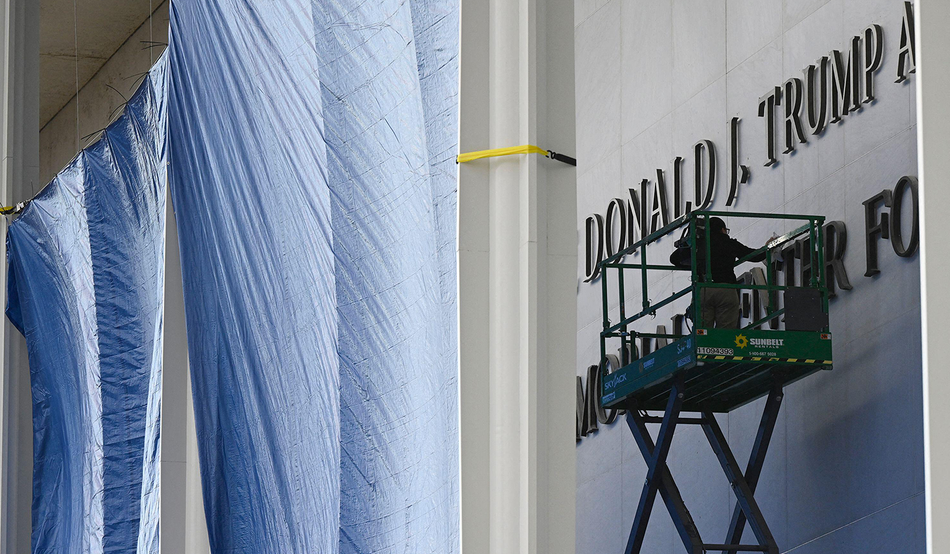
Let’s start with the easy stuff. Remove the tarpaulin covering the words “John F Kennedy Center” so that the imposter’s fleeting link with the building is forever expunged. Call in the craven tech bro toadies and suggest they reinstate the Gulf of Mexico and Lake Ontario on their maps. Halt the tacky triumphal arch. Replant 150 trees on the East Potomac golf course. Refuse to call it the Department of War. Announce that, from January 2029, the monstrous carbuncle that is rising in place of the East Wing will become a museum of corruption and autocracy.
Stop all the clocks. At noon on Sunday 3rd January the democratic heartbeat of the America we once thought we knew can begin to pulse again. For 713 days it has been mothballed like an unloved grandfather clock hidden under dust sheets somewhere in the White House attic. Time to bring it out, blow off the cobwebs and get it chiming again.
If only you could rewind the clock. It would be impossibly expensive and time-consuming to reverse all the mindless vandalism that Donald Trump and his enablers unleashed on the US. But you’d hope the Democrats have some sort of spreadsheet at the ready to start repairing the damage.
Who knows the cost? This week we’ve seen multiple calculations of the billions it will take to rebuild Ukraine and Gaza, but so far no costings for the amount needed to repair the rubbled ruins caused by the Trump-Musk wrecking ball. For the next two years, we can expect the lame-duck occupant of the White House to veto everything he can. But one would hope that the Democrats can at least have some of this restorative work oven-ready for when he finally packs his bags.
Relatively easy: rejoin the World Health Organization, the Paris Agreement and the UN Human Rights Council. There are more than 60 bodies in all that Trump turned his back on. Rescind and/or review all pending departures from all multilateral entities, including Unesco. It will take years to rebuild something that looks like USAID after the Musk chainsaw, which has led to an incalculable death toll. The Democrats can start restoring operational capacity and appropriations and talking to international partners.
Restoring broader confidence with the countries the US formerly considered its allies will take time. Talk will mean little unless it is backed by funded commitments; sustained and consistent policy; a return to professional diplomacy; and forging agreements that are credible beyond the next election.
Health may be an easier nut to crack. America has woken up to the fact that measles cases are now exploding. A country that was declared free of endemic measles transmissions in 2000 has had more than 5,000 cases recorded in under a year after Trump elected a vaccine sceptic to lead the Department of Health and Human Services.
RFK Jr has claimed that the three-in-one MMR jab causes “all the illnesses that measles itself causes” and that it contained “a lot of aborted foetus debris”. A determined Congress could start by reversing all RFK’s attempts to nobble the vaccine advisory committee of the Center for Disease Control (CDC, Kennedy sacked all 17 members in June 2025). The CDC must have a credible director. Congress needs to restore scientific and medical funding, including programmes developing mRNA vaccines. RFK has been a disaster for America’s public health: it’s time to recover some sanity. And science.
Congress can’t easily sack Kash Patel, the hopelessly out-of-his-depth FBI director, any more than they can fire other toadies heading the US’s defence and security apparatus. But it does have controls over the levers of funding. It can set enforceable restrictions and put independent scrutiny in place. Representatives can mount serious investigations and order the preservation of evidence. It’s not everything, but it’s something.
There’s no magic wand with the environment, alas. Trump has caused a quite staggering amount of vandalism wherever you look: on climate regulation; on carbon emissions; on oil, gas and methane controls; on electric vehicle incentives; on PFAs in drinking water; on the protection of wetlands and streams; on the protection of forestry; on extraction leases and endangered species… and much more. Every extra tonne of CO2 emitted during the rest of Trump’s tenure will stay in the atmosphere for centuries.
It’s not going to be easy to reverse the $4bn sunk cost of Trump’s war on offshore wind. New lease sales, permissions and construction can take the best part of a decade, but there’s no reason not to start now. Restoring clean energy credits would need a law and a president willing to sign it, so realistically it’s not going to happen before 2029. The Inflation Reduction Act (IRA)’s credits were originally estimated at around $370bn over a decade. The deeper cost is investor confidence: capital that has learned US clean-energy policy can flip every four years will demand a risk premium, or go elsewhere.
When it comes to the breathtaking two years of alleged enrichment and corruption there’s more room for Congress to have a meaningful impact through relentless investigation and auditing. Committees with subpoena power can investigate foreign payments, token buyers and policy favours (the House Judiciary Democrats’ “crypto empire” report shows the material exists). This is all doable, is relatively cheap and needs no presidential signature. They could start with a proper look at the bizarre “gift” of the Qatari Boeing 747 “palace in the sky” and determine the best public use for it once Trump has departed.
It would be relatively simple to refund and rebuild Voice of America, which once broadcast in 49 languages and is now down to just eight. Fortune reports taxpayers are paying about $1.6m a week to keep some 420 staff idle, so the cuts have not even saved money.
The funding of public broadcasting will take longer since the Corporation for Public Broadcasting (CPB) no longer exists. A smarter design—multi-year advance funding, a board insulated from the White House—would make it harder to defund next time. While Trump is still around it will be hard to curb his short-term attacks on press pool access or his use of the Federal Communications Commission to do the presidential bidding. But it’s time to start planning for 2029.
The Supreme Court is likely to be preserved in aspic for the next two years. Two of the most conservative appointees, Clarence Thomas and Samuel Alito, are in their mid to late seventies and have both signalled that they have no intention of moving on. They’ve missed their chance to retire and be replaced by a Trump-appointed originalist. The power to rebalance the court should fall into the lap of whoever follows Trump.
There’s a pattern in the above. The most visible, symbolic acts (eg names) are the cheapest to undo, while the least visible (lost expertise, broken trust, deaths abroad, Supreme Court precedent) are the most expensive and the slowest. The danger is that the political energy of reversal will tend to flow to the wrong places. All the more reason to start planning now.