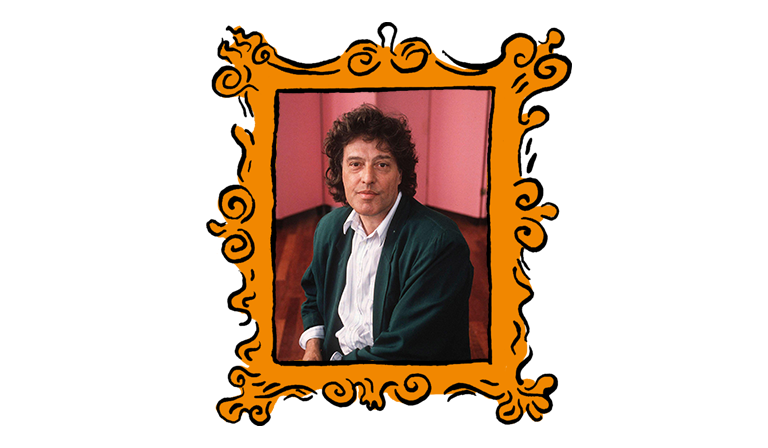
The child who would become Sir Tom Stoppard, OM CBE FRSL, fled Czechoslovakia when he was not yet two years old. Years later, he would like to say that at the age of eight he had “put on Englishness like a coat”. That was in 1945, when his widowed mother married Major Kenneth Stoppard, who provided the family with an English surname and an English home in Nottingham.
The transformation was complete—almost. Until his final years, Tom Stoppard, who died on Saturday at the age of 88, would grimace if anyone was so rude as to mention the unmistakable Central European “r”s that rolled around the sides of his distinct baritone accent. But to those of us with our own Central European grandparents, when we heard Stoppard being interviewed on the radio about life as “a wrrrriter”—alveolar fricative trills and all—we knew we were listening to one of our own.
Stoppard was one of the great British writers: the type of genius who makes us grateful to have lived in his lifetime. That he chose to channel his talents first and foremost into theatre speaks to the central role that theatre can and should play in British intellectual life. Stoppard was also one of the last of a generation of intellectuals born in continental Europe whose talents, snatched from the pyre of the Holocaust, lit up the nation that had given them refuge.
As Tomáš Sträussler, Stoppard was born into the company town of Zlin, which functioned almost entirely as a campus of the Bata shoe factory. As Nazi Germany geared up to invade Czechoslovakia, the Bata CEO had the foresight and care to transfer all his Jewish employees to overseas postings. Amongst them was Tom’s father, a company doctor, who took his family to Singapore only to die during the Japanese invasion.
But young Tom and his brother Peter lived, escaping first to Darjeeling, India, where his mother met Stoppard. Had they stayed in Moravia, things would have been different. 15,000 Jewish children are recorded as having been sent to extermination camps from the region, via the transit camp at Terezin. Next time you see a play by Tom Stoppard, reflect on how diminished our world would be had he been among them.
For most of his life, however, Stoppard understood himself and embraced a life as not only British but English. For this, he credited his stepfather, despite their difficult relationship. Kenneth Stoppard, Tom would later write, “believed with Cecil Rhodes that to be born an Englishman was to have drawn first prize in the lottery of life, and I doubt that even Rhodes, the Empire builder who lent his name to Rhodesia, believed it as utterly as Ken”.
Hermione Lee, Tom Stoppard’s authorised, authoritative and adoring biographer, tells a slightly different tale. Her doorstopper biography, published in 2020, drew new attention to his childhood refuge amongst the English community in Darjeeling, in the death throes of the British Raj. This is where he first learned English, cricket and Latin; where he first observed that to be English was to be set apart.
Stoppard’s passionate patriotism, however, was not merely a psychological reflex for suppressing his roots, or an absorption of imperial chauvinism. It was rooted in a profound moral vision of the world. He understood himself as having escaped not only Nazism, but also the horrors of the Iron Curtain that fell over his homeland in its wake. From the days of his earliest success, he worked to support dissidents in Soviet-occupied territories, but his ideals were galvanised by the arrest in 1977 of Vaclav Havel and other founder members of the democratic Charter 77 movement.
As Stoppard wrote in his diary, he saw Havel as a twin self-trapped in a darker fate: “Vaclav Havel, a playwright whose mother didn’t marry into British democracy has been charged with high treason… Could I contemplate a life where all can be preserved by moral cowardice, lost by moral courage?” From that moment on, as Lee writes, “Soviet Communism and its victims became ‘his’ cause: all his political views and his emotions, and his personal history, pointed him towards it.”
In 1977, he gladly accepted a commission from the New York Review of Books to report from Prague on the fate of the Charter 77 dissidents. The following year, he joined the advisory board of Index on Censorship, after writing for the organisation’s magazine about the ill treatment of the Czech activist Viktor Fainberg. His commitment to victims of totalitarianism in Eastern Europe continued all his life: in 2011, he founded the “Belarus Committee” and dedicated months at a time to campaigning with Index on Censorship, Pen, Amnesty and the Belarus Free Theatre for the release of Belarusian political prisoners.
Stoppard understood British political traditions as the safeguard that guaranteed liberty, allowing him to live his own free life of the mind. He would later cite this as the greatest benefit of arriving as a child in the land “of tolerance, fair play and autonomous liberty, of habeas corpus, of the mother of parliaments, of freedom of speech, worship and assembly, of the English language”. Four years ago, in an interview with Index on Censorship, he admitted to having doubts about the long-term stability of these bulwarks of bourgeois democracy. On approaching death in an age of online polarisation, he told the journalist Sarah Sands: “A line of Philip Larkin comes into my head: ‘Get out as early as you can and don’t have any kids yourself’.” (In fact, he had four children, whose future worried him deeply.)
He remained, however, a political patriot. Throughout his life, as Lee writes, “the radical left’s attack on British and American societies and politics as repressive or totalitarian seemed contemptible to him”. It was the knowledge that he had so nearly lived his life in the Czechoslovak Socialist Republic that made him grateful to have lived it as an Englishman. His was a form of migrant politics that is out of fashion.
Yet, until his last decade, he shied away from looking too closely at exactly what had brought him to England. He claimed not to have understood until his sixties that his mother had been raised in a Jewish family, a level of self-denial which may seem implausible unless you come from one of the many families to share this post-Shoah need to start anew. In 1994, he finally sat down with a cousin who drew a map of their family tree. His mother was one of six siblings; three died in the camps.
When he put this scene on stage, it became his last play, Leopoldstadt: less intellectual dazzle, more raw grief than anything he had staged before. As I wrote of the first performance, “It often feels like watching a man performing an autopsy on himself.” The final scenes feature an undisguised Stoppard stand-in: a young man who returns to the Vienna of his birth with no memory of any other life but being raised by his Gentile English stepfather. “Leo”, like Stoppard, is proud to be English, proud of “fair play and Parliament and freedom of everything, asylum for exiles and refugees, the Royal Navy, the royal family… oh, I forgot Shakespeare.”
But when we saw Leo as a child, he was surrounded by throngs of relatives, making up a cast of 37. Now Leo—or should we call him Tom?—utters it on a vast, empty stage. We hear the last known locations of each missing relative: “Auschwitz. Auschwitz. Dachau. Auschwitz. Auschwitz. Auschwitz. Auschwitz. Auschwitz.” Amid the proud and pompous patriotism, there is an enduring sense of loss.