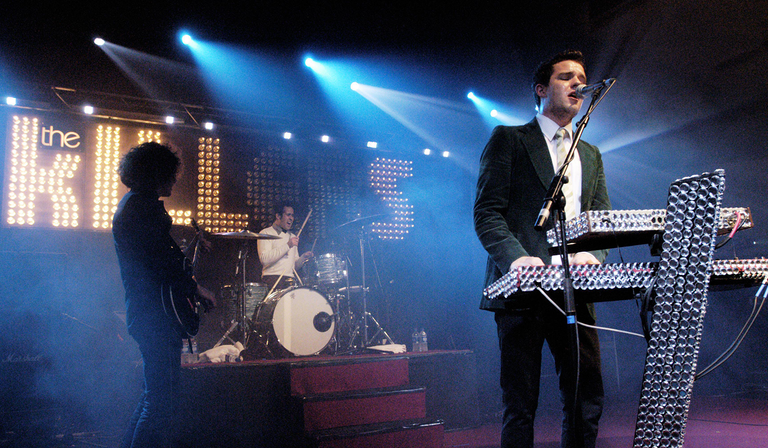
It is the first week of December, and the song occupying the number 91 spot in the UK chart is “Mr Brightside” by the Killers. You may well wonder why we should concern ourselves with a song dwelling in the briny depths of the top 100, but “Mr Brightside” is a fascinating study of pop longevity and British musical tastes.
Released in 2003, it has now spent 485 weeks on the chart. It is the third-biggest-selling single of all time, the longest-charting song of all time and, in 2024, it eclipsed “Wonderwall” by Oasis as the most successful song never to have reached number one.
You might except that a song at number 91 would drop out of the top 100 altogether next week, but “Mr Brightside” has a tendency to ping-pong around the charts. Last week, it was at number 63. As the festive season gathers pace, the song—a mainstay of DJ sets, party playlists and covers bands—is likely to rise again.
I’ve interviewed the Killers on several occasions over the years, from early unknowns to magazine cover stars. Some time ago, I even joined them on a mini-tour of the United States, ending in their home city of Las Vegas. One evening, the band’s lead singer, Brandon Flowers, took me sightseeing in his silver sportscar, pausing at places that held personal significance for him. We stopped at his favourite 7-Eleven, where he insisted I try a Slurpee; at the shop where he got his ear pierced; at a golf course where he worked as a teenager.
We were on West Spring Mountain Road when he idled the car across from a British-themed pub named the Crown & Anchor and told me the story of “Mr Brightside”. “I was asleep and I knew there was something wrong; I have these instincts,” Flowers began. “I went to the Crown & Anchor, and my girlfriend was there with another guy…”
In the song that followed, Flowers ricochets between the torment of imagining his girlfriend with another, and a kind of radiant defiance. His approach was to capture some of the urgent cadence of David Bowie’s “Queen Bitch” (you can hear distinct echoes of Bowie’s lexicon, too) and a little of Iggy Pop’s monotone on “Sixteen”, and marry it to a pre-chorus anthemic quality he knew from Oasis’s “Don’t Look Back in Anger” and U2’s “Where the Streets Have No Name”.
The riff was written by the band’s guitarist, Dave Keuning, some while before he and Flowers met and decided to form a band. It is an unusual one. It’s played high on the neck of the guitar, using arpeggios rather than rock music’s favoured power chords, with a picking pattern that involves open string voicings. Throughout, it’s the guitar, rather than Flowers’s vocal, that provides much of the song’s melodic interest and texture.
Throughout, there is a gathering; a sense of building pressure and then release
Part of what’s compelling about “Mr Brightside” is the way it moves: verses one and two are, strangely, identical, and sung by Flowers in that Iggy-esque monotone (D-flat, for the record). The flatness and repetition together compound the feeling of being trapped in the same thoughts. It takes the pre-chorus, and a nostalgic surge of 1980s-style synths, to bring a shift, and then the chorus moves up again. Throughout, there is a gathering; a sense of building pressure and then release. At the end, unusually, the song does not resolve.
Just why this should appeal so deeply to British audiences is a curious matter. It surely has much to do with our longstanding fervour for the pub singalong, the music hall and the football terrace; with an island’s ear for sea shanties, and the strong Anglican tradition of congregational singing. Certainly, with those repeated verses, the unchallenging monotone and the predictable dynamics, “Mr Brightside” makes it easy for even the uninitiated and the inebriated to join in.
One of the fundamental tensions of “Mr Brightside” is that it’s a terribly lonely song to sing in unison. That singular guitar line, that plaintive narrative, have nonetheless become something anthemic. Whether or not this is peculiarly British is debatable, but it’s notable that one piece of classical music that enjoys a similar level of popularity here is Ralph Vaughan Williams’s “The Lark Ascending”. This composition is also a nostalgic upsweep that begins with the intricacy of an open solo violin cadenza, ends similarly unresolved and is marked by its solitariness.
You’re unlikely to hear “The Lark Ascending” played at many festive soirées, but there is something rather lovely in the idea that, whatever the form, we as a nation should take such pleasure in being alone together.