Do you want to know what they are saying about you at work? Did you know you can legally demand that information, even down to the emojis and WhatsApp messages? Under the Data Protection Act of 2018, any organisation must render any document with your name on it to you on request. It’s called a Data Subject Access Request or SAR. It’s free, staggeringly easy to file and absolute rocket fuel for HR and employment tribunal actions which have, relatedly, ballooned in number since the law was passed.
It was a SAR from Nigel Farage that revealed Coutts Bank had called him a “disingenuous grifter”, thus giving him a case for political debanking and jump-starting his rehabilitation. There are SARs and an HR grievance at the bottom of the Lucy Letby case. So powerful are SARs that companies are fighting back over what parts of a SAR they can redact, often on the grounds that the data belongs to someone else. Mike Lynch, the British tech billionaire who died in the Bayesian yacht incident, had sued the Serious Fraud Office over this issue and won. A SAR, he established, must be “transparent”.
The definition of “transparent”, though, is still evolving. When I submitted a SAR to my former publisher, Picador (an imprint of Pan Macmillan), in 2022, for instance, they sent me 700-odd pages of emails redacted to the point that often only a few words were still visible. “Sick of the woman” and “Bloody Kate” stuck out bleakly from a sea of black pen.
I gathered, mostly, that I was hated very much. But I knew that—these were the people who’d expressed no compassion to me when my editor reported talking me down from suicide. What I wanted to know was why.
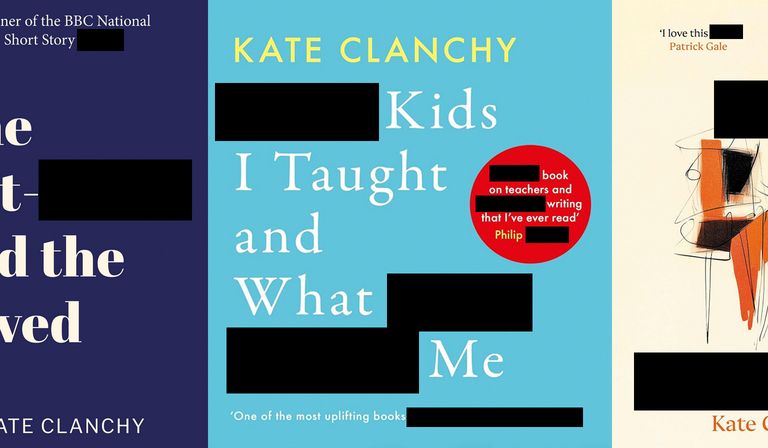
After all, just a month prior to that incident, in July 2021, I’d been a multi-award winning, long-established and beloved author at Picador. I’d won the Orwell Prize for my teaching memoir, Some Kids I Taught and What They Taught Me, in 2020. I was the editor of England: Poems from School, the poetry anthology they’d proudly used as an emblem of their multicultural values when Picador were imprint of the year in 2017. They were preparing to publish Friend, a further anthology of my student’s poems. I trusted them.
I trusted, as any writer would, that my publisher cared about my words and would make sure they were quoted and represented properly. But I’d also trusted them with the reputation of the diverse young people I’d represented as writers in England and Friend and as characters in Some Kids. I took great care not just over generous contracts for each young poet and the legal reads and consents for Some Kids, but also to keep Picador up to date with the records of my teaching practice. In addition to an academic archive and radio programme, there was an upcoming documentary film. All those records were, and still are, immaculate.
So when a campaign started on the social literary platform Goodreads to discredit me as a racist teacher I was puzzled that Picador didn’t seem to care. I asked for help with particular reviews that falsely stated I had used terms such as “slanty eyes” and “Jewish nose”, but none was forthcoming. Soon I was being accused of child abuse—and, instead of defending me, Picador started to pressure me to agree by apology.
Then, without so much as forewarning me, Picador released this extraordinary statement on 9th August 2021:
“We have been listening to the responses to what we said about Kate Clanchy’s Some Kids I Taught and What They Taught Me and we want to apologise profoundly for the hurt we have caused, the emotional anguish experienced by many of you who took the time to engage with the text, and to hold us to account. We understand that readers wish to know specifically what will be done about the book, we’re actively working on this now and we will communicate this as soon as possible.”
When I first read those words, I was so shocked I thought I might pass out. Four years on, the inanity of it is still breathtaking. Over 150 years, publishers had painfully established the legal tort that they would apologise, withdraw or pay only for misrepresenting recognisable people in texts. No one represented in Some Kids had complained or ever would, but now Picador were promising that a long-published, award-winning book would be rewritten or possibly destroyed because it had caused “emotional anguish”—an infinite, subjective measure—in readers.
And they weren’t finished there. In the same statement, they suggested that they were responsible for policing the internet:
“We realise our response was too slow. We vigorously condemn the despicable online bullying of many of those who have spoken out. This has no place in our community.”
This bonkers claim was a response to a tweet by Chimene Suleyman. It featured a scrolling video of nasty remarks about Suleyman by American alt-right trolls under a subtweet by another American alt-right troll. She wasn’t claiming this abuse was connected to me, and the most rudimentary check—slowing down the video, looking up the subtweet—would have confirmed that it wasn’t. Picador’s apology instead cemented the idea that it was. From there came the story, fabricated by others, that the abuse in the video, posted under the subtweet on the evening of 7th August, was connected not just to me but to a tweet by Philip Pullman posted on 9th August. Six-thousand literary people would then sign an open letter in the magazine Bad Form in support of this baseless idea.
So when I sent off my SAR I wanted to know, above all, how that Picador statement had come about—what had been the steps between treasured author and pariah? I’d been told various stories by insiders, but they always seemed implausible. For example, that none of the decision-makers had read my book, or that the firm discussed recalling and pulping my books and giving the money to charity. How did any of that make sense for a well-established literary imprint? For the firm that published Brett Easton Ellis and Adam Kay?
Picador was part of a bigger publisher, Pan Macmillan. I’d been informed, sotto voce, that its children’s and cookbook arms were involved in the Picador decisions. The man who had recently taken over publishing my books, Philip Gwyn Jones, told me that a particular author, Nikesh Shukla, had “directed meetings from his editor’s phone”. On the other hand, Chimene Suleyman had posted on Twitter that she had been to meetings with Picador in which Gwyn Jones “slagged Clanchy off”. Shukla had organised the Bad Form letter. Suleyman and Shukla were launching a book together at the time, The Good Immigrant USA, but it wasn’t with Pan Macmillan. How did this all fit together? Where were the protocols and hierarchy of a large corporation? Alas, the blacked-out SAR could tell me only that I was blamed—not why.
But in 2023, in connection with something else, I popped off another SAR to a PR company that had been working with Pan Macmillan. This time, I was hoping for very little and was astonished to receive more than 1,000 unredacted emails, most in long chains with Pan Macmillan officers. When I wrote to check whether this was indeed what the PR firm intended, they sent me several hundred more, so I proceeded on the assumption that this was their definition of “transparent”.
If the first SAR was shouting in the dark, this was switching on all the lights. The PR firm, it turned out, had been intimately involved in my whole cancellation and copied into very many emails, including the redacted ones from the Pan Macmillan SAR. I found I could match them up, using dates and times. Very often, a long chain of discussion, obscured in the Pan Macmillan document, was revealed in full under one of the PR emails. I coordinated the emerging stories with newspaper articles from the time and tweets pulled from the Internet Wayback Machine. I learned to read blacked-out email signatures by their pattern on the page.
Now I could see the names, characters emerged. Here was the original editor of Some Kids. He’d been too modest to tell me he had spent August 2021 channelling Henry Fonda in 12 Angry Men—thoughtful, principled and in a minority of one. He defended me doughtily as the firm did indeed discuss pulping my books. But he had resigned months beforehand and was due to move on from Picador exactly as the storm broke. I could see that a few individuals, such as the publicist Camilla Ellworthy and the editor Georgina Morely, had stepped away from the email chains and chosen not to be involved.
But many others had piled right in. Here, just as I’d been told, was the children’s poetry editor, whom I had never met, helping to draft an apology in my name. Here was Shukla, making a threat. And here was his editor, also Russell Brand’s editor, paws very much in the pie. Wilbur Smith’s editor, too, was making most of the substantive decisions and corresponding and meeting with Suleyman. And here, here and everywhere was my oldest friend in the company, whom I will call Brenda, and—oh look!—she seemed to be the instigator of the whole operation.
Brenda? Surely not. I’d known her for 25 years. I’d confided in her when both my parents had died with Covid and my husband left me for a younger woman. My agent and my editor regarded her as a trusty go-between with the Pan Macmillan senior team and board. I thought of her as my friend.
And yet indubitably that was Brenda coming up with the idea of a public statement by Picador all on her own initiative. Her “initial stab”, she called it. She recruited first the PR team, then the children’s editor and only then, 36 hours later, her boss. And then—and here I had to check my emails many times, so bamboozling were the timelines—she pressured me and my agent to make a statement on the grounds that Picador wanted us to; and, when we did, double-crossed us and told Picador we’d done so on our own account and that the firm would have to live with it. That caused a lot of trouble.
Soon I couldn’t doubt that most of the really nasty remarks in the SAR—“much of her isn’t very nice”; “she really does use unpleasant racialised language”, “no one should take all the hit – except perhaps KC”—were hers too. And hers the brutal “surely not your responsibility” when my editor reported talking me down from suicide.
I could hardly believe it. And yet, it made so much sense. Brenda was the person who refused, on behalf of the firm, to back up my students when they wrote a letter to The Bookseller defending me. I’d entrusted my students’ individual testimonies to Brenda. Perhaps pure malice was the reason they had disappeared.
Most of the really nasty remarks were hers
Here too was an explanation of why Pan Macmillan was so willing to believe I was an abusive teacher: Brenda was my reference. The publisher of most of my books, Paul Baggaley, had moved on in 2019. His replacement, Gwyn Jones, had never troubled to contact me, even when I won the Orwell Prize. Don Paterson, the poetry editor who originally had the idea of using only my migrant-heritage students to create England: Poems from a School, “chose to remain silent” because, he told me, he considered he had “discharged his professional responsibilities to the book”. So Brenda was the only person in Pan Macmillan who knew me, and she, I had to suspect, was the one answering queries with vicious implications. “It’s always been to easy to focus on the amazing work she’s been doing with clever kids.”
But Brenda wasn’t even on the executive board of Pan Macmillan. What sort of corporation allows itself to be pulled by the nose like that by a relatively junior employee? An anxious one, based on my reading of the SAR. One where decisions were made by long, confusing aggregations of email, perhaps a habit acquired in lockdown. One where a PR company could come and go, freely acquire acres of information about me and take it home. One where many old-fashioned publishing practices, such as reading, seemed to have been lost.
For example, when Brenda was put in charge of replying to an open letter about safeguarding in Some Kids, she assembled a team of 10 to do so, including the PR firm. She shut the door on my students and didn’t tell her team about the letter they had just sent her stating, “we have experienced no safeguarding or consent issues, and we have never felt excluded from the process”. The team didn’t look at the actual legal reads and consent forms, all in order and available at the touch of a mouse. And none of them, not even Gwyn Jones, ever read the book itself, not even the first few pages where the introduction would have told them all they needed to know: that this was a literary memoir, just like so many others they published.
They did read Twitter though, religiously. And though they didn’t check real-world facts, they commissioned literally hundreds of reports about it from the PR firm. In times of crisis, these arrived on the hour. They showed the firm’s reputation leaping up and down a graph according to mentions by “Accounts of Interest”. There was, of course, no account of those not on Twitter. “Of interest” seemed to mean “interested”—such as my prominent critics. This amplification of already loud views seemed to block out simpler commonsense. A special series of these reports were commissioned, for example, when the US Picador writer Alice Sebold was found, during the same time, to have identified the wrong black man as guilty of her rape, sending him to prison for 16 years. The firm became anxious that I would be caught up in this scandal because my actions in using the wrong metaphor were, to their minds, so very comparable. They were surprised when no one in the wider world spotted the similarity.
Perhaps the reports also created a sense of helplessness, as if Twitter were a sort of weather. Certainly, no one in Pan Macmillan ever thought their statements or actions might be contributing to the crisis—that issuing unprecedented statements about an author might make that author look especially bad. They viewed themselves often, it seemed, as my victim. “I hope this demonstrates that Picador is bigger than Kate Clanchy,” wrote CEO Anthony Forbes Watson, after the company had offered a second abject public apology. But I was an author, and they were a large corporation. I was always small, in the same way that witches were always just old women, really, shouting in the road. The power imbalance was obvious to everyone but them.
How did the firm get into such an irrational, inward-looking state? The pandemic had left everyone drained. It was summer so people were on holiday. Forbes Watson was about to retire: “I frankly don’t give a toss about Kate Clanchy,” he wrote, and perhaps that applied to a few other things too.
And maybe publishers have always had a silly streak to go with their necessary sensitivity to fashion and fantasy. Russell Brand’s editor, for instance, had more or less sustained the company by choosing the right cookbooks. Successful runs like that can’t be achieved through dispassionate analysis or there would be more of them; it takes a genius for trends, true faith. This editor didn’t publish Jack Monroe or Brand’s book on mentoring to make money. She did it because she believed the books would make a tremendous difference in the world. Now that same utter credulousness, that soul deep commitment to fashionable belief, was turned against me.
In 2021, one of publishing’s top fashionable beliefs was that liberal, middle-aged, white women like me—and like Brenda and Russell Brand’s editor, as it happens, and most of the PR firm—were especially dangerous and racist. Several books were being published on the subject. There was a new name for these women: Karen. That August, the most fashionable new books were about their “white women’s tears”, shed in order to abuse people of colour.
By this logic, it was most plausible that someone known for working with migrant students was secretly abusing them. It was very probable such a woman would incite her followers, previously people who liked reading poems by multicultural school children, to racially abuse anyone raising concerns, for that was their true nature. My SAR shows me that the youngest member of the PR firm was circulating an essay accusing me of being a “memsahib” with “colonial-era pseudo-scientific taxonomies of race” back in July 2021.
By August, the whole firm seemed to believe me guilty of causing racial “harm”—though it’s notable that they never said exactly what they thought I did, or how, even to each other, and nor was it ever worded to me. Perhaps trying to explain it—she wrote to her alt-right Christian contacts and asked them to post tweets in defence of the famous atheist Philip Pullman—would have broken the spell.
It is very hard to describe the personal impact of such scapegoating, but I tried in this magazine, in November 2021, to write at least a warning of the suicidality that it induces. This article coincided with an interview with Gwyn Jones in the Telegraph in which he said that I should have been given “more rights”. My article included no names; Gywn Jones’s observation was made in passing. And yet I was pressured to withdraw my Prospect piece, while staff in Pan Macmillan said they felt “tainted” by Gwyn Jones’s mild intervention. Within days, Gwyn Jones was obliged to tweet a statement written for him by the youngest member of the PR firm: “I now understand I must use my privileged position as a white middle-class gatekeeper with more awareness to promote diversity, equity, inclusivity, as all UK publishing strives to put right decades of structural inequality.”
I read that lurid and ludicrous statement and decided that enough was enough. Though I had no other publisher then, and knew I would lose my agent too, I asked for the return of the rights for all my books.
When the split was first mooted, Pan Macmillan could imagine only joyous consequences. They composed a set of celebratory FAQs for the press. “Will the Orwell Prize [sic] be revoking the prize?” would, they imagined, be first question. “We have to refer you to the Orwell Prize (sic) for that,” answered Imaginary Macmillan, magisterially. A little further down: “Did you take into account the fragile state of Kate's mental health?”. Imaginary Macmillan’s response: “What we can say is that Kate’s team at Picador provided round the clock support to her...”
When the announcement was made, though, those weren’t the Qs most FA. “I think the [newspaper] curated the comments as there is literally only one comment that has anything negative about Kate,” they wrote in puzzlement. Who could these people be who thought differently from Pan Macmillan? Who perceived that I had been abandoned unfairly? And so many of them! Pan Macmillan authors started contacting the firm, angry and afraid, another consequence no one had foreseen. One was even rude to the CEO. No one within the company could recognise my account of the story in interviews with UnHerd and the Sunday Times, either. They apologised over her head? What rhubarb! Libellous!
But when they looked closely, they couldn’t find the libel. Mysteriously, all documents confirmed that they really had apologised without telling me first. The BBC enquired whether it could possibly be true that no one had read the book before issuing the apology. The comms team did a quick round robin. “That’s no comment?” asked the PR firm—and it was.
And there my SAR story ends. I don’t think it is an unusual tale about workplaces. I know several women in publishing, social work, teaching, museums, academia and large corporations—nice, liberal, middle-aged women, good at their jobs and kind to their colleagues—pursued as “Karens” in the years after 2020. All of their chief persecutors were other middle-aged white women high on piety. All of their bosses were men and stayed comfortably in position. Some of these women also made SARs, several lost their jobs, some sued, some settled, but all of them thought at some point of suicide because—as I am not at all sorry I wrote in Prospect—that is an inevitable consequence of such an assault on core values and trusted relationships, such a devaluing of self and humanity.
Reading through a SAR is likely to revive this sort of distress and I wouldn’t necessarily recommend it. In doing it for myself, I’ve tried to remember that much of it was caused by the strange times that created it, by lockdown and social media. I remember the courage of my students, how they wrote I had given them “unequivocal care and support, always, for us as poets and as people”. I try to think of all the protagonists in the story as human. I remember that the one time I met the head of comms, she wept. I tell myself that, in the end, I was injured by a corporation, and when that occurs the CEO is the person responsible. The CEO of Pan Macmillan at that time was Anthony Forbes Watson.
I cannot think of why Brenda hated me so much, though I have puzzled over it often. I suspect it might be connected to long-nursed, deeply felt envy. That must be a horrible feeling to have, and I don’t believe that her actions will have alleviated it. I remind myself that Othello has the structure of a sitcom—a joke with a handkerchief leads to more trouble than anyone planned. No one intended to actually kill Desdemona.
But the innocents here were my students. I can’t forgive Brenda for failing to back their letter to The Bookseller or for hiding their testimonies. I can’t forgive Pan Macmillan for failing them either. The poems of England were precious to their writers. They represented real excellence attained against the odds. They represented years of work. That achievement was taken from them when their publisher agreed that the young writers were victims of abuse. Now, none of them can talk of that book with pride. None of them can mention it on their CVs and profiles. It is soaked in disgrace. That this was done in the name of protecting them, or in the cause of being “inclusive”, I will always find contemptible.
I also fear that the episode has had enduring consequences for writers. Some are direct—such as the recent convulsions in the Society of Authors and Royal Society of Literature—others more tangential. For example, Shukla, Sunny Singh and others of the group that so visibly bullied me went on to found Fossil Free Books and campaign against Baillie Gifford. Fear of what was done to me, and the ease with which my publisher submitted to it, must have added an extra frisson to the letters the group sent to writers at festivals.
I think, though, that the most pernicious effects are small and private and occur to a writer pausing over a keyboard. If they write the wrong word, my fate told them, they might lose their career and all their friends. It’s enough to make anyone cower, and cowering writers write poor prose. That’s one reason to read through the SAR, and to write this down now and to cooperate with a podcast series on Radio 4, too. I hope there is something to be gained from exposing the silliness of so much of what happened, as well as the cruelty, because these events urgently need laughing at. They have cast too long a shadow, for too long, over writers and publishers alike.