It has been the most extraordinary year in Syria’s modern history since the Assad family took over the country in 1971. On 8th December 2024, this tyrannical dynasty fell after almost a decade-and-a-half of civil war. The toppling of Bashar al-Assad as president brought Syrians hope of rebuilding their lives and their nation, and lifted the country out of international isolation.
Since then, Syria’s political transition has faced challenges, though none of them are insurmountable. For Syria to avoid the fate of other Arab countries that transitioned from autocracy only to end up stuck in new cycles of violence, the Syrian administration and the global community need to nurture the progress that has been made over the past 12 months.
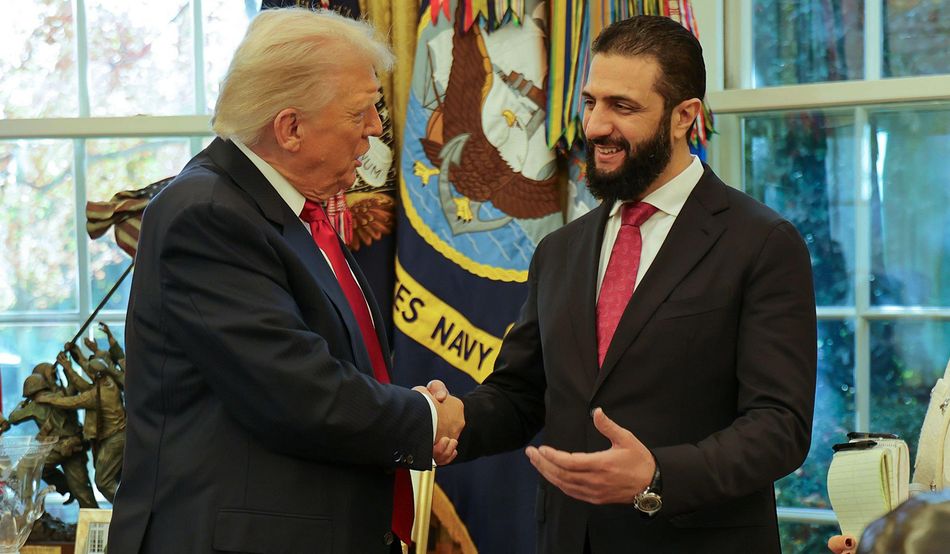
Syria’s government, led by President Ahmed al-Sharaa, seeks to position it as a country open for engagement with the outside world. This is in stark contrast to Assad. During the regime’s last decade in particular, Syria was squarely in a pro-Iranian, pro-Russia, anti-western camp. Now, with the world prioritising stability in Syria, al-Sharaa has been embraced by Washington and Riyadh, while western countries have been steadily lifting sanctions and expressing public support for his government.
Commitment to Syria’s stability is one of the reasons why the US-led Global Coalition Against Daesh added Syria to its membership in November. Such a move is also important as Syria grapples with attempts by Daesh, or Isis, to resurrect itself in the country since the regime collapsed. Assad’s fall came mainly at the hands of Hayat Tahrir al-Sham (HTS), a jihadist group founded and led by al-Sharaa, which also fought with Daesh during the Syrian conflict. The Assad regime claimed to fight Daesh, but it also instrumentalised the terrorist group against Syrian opposition factions. With HTS now in charge, Daesh is threatened and trying to expand the scope of its attacks inside Syria.
At the same time, Iran-backed militias and their cronies have been attempting to sow sectarian grievances, especially in relation to the country’s Alawite community (the minority to which Assad belongs). And, driven by security concerns about both Sunni and Shia jihadist groups, Israel is capitalising on the injustices felt by the Druze minority in Syria in order to expand Israeli military control in the south. Benjamin Netanyahu is doing this under the pretext of protecting that community, of which there is also a minority in Israel. Sectarian tensions over the past year have led to deadly clashes between Sunni factions aligned with HTS and the Alawites and Druze. There have already been massacres of Alawites and Druze, and there is risk of further violence if Syria’s government does not implement genuine transitional justice processes. Countries with experience in this, including the UK with its efforts in Northern Ireland, could help.
Syria also needs to rein in rogue jihadists. But the country’s security apparatus lacks the capacity it needs for reform, especially as the HTS-led government dismantled the Syrian military after the HTS takeover of Damascus, Syria's capital, last December. Although it is now trying to rebuild the army, Syria cannot address these problems alone. This calls for significant commitment and resources from international allies, especially the US and the UK, given their leadership within the Global Coalition.
Stability cannot happen without economic recovery, however. Syria’s infrastructure was devastated by the war. Many Syrian refugees cannot go back because they no longer have homes to return to. Although Saudi Arabia and the UAE have declared they will help to rebuild the Syrian economy they have yet to channel funding into the country. Syria’s reconstruction requires investment and trade, as well as foreign aid. The private sector is trying, but the Syrian government needs to reassure investors, including by addressing emerging HTS monopolies over some state institutions, such as the customs authority.
While the Syrian government understandably wants to minimise the chances of Assad-era factions being influential inside state institutions, it must balance this against the need for more inclusive governance. Given Syria’s various sectarian and ethnic fault-lines, lack of inclusion only fuels community grievances. These divisions are something that remnants of the Assad regime, as well as Daesh and foreign actors, can take advantage of to try to carve out power for themselves. Inclusive governance becomes even more necessary in light of Iran’s attempts to resurrect its influence in Syria and Lebanon, the increasing Israeli pressure in southern Syria, and Russia’s goal of maintaining a long-term military presence inside the country.
The international community at large can help Syria to become less vulnerable, so that free and fair political processes are embraced, and principles of good governance are applied across the state. It can also help to build the capacity of Syrian civil society, which is doing its best to act as a watchdog for the government.
Syria’s challenges may be many, but al-Sharaa’s desire for the country to be a legitimate member of the international community surely represents an opportunity. Syria’s allies and partners should grab this chance to nurture change in the country, from brutal autocracy to the start of a better, more stable, future.