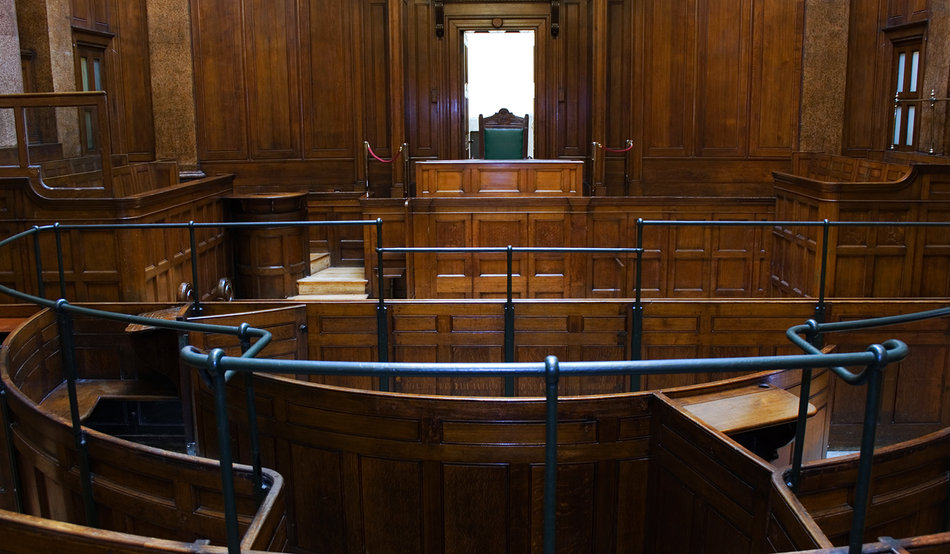
Do jurors have the right to apply their conscience when giving a verdict? This centuries-old principle of our jury system is at stake after a landmark hearing at the Royal Courts of Justice (RCJ).
The question arises because a group of women have appealed their convictions based on the directions that the judge at their trial gave the jury. The women had been charged with criminal damage for breaking glass windows during a protest at JP Morgan Chase in London in September 2021—an action intended to highlight the bank’s continued investment in fossil fuels.
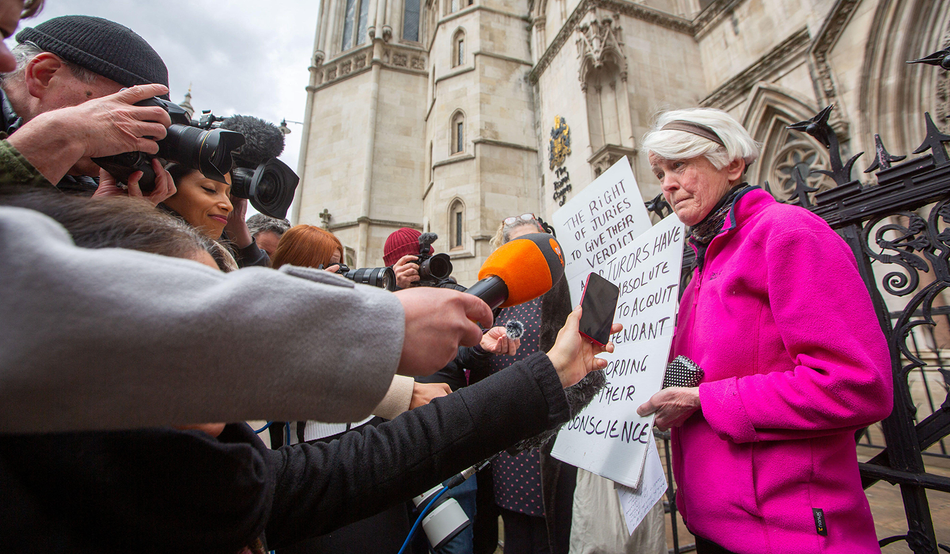
During their trial in February 2024 at Inner London Crown Court, posters were displayed near the court by members of the public, informing passers-by that jurors have an “absolute right” to acquit a defendant on grounds of conscience. Some people also held placards with the same messaging.
In response, Judge Silas Reid told the jury that the signs were “misstating the law”. He then said, “It is only on the evidence you are able to try the case, and not on conscience or favouritism or the like… It is a criminal offence for a juror to do anything from which it can be concluded that a decision will be made on anything other than the evidence in the case.”
The women’s case before the Court of appeal is that their convictions are unsafe because the jurors may have felt pressure to convict them, fearing that if they found the defendants “not guilty”, Reid might presume they’d taken something other than the evidence into account—and that this would be a criminal offence. Notably, Reid went beyond telling the jury to disregard the posters, expressly instructing jurors that they could only try the case on evidence and “not on conscience”. The women’s case is that Judge Reid himself has misstated the law.
So, what is the law? The case highlights a tension in our justice system between jury equity, which is the power of a jury to give a verdict according to conscience, and the obligation of a jury to follow the judge’s legal directions and try the case on the evidence alone.
Jurors are given a document setting out their legal responsibilities, which states, “As a juror you have taken a legal oath or affirmation to try the defendant based only on the evidence you hear in court.” The same document stresses that if you don’t follow the rules “you may be in contempt of court and committing a criminal offence”.
The Crown Prosecution Service, which is fighting the women’s appeal, has defended Reid’s directions and argued the convictions are safe—but crucially it also acknowledged in its submission to the RCJ that juries are able to follow another principle, too.
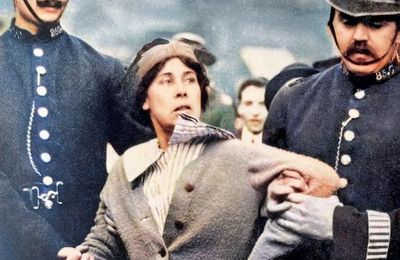
In 1670, Bushell’s case established the power and independence of juries, after two Quakers were prosecuted for holding an unlawful assembly. The judge directed the jury to convict them—and when the jurors, including a man called Edward Bushell, refused, they were fined and imprisoned. This imprisonment was eventually overturned, and a plaque in the Old Bailey celebrates this case “which established the right of juries to give their verdict according to their convictions”.
Today, a judge can never direct a jury to convict, however clear the evidence; only the jury has that power. However, judges can direct juries to acquit a defendant to prevent a miscarriage of justice if they see no evidence of guilt. And a jury can’t be punished for delivering a verdict of acquittal, even if it seems against the evidence of a case. It can never be known exactly why a jury reaches a decision because it delivers judgments without sharing its reasoning.
“Perverse verdicts” (those which seem to go against the evidence) can be controversial. In our democracy, parliament makes laws, and courts exist to uphold these laws. It could be considered highly undemocratic if 12 randomly selected people have the power to choose whether to apply the law or not, according to their own preferences and convictions.
On the other hand, this power of juries is an essential safeguard against executive power and judicial overreach. Patrick Devlin, a judge and legal philosopher, famously said that juries provide “an insurance that the criminal law will conform to the ordinary man’s idea of what is fair and just” and that “no man can be convicted against the conscience of the jury”.
Yet juries are not told about the power established by Bushell’s case, either by the video they watch at the outset of their jury service or by the judge. The defence counsel is not permitted to tell a jury that it could acquit a defendant for such reasons, either, because this would be a breach of the Bar’s Code of Conduct. This is precisely why retired social worker Trudi Warner held up her now-famous placard outside a different trial, in March 2023, saying: “Jurors you have an absolute right to acquit a defendant according to your conscience”. What good is such a power if people don’t know that they have it?
It was Reid who had Warner arrested for contempt of court for displaying her placard, an act which eventually led to the attorney general pursuing Warner all the way to the High Court, where Justice Saini dismissed the state’s case. He ruled that Warner had simply informed potential jurors about one of their legal powers, which he said was a “principle of our law” and “part of our constitutional landscape”.
Now this principle is being tested once again—and Warner was in the public gallery watching as one of the women convicted, Amy Pritchard, took up the baton of defending it before the Court of Appeal. Pritchard represented herself before the court because her barrister was unavailable.
Pritchard raised the case of Kay Gilderdale, a mother who was prosecuted for attempted murder when she helped her seriously ill daughter to die. She told the court, “the jury heard the evidence about what a devoted mother she was. They heard evidence about her daughter’s failed suicide attempts. When the jury acquitted her [in January 2010] they were not ignoring that evidence. They were not disregarding it. They were simply applying their conscience to it.” The judge in that case, Justice Bean, praised the “common sense, decency and humanity” of the jury.
Pritchard continued, “Judge Reid created a false binary by implying that it’s either making a decision on conscience or the evidence. It’s not either/or, it’s both/and.” Henry Blaxland KC (representing three of the appellants) concurred, saying Pritchard “makes a very good point that there is no dichotomy between the evidence and conscience” and supported her submission.
John Spencer, emeritus professor of law at the University of Cambridge, is among those who have previously suggested that the juror’s oath could be adjusted so that jurors swear to “deliver a true verdict in accordance with the law and justice”, to encompass this more expansive and nuanced position.
Others have argued for the law to be clarified in the opposite direction. Robin Auld, in his 2001 “Review of the Criminal Courts of England and Wales”, recommended that “the law should be declared, by statute if need be, that juries have no right to acquit defendants in defiance of the law or in disregard of the evidence”.
Finally, Pritchard said, with her voice slightly cracking with emotion, “We are witnessing a time of rising authoritarianism and loss of democratic freedoms, in this country and beyond. The decency and humanity of juries, the conscience of juries, is absolutely vital at this time.”
All this just at the moment when justice secretary David Lammy is proposing to remove jury trials from all cases involving a likely sentence of less than three years, including protest-related trials such as the one that triggered this appeal.
At the end of last Thursday’s hearing at the RCJ, the three judges explained that they would be reserving judgment and issuing a written decision as soon as possible, most likely after Christmas. Lord Justice Edis told the courtroom, “It will take a while because there’s quite a bit to think about”.