Adrian Bannon

Is this the end? Google has threatened to pull out of China
In China, the release of Frankie Goes to Hollywood’s 1984 hit song, “Two Tribes Go To War,” was greeted in a similar vein to the arrival of the internet search giant Google: both were immediate smash hits.
The Google tribe is undoubtedly one of the most remarkable organisations of our time. Through the creative utilisation of cutting-edge technology and innovative business deals, Google’s mathematicians-turned-mogul founders, Sergey Brin and Larry Page, have taken their tribe from academic slipstream to the global mainstream. Every tribe, however, needs a battleground—and for Google that must include the world’s fastest growing and relatively untapped economy: China.
The country is set become the biggest internet market in the world. In attempting to gain a strong foothold in this Midas market (Google still trails local Chinese competitor Baidu by a considerable margin), Google has nevertheless achieved the double bonus of keeping Microsoft at bay as well as having access to China’s perennial army of computer scientist graduates.
But getting so heavily involved in China has presented Google with its own set of problems, and the recent sophisticated attacks on the email accounts of Chinese human rights activists and the 20 plus other companies, highlights this. The Google philosophy of “youth + freedom + transparency + new model + the general public’s benefit + belief in trust = The Miracle of Google”—as famously enunciated by Dr. Kai-Fu Lee, a high profile Chinese Microsoft employee who crossed the binary war lines by seeking to join Google—sits very uneasily with the Chinese political equation of “Communist bureaucracy + active monitoring + restriction + censored internet.”
Read more »
David Goodhart

1989: "Ich war dabei"
I was there in Berlin on November 9th 1989. There is nothing special about this: it seems that half the world was there with me, although I don’t recall seeing them at the time. Daniel Johnson, the editor of a rival publication, even claims to have asked the vital question at an East Berlin press conference that led to the announcement that the wall was effectively defunct. But I think I am the only British journalist who witnessed that great evening in the company of pony-tailed American pop music impresarios.
The East German regime had been looking vulnerable for several weeks—even since the big East German outflow through Hungary—and we (at the Financial Times where I was working) were taking every opportunity to get into the country to gauge popular feeling. So when the opportunity came to attend a conference on rock music promotion in East Germany at a swanky East Berlin hotel from November 9th to 10th I grabbed it.
The East German government was keenly aware of the importance of rock music in keeping its young people happy and it used to attract a stream of the best bands in the world. It also had quite a thriving rock music industry of its own and was keen to export bands—at least those who could be relied upon to return. As I sat rather bored listening to East German cultural bureaucrats debating with the pony-tailed Americans I remember someone coming into the hall, in the early evening, and saying that the wall had opened.
Read more »
Elizabeth Kirkwood

The Brandenburg Gate, 10th November 1989
To mark the 20th anniversary of the fall of the Berlin wall we’ve made several articles from Prospect’s archive free to read online.
For an overview of the complex cross-currents that fed into the collapse of the Soviet Union see historian Victor Sebestyen’s profile of its last leader, Mikhail Gorbachev, in “The accidental hero of 1989”. A man of huge and fascinating contradictions, Gorbachev, and his particular form of communism, played a far greater role in the end of the USSR than the western powers of the time may have cared to admit. And while he is revered in the west as a hero, this reputation is based on failure: his failure to reform the system he passionately believed in.
Read more »
Dan Hancox
ABOVE: outside the House of Terror, plaques on the wall commemorate those killed for taking part in the uprising against the Communist regime
After communism came the vile capitalism,” Gabriel, my guide on a communist walking tour of Budapest, said. Vile? “Oh, it’s just an expression” he told me. “But for millions of Hungarians it has not been a good 20 years, most of us don’t feel like celebrating.” Friday, 23rd October marked two decades of Hungarian independence from Soviet rule, and was also the anniversary of the 1956 revolution. And even if Gabriel was reluctant to reminisce (“I just want it to be passed”), the country’s public life is strikingly forward about looking backwards.
Hungary’s public arraignment of its 20th-century crimes—a trial put on for tourists, as much as citizens—marks it out from most of Europe. Measured by the number of museums, Spain seems largely in denial that it had a civil war, let alone 36 years of Franco, and Britain’s accounting of its empire is still woefully inadequate. In Hungary, however, the willingness to acknowledge the recent past is nowhere more evident than in Memento Park, a home for dead statues and an epic artistic achievement. Most former Soviet bloc countries demolished their communist relics or let them rot. In 1993, the Hungarian government decided to put their totems to Marx, Engels, Lenin and friends on display on the outskirts of Budapest. They loom noiselessly amid dusty scrubland, disconnected from the people over whom they once held sway. If you’ve ever wondered what a socialist realist Disneyland would be like, this is the quickest way of finding out.
“This park is about dictatorship,” architect Ákos Eleod wrote about his design. “But as soon as [it] can be talked about, described and built, the park is already about democracy. Only democracy can provide the opportunity for us to think freely about dictatorship, or about democracy, come to that.” Its creators wished to avoid creating a “grotesque irony park,” and they succeeded—that is, if you ignore the T-shirts on sale depicting the fathers of communism as characters from South Park. But I doubt even the most sober of historians would begrudge: “Oh my God, they killed Trotsky!”
In contrast, there’s no macabre kitsch in the House of Terror, a museum devoted to state oppression. It is located in central Pest in a house with great symbolic resonance: 60 Andrássy Boulevard served as headquarters for both the quisling Nazi regime (the Hungarian Arrow Cross party), and the Soviet-backed Hungarian secret police. The grim, damp-stained basement prison cells witnessed the torture and murder of Hungarians of all political persuasions. The perpetrators, we are told, merely “changed clothes”: replacing fascist with communist uniforms.
Any sense of ostalgie that might be sparked by the House of Terror’s superb socialist realist paintings is extinguished by the vivid tales of arbitrary state violence and systematic oppression. The last room is devoted to shaming the “victimisers”: 200 or so people deemed responsible for the brutality, photos captioned with names and positions in the state apparatus. “The victimisers‘ lives before or after do not acquit them from their individual responsibilities,” reads a bulletin by the door. All very well, but many of these people are still alive.
Reconciliation is still a long way off. “Monument Park is seen as very much a left-wing way of remembering, and the House of Terror a right-wing way of remembering,” János Hideg, a translator of history books, told me. “The left don’t like the equivalence that the House of Terror makes between the Nazis and the communist regime. You can see who’s behind each one from the way they present history.”
The framing of the past is a major political issue across the post-communist diaspora. Returning from Memento Park, I stumbled upon a group of people dressed in white shirts, black trousers, black waistcoats and—unmistakably–jackboots. They were milling around in front of a statue of Count Lajos Batthyány, the first Hungarian prime minister. After leading the failed Hungarian revolution, he was executed by the Austrians on 6th October 1849—160 years ago to the day that I was there.
Sidling up to them and finding an English speaker, I asked if they were a political group, “No, no—we are just a friendship group,” a thirtysomething skinhead with a ginger handlebar moustache kept telling me. “Friendship group, friendship group.” “So you’re not communists then?” I asked. “Ha! No. No, they are the communists!” he said, pointing to the nearby Hungarian parliament building.
It turned out this was a meet-up of the Magyar Gárda (Hungarian guard), the paramilitary wing of Jobbik, the “neo-fascist” political party. The red-and-white striped badges worn by the group were the colours of the Árpád dynasty of Hungarian kings; tellingly, the Arrow Cross party were also fond of this flag. Formed in 2007, the Gárda were banned in 2008, before being allowed to reform in July this year. Jobbik took three seats, and 15 per cent of the vote, in June’s European parliament elections.
Later that night, I returned to the statue, where a candelit vigil had begun for the execution of Count Batthyány and the 13 martyrs of Arad, the rebel generals who died with him. In attendance, along with the tattooed bikers and youths in combat trousers, were smartly-dressed middle classes. After the speeches, as the people dispersed, Árpád flags tucked under their arms, two young men gave out small slips of paper adorned with the names of those 14 icons of Hungarian nationalism. Though I probably should have stuck up for historical integrity, it didn’t seem prudent to mention that several of the martyrs came from Serbia, Germany, Armenia and Austria.
Ivan Krastev
Above: the end of intimacy in the old eastern bloc
The revolutions of 1989, which saw communist governments toppled across eastern Europe, used to be considered among the continent’s most agreeable. The left praised them as an expression of people power and the victory of civil society against the state. The right celebrated them as a triumph of the free market and the free world. But the combination of the global economic crisis and the rise of political populism in eastern Europe is challenging long-held assumptions. The financial crisis has put neoliberal capitalism on trial and the claim that democracy is best at delivering growth has been shaken by the success of China.
The geopolitical gains from the end of the cold war now also look uncertain. Writing in the Observer in September 2008, the philosopher John Gray prophesied that “the upheaval we are experiencing is more than a financial crisis.” He argued that “the era of American global leadership, reaching back to the second world war, is over… a change as far-reaching in its implications as the fall of the Soviet Union.” And the EU’s declining global relevance is acknowledged even by Brussels. The revisionists’ hour has arrived.
The revolutions have always been celebrated for setting people free. But an alternative interpretation of the events of 20 years ago is gaining ground: that in 1989, the elites broke free. It is easy to dismiss this as a conspiracy theory. It is not, however, easy to ignore its political followers. In eastern Europe, populism—a political doctrine that pits the interests of “ordinary people” against the “elites”—is on the rise. Populists have held power in Poland, Slovakia and Bulgaria. But why should people be angry at their ruling elite, when these rulers have made them freer, wealthier and citizens of the EU?
Václav Havel wrote about the ordinary eastern bloc citizen in a 1978 essay, “The Power of the Powerless.” Havel imagined a greengrocer who places a sign in the window of the shop where he works. The sign reads “Workers of the world, unite!” Yet the greengrocer doesn’t care about the proletariat and its unity. The slogan was a declaration of loyalty to those in power, and a plea to be left alone by them. Since 1989, of course, the greengrocer has been free to take down the sign. But how else did he fare during the past 20 years?
Read more »
Leo Hornak

Geithner in China: a meeting of equals?
This month’s edition of Prospect contains a range of perspectives on the meaning of the Tiananmen anniversay (see here and here). For our archive selection this month however, we revisit another crucial turning point in recent Chinese history: Beijing’s entry into the WTO in 2001.
If Tim Geithner finds one article to read on his trip to Beijing this week, he could do worse than Lawrence F Kaplan’s China and Freedom, published in Prospect in October 2001.
More than any other event in the last decade, WTO accession signaled the emergence of China as an economic superpower. Indeed, over the subsequent eight years, the importance of that step for the global economy has only become clearer. Geitner’s discussions this week are based on the assumption that the health of the US economy is linked inextricably to China. America’s recovery will be China’s recovery.
Read more »
David Killen

Tony Benn, Big Ben: national monuments both?
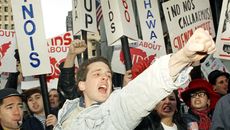
Listening to last Thursday’s Today Programme covering the G20 protests, I experienced two waves of unwelcome nostalgia. The first was when, amidst futile attempts to rendezvous with the Brockley Anarchists—or some other such implausibly-named group—the reporter stumbled across an elderly woman selling the Morning Star. She seemed sweetly eccentric at first, but her tone soon modulated into a beleaguered righteousness that I found all too familiar. In the early 1980s, having fled the Labour Party to escape the rising tide of Trotskyism, I became a member of the Communist Party of Great Britain. It’s difficult now to recall my motives for joining. I had a hopeful conviction that, since Marx’s analysis of history was so compelling, the Marxist prescription for the future was probably the best we had. But I also had a romantic notion about commitment to an enduring cause. All my heroes seemed at one time or another to have been party members and somehow, in the absence of an “International Brigade,” this seemed the next best thing.
I sold the Morning Star at rallies and marches, and campaigned for candidates who had no hope of being elected. There was no Spanish Civil War to fight but there were real causes to support, and soon we had found the biggest cause of all: for this was the time of the miners’ strike. I supported the miners—how could I not? These brave and admirable men had stepped into the breach: they were taking the stand we all longed to take. But my genuine commitment was tinged with a sense of hopelessness. This was the wrong fight, at the wrong time, over the wrong issue, against an adversary who had chosen and prepared the ground and was willing to go to almost any lengths to win. It was doomed from the start and most of us realised that from very early on. The BBC’s daily count of returning strikers felt like a grim toll of our mounting battle losses. But the battle united a largely unwilling left in one last heroic march into oblivion: banners flying, cornets blaring, CND badges glinting in the sun. Read more »